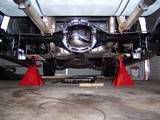
OK everyone. Here is a challenge. Whoever leads me to the right solution WILL get a prize. Imp not kidding either, I will get you something for solving this problem because it is odd to say the least!!! Ready??? Here we go: Myself and another board member (Dennis) totally re-built my rear. Today I put it back in with new rear drum brake pistons. Here is where the fun starts. I used a vacuum bleeder on the rear, but there was so much air it simply wouldn’t bleed out. I ran 2-3 pints of fluid through this bastard and it just wouldn’t bleed at all. After about 2 hours I called for help. So, Dennis comes over, we bleed the master, that didn’t work. While pumping up the brakes we find that my rear line at the block by the master cyl. was loose and introducing air into the system. OK, tightened that up and continued the to bleed the rear brakes. After a while of manual break bleeding the rear brakes were pumping up really nice with no air coming out. Nice solid peddle. At this point, we moved to do the front brakes just for good measure. The fronts were never opened at all and the car always broke well. This is where things went bad. I pump up the brakes, then Dennis cracks the bleed on the front pass side. OK, no problem. When I go to pump up the brakes again, they are really soft as if there was a whole bunch of air in it??? The fluid is also very foamy. We go again, and again and again in the front and no improvement at all. We checked around and there are no leaks, nothing. Everything seems ok. We move to the front drivers side, same thing. The barely any fluid coming out and its all foam??? What is the deal with the foamy fluid? We bleed the front over and over again with little to no improvement. We then moved to the back. The brakes pumped up a little (I would get 2-3 inches from the floor pump up) and when cracked there was no air. We keep bleeding and bleeding and no improvement. We at this point said screw it and gave up.
So, the history on the car is this: it is a running car and always broke really well. Only the rear brake lines were disconnected to remove the rear end. I installed new brake cylinders.
My questions:
Why would the brakes pump up nicely and then when you went to bleed the front, go soft and then not be able to bleed them out?
If the master cylinder went bad, would it hold any kind of pressure on the system? The rear brakes squirted more fluid out than the front. Why, is there some valve causing this?
Why would we have great pressure on the rear brakes then when we cracked the front bleeders go totally soft?
Can pumping the brake pedal too fast foam up the fluid and cause a soft pedal?
I talked with Vikki and she said she had the same problem with her’s. She said screw it around 1am, and the next day the brakes were ok. Why?
When doing my brakes, the rear took alot of effort and time to remove all the air from the lines...on the side of the master cylinder.....there are 2 fittings...make sure you open and close these....i think its all about back pressure...my thoughts....hope this helps.
First, when using a vacuum bleeder you need to put teflon tape around the bleeder screw threads or you'll suck lots of air in making it look like you've got air in your lines.
Second, when you pumped up the brakes I hope you did it slow and gently. Stomping the brakes could foam the fluid if you had air and could have also activated the valve in the distribution block that will close one circuit if pressure is much lower on that circuit. It also causes your brake light to come on. These will sometimes reset if left alone over night.
I think it is the mastercylinder. because the pistion inside is letting the fluid leak from the front to the rear. there are two rubber rings inside and the front one is capable of building pressure but not keeping pressure. It leaks into the second area and thats where the foam is coming from. use a hand vacumm pump they work great. I have no air and a really solid peddle.
I experienced very similar troubles when bleeding the brakes on my car.
We finally determined that we think that the air was being sucked in around the threads of the bleeder valves, and mixed into the fluid stream coming out of the bleeders into our clear hoses. So yes, coating the threads with teflon, or buying new self-bleeders that have a similar substance coated on the threads might be a good solution.
Also, you might want to check your rear axle bleeder seals. We removed the rear bleeders and there there was crud at the seat of the bleeder inside the cylinder. That crud may cause an improper seal on the rear end.
We ended up bleeding 2-3 whole quarts of brake fluid and still had intermittant air issues that we couldn't explain. But, after we gave up and started the car and drove it, the brakes worked beautifully.
And the winner is: 'ho4spdtogo' Congrats Mark! What's the prize? I wish I would have been online so I could have won it! You have an intermittently bad master cylinder. It could work for years like it is or you could replace for peace of mind. Your wild pumping expedition(pun exPEDition) put the final touches on it.
Jim, I was installing a fresh master and new rear lines and wheel cylinders when I experienced this problem. The same master cylinder is still on the car, there was nothing wrong with it. John had the reason for the problem and the cure.
Vikki 1969 Goldenrod Yellow / black 400 convertible numbers matching
Foamy fluid is a dead giveaway. For foam to occur there must be air present.
John Quote;
"Stomping the brakes could foam the fluid if you had air and could have also activated the valve in the distribution block that will close one circuit if pressure is much lower on that circuit. It also causes your brake light to come on. These will sometimes reset if left alone over night."
If the air was getting sucked in through the bleeder screws it wouldn't have made it's way all the way up to the MC. Air getting sucked in past a bad piston seal in the MC causes foaming.
Another clue: Quote,"I talked with Vikki and she said she had the same problem with her’s. She said screw it around 1am, and the next day the brakes were ok. Why?"
The answer is a question; What part of a braking system can bleed itself over night? MC
That's describing a master cylinder bypassing intermittently. It can happen just as easily with a new rebuilt as with an old tired one. I have went through three once until I got a good one from the parts store. They frothed up while bench bleeding.
I just tried to pump up the brakes this am and they are still just as soft as yesterday. How can you determine that the metering block has shutdown one circuit so I can test this theory? If not, it appears that the master is going to be replaced.
Did you try bleeding the brakes again this morning?
The fluid can foam if you already have air in the system and you pump the brakes too hard. Bleeding the master cylinder would've gotten air into the system. Also, did you correctly bleed the mastercylinder? To do this you need to run lines from the MC into the respective reservoirs making sure to keep the ends of the lines submerged and the MC level. Not adhering to these details will prevent you from completely bleeding the MC or worse, put more air into the system. Also, if the MC is bad like Jim suggests, you should've seen fluid around the back of the piston when you removed it to bleed it.
The distribution block valve should recenter itself overtime if the system is allowed to rest and the valve isn't stuck due to crud in the system. If your brake light is on and won't go off, that's a sign that it's still uncentered.
I would check your MC and if you're confident everything was done correctly, try bleeding the brakes again.
If a master has an internal leak that causes soft pedal, then there should be no air bubbles. Mine had a long-term seep in the rear yet still worked fine until the seal between the pistons failed and there was no pedal at all. If I depressed the pedal fluid would be displaced from the one chamber to the other, not forced into the brake lines.
You should not try to pump up the brakes. Either the pedal gives resistance, or not. And since you had no trouble with your master until you began to bleed lines, I would follow John's suggestion and slowly, gently, bleed it with hoses from the just-cracked bleeder valves back to the chambers. Don't bury the pedal as brake fluid will become airborne, it takes only a little movement each stroke to properly bleed the master. You should feel the pedal return when you are successful, and no bubbles should appear in the reservoir. At that point, close the bleeders, remove the hoses, fill the chambers, reattach the brake lines and start the bleeding process again using the vacuum bleeder, one wheel at a time.
Vikki 1969 Goldenrod Yellow / black 400 convertible numbers matching
True, if only the internal seals are bad the brake pedal will drift down without having air in the system. But because the rear circuit is holding pressure and the front circuit won't bleed, I thought the main problem here was identifying why there was air in the front circuit. For air to get in, fluid likely has to go out. In that case he should, but not necessarily, see fluid at the back of the MC.
Further, if the back circuit is okay and the front circuit is on the front reservoir (like I believe my factory disc car is) then it's even more unlikely that the MC is bad IMO. At this point I think Joe has to be methodical in approaching this problem if he's going to figure it out. Double checking everything before buying a new MC is my suggestion for how to proceed.
I bench bled three new rebuilt master cyls that 'blew bubbles' because of an internal leak. It's not all that uncommon. You can suck air through a leak that will never let fluid by.
I would like to add that these braking systems are so simple that if it's a mind 'boogler' LOL it's the master. Or once in a while the brakes hoses. The rest is elementary.
I believe Joe has a correct master with bleeder screws. Although in theory these are far easier to bench bleed, I still like using the screw in barbs and hoses to remove air from the master. Then I can visually confirm that no bubbles are escaping from the fluid. If you have very snug fitting tubing you can do the same with the bleeder screws, and not disconnect the brake lines again.
The whole point is that his master was fine until he tried to bleed the front lines. I think the root of his problem is air in the master cylinder and the lines, not a suddenly and coincidentally failed master cylinder.
Here's why:
</font><blockquote><font size="1" face="Verdana, Helvetica, sans-serif">quote:</font><hr /><font size="2" face="Verdana, Helvetica, sans-serif">So, Dennis comes over, we bleed the master, that didn’t work. While pumping up the brakes we find that my rear line at the block by the master cyl. was loose and introducing air into the system. OK, tightened that up and continued the to bleed the rear brakes. After a while of manual break bleeding the rear brakes were pumping up really nice with no air coming out. Nice solid peddle. At this point, we moved to do the front brakes just for good measure. The fronts were never opened at all and the car always broke well. This is where things went bad. I pump up the brakes, then Dennis cracks the bleed on the front pass side. OK, no problem. When I go to pump up the brakes again, they are really soft as if there was a whole bunch of air in it??? The fluid is also very foamy. </font><hr /></blockquote><font size="2" face="Verdana, Helvetica, sans-serif">After air was known to have been introduced into the system, the master was not re-bled.
Vikki 1969 Goldenrod Yellow / black 400 convertible numbers matching
A point that is undisputable and has not been address as of yet is that is it nearly impossible to put air into the system by simply vacuum bleeding. Yes, you can fail getting the air out BUT you can't make air travel all that way upstream with a vacuum bleeder. With this fact, how did the front brakes get spongy?
They bled the master. Once the bleeder screw was opened the possibility existed for air to enter the lines.
Also, </font><blockquote><font size="1" face="Verdana, Helvetica, sans-serif">quote:</font><hr /><font size="2" face="Verdana, Helvetica, sans-serif">I pump up the brakes, then Dennis cracks the bleed on the front pass side. OK, no problem. When I go to pump up the brakes again, they are really soft as if there was a whole bunch of air in it??? The fluid is also very foamy.</font><hr /></blockquote><font size="2" face="Verdana, Helvetica, sans-serif">Which indicates that there was pressure in the front system even after the repair, until the bleeder screw was loosened. It appears at that point they are pedal bleeding, not vacuum bleeding. Was the switch on the delay valve depressed during bleeding? Were bleeder lines into a clean jar of fluid used? Were proper brake line wrenches used to ensure the bleeders were properly sealed before the pedal was released?
Vikki 1969 Goldenrod Yellow / black 400 convertible numbers matching
Sorry I have been out in the garage finishing up the rear end. The whole system was fine until Dennis and I went to bleed out the fronts after we finished the rear. We are manually bleeding, not vacuum bleeding. Just to recount: We bleed the rears and everything was great. Hard pedal and all. We then figured for good measure that we would bleed the fronts. I pumped up the pedal, Dennis cracked the line (using the right tool, clear line and into a jar filled with fluid so no air could get back in). Went to pump up the brakes again, and it was soft. At this point, we did it over and over with foamy fluid coming out. We then bleed out the MC using the barbs, lines submerged etc... There was NO air in the master at all.
No the car's rear end is jacked up in the air because I am working on the rear end. Will this cause a problem? The delay vale on the switch was not depressed during bleeding at any time.
Yes - you must compress the delay valve switch with a small c-clamp to properly bleed the brakes. The delay valve requires about 75 psi to be built up before the front calipers begin to move. Neglecting to do this is probably one of your problems.
The rear drums require more travel before contacting so the delay valve gives them a "head start."
I have never had a problem bleeding brakes and I leave the delay valve alone. Unless you replaced the delay valve leave it alone. All this is muddying the water. The position of the rear end doesn't matter unless you are gravity bleeding.
I would buy a new Master, $25, and bleed the brakes again.
Just on a chance, make sure your calipers' bleeders are pointing up. I have seen them reverse and the bleeders do not work correctly.
The factory service manual instructs one to hold the delay valve open (by depressing the plunger at the back end) when bleeding a disc brake system. Thus, would it hurt for Joe to try this?
Would not hurt. After bleeding hundreds of old cars though, it seems pointless. I learned by trial and error and I think I got the routine fine tuned about 1977. LOL Back when it meant getting to work or not. This stuff is OLD.
Sorry guys, maybe I wasn't specific enough. I have power drums all the way around, not disc in front and drums out back. I'm not sure what this valve is that you are talking about? Is it only on disc systems? If not where is it located? I most likely am going to replace the master cylinder anyway for peace of mind but I would really like to know what the root cause of this problem is. I don't like throwing parts at problem without knowing exactly what the problem is. Either way though, I really appreciate all your help with this problem and we will figure it out. Thanks. It sucks though, I have the car all put back together and now the brakes don't work
Sorry for the wild goose chase on the delay valve, Joe.
Find a pipe plug, properly sized, and thread it into the master cylinder front brake line port. Check your pedal with one gentle press. If the pedal is firm, there is air in the front lines/front side of the circuit. Bleed the lines by attaching a hose to the end of the line and pulling from a clean jar of fluid, use the vacuum pump at the bleeder and bleed one front line, then the other. Close both bleeder valves and reattach the line to the master cylinder. Do not try to pump it up, just gently apply pedal pressure to see if the pedal is firm. If so, you're good to go. If just a little soft, bleed the lines again using the vacuum bleeder and gentle, steady suction. Just watch the fluid level in the master carefully, those drum brake masters have very small reservoirs.
Vikki 1969 Goldenrod Yellow / black 400 convertible numbers matching
You said a mouthfull there! It's getting them to believe you that's the big challenge. Cheers to you Mark! We have both been down the master cylinder 'mind boogler road'. How many times? LOL
I'm late on this one, but I agree with Jim on this one. Everthing seems to point to the master cylinder. If you had a hard pedal after you bleed the back brakes, then it goes to hell when you start to bleed the front, a bad m/c could be the cause.
I'm not big at hit-or-miss part replace as a way to solve a problem. But it's common for m/c's to be bad on the shelf, and m/c's fail on a regular basis--from 85 to 91, I had installed 3 on the car. Sure enough, a new m/c cured the problem.
As winners, since Jim and I both have 9's, maybe you can find a common part that we both need, and we could alternate which car it's on every other week.
One of the stranger things that I've seen happen on these cars. (or any car for that matter...) I've experienced a MC with internal leak. In the last 20+ years put replaced several on my car. Seems to me to be the most common failure. Joe's system is acting differently. We did back track and bleed the MC after finding a loose fitting to the junction block. The MC bled fine and actually had no air in it. (which is what I would expect from and existing MC installed on a car) We then manually bled the rears. Took some doing but we managed to chase all the air from the rear system. Had a decent pedal. Like Joe relayed, we then attempted to bleed the fronts just for good measure. (I hadn't touched the front brakes and wanted to make sure all was good) As soon as we cracked open the front bleeder screw, the firm pedal we had was gone. After a whole bunch of bleeding, both front, which netted foam, and rear, which seemed good, pedal was still poor. At first blush I thought the MC had soured. Doesn't make sense that the MC would fail right at that moment but stranger things have happened. I now suspect the air trapped front system must have gotten back to the MC. I believe we may need to bench bleed the MC again and start over with the wheel cyliners.
I've never had this kind of issue bleeding the brakes on these cars. I have found that vacuum bleeding nets a tighter pedal but manual bleeding works fine if time is taken to ensure all entrapped air is chased out.
I agree with Joe on this one. I think it unlikey the MC failed. I think we need to start over and confirm the MC failed (if it has) instead of just swapping parts.
Dennis, You say that you don't believe the MC was the culprit but you offer no other explanation??? This is kind of strange but I had something exactly like this happen after a rear end swap. I kept reasoning that it could not be the master cylinder. I went through about 5 quarts of brake fluid trying this and that. I can remember my leg aching from all the pumping. It was really crazy because I would get the pedal just about right and then they would fade again. Long story short, I bought a new MC and bled the system once and the pedal was rock hard. This isn't rocket science. The only tricky part is the MC. The only other thing it could be is Human error.
Whether or not Jim and I bark at each other, you have the same dogs barking up the same tree. That ought to speak volumes.
Proper bleeding will not allow air to go back into the cylinder. Even if the bleeders are sucking air, the volume of brake fluid drawn in from the resivor exceeds the volume of air sucked in by the leaking bleeders, meaning that you can bleed all the air, even if the bleeders are sucking air.
My manual drums gravity bleed like they were attacked with an m-16. Jim claims that his disc brakes won't gravity bleed for anyting. The difference is probabally the differences in the systems.
If you gan get them to gravity bleed, it's the only way to go.
Why would it suddenly fail right at this moment? The answer seems fairly easy with many reasons. First of all, the pump people seem to do so with overkill. That's the reason I pefer to gravity bleed my brakes. When the pumper is in the car, they have, probally, the same grimace on their face when they are sitting on the toilet. They are applying ten times the pressure on the pedal than it would take to lock them up. Often, in accidents, brakes fail. It almost looks as if it was the cause of the accident, when in fact the driver was on the brake so hard that they ruptured the system with overpressure.
Even if the pumper isn't pumping with overkill, the m/c cups are traveling much further in the bores than they would under normal operation. As a reslut, the cups are going past their normal area, which has been kept polished by the cups and the cups have worn themselves into the "normal operating" travel area.
Of course, I'm taking a couple of hit-or-miss stabs, but both reasons are fairly logical explainations as to why the m/c would suddently crap out.
LOL "same grimace on their face when they are sitting on the toilet"... best line I heard all day. I can't tell ya for sure as Joe was pumping and I was working the screws. (wait a minute... that don't sound right either)
Yeah, you guys are most likely correct. The MC died. We'll have to check it out and let everybody know.
Let it sit a day or so. Then watch the fluid in master cylinder while slowly depressing the pedal. Are bubbles comimg up? Do it a few times to see it it improves. I dont think your sucking air, but the cylinder may have gone bad. It happens...
After many years of replacing calipers and cylinders, i have had best results by gravity bleeding 1st before using the 2 person method. Steady even pumps work best..at least thats what the girl friend says




![[Linked Image]](http://i23.photobucket.com/albums/b376/restorium/face5.gif) 'ho4spdtogo' Congrats Mark! What's the prize? I wish I would have been online so I could have won it! You have an intermittently bad master cylinder. It could work for years like it is or you could replace for peace of mind. Your wild pumping expedition(pun exPEDition) put the final touches on it.
'ho4spdtogo' Congrats Mark! What's the prize? I wish I would have been online so I could have won it! You have an intermittently bad master cylinder. It could work for years like it is or you could replace for peace of mind. Your wild pumping expedition(pun exPEDition) put the final touches on it.


![[Linked Image]](http://i23.photobucket.com/albums/b376/restorium/ynew382.gif) How about a master cylinder?
How about a master cylinder? 


