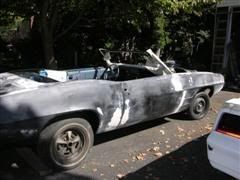
Anyone have any good luck with building a rotisserie? I have found a few plans on the web but thought I would see if anyone had any experience with one that will work best with my 69 convertible.
It looks pretty good to me and the engine cranes they are constructed out of go on sale at Harbor Freight once in a while for $150 each, making the total cost under $400. You would have no trouble selling it when you were finished with it.
Scotts design is not adjustable. It is designed to balance a first generation f-body coupe or convertable, depending which way you configure the arms when you're welding things up.
Worked great for me! It was a little tricky getting the body mounted. I didn't use the center mounting bracket for the rear because it allows me more access to the tail panel. I built mine a hair too short and I can't do a 360.
I built mine using two engine stands. I cut the vertical part of the stands and re-attached them so that they were straight up, instead of at a backwards angle. I also made brackets out of larger square stock so that the crossarms are adjustable. I will try to post some pics later today after work. I also cut the vertical section to put a "riser" inside so that I could raise and lower the car using a hydraulic ram on both stands. Worked well for me.
I think I might try to incorperate both designs and maybe make it adjustable so it will be more universal (for resale value). The only other idea I had was to make brackets that mount to the rear leaf spring mount. I thought if that works, it leaves the rear panel open. Any input??
Thanks again.. Everyone on this forum has been bery helpfull.. AND, I know I will have ALLOT more questions!!!!
The reason that the rear is mounted to the bumper bracket holes is that it's close to the center of gravity of the body. You have to be careful altering where you spin it from. It can get away from you if it's not balanced. You could bolt it to the frame, like you suggested, but you would have to offset back up to the center of gravity.
Thanks again for the replies... I see your point on the center of gravity.. I don't think it's that critical that I be able to access the rear panel.. I can easily do it off the rotisserie. Thanks CDJr for the pics.. If your's supports the body with no problem, I think I could build mine a little lighter than I had planned.. I had planned on using 3/16 square tubing for most of it.. I also want to put pneumatic casters on it so I can leave it on the rotisserie when I take it to the sand blaster..
Balance is important. Someone on Camaros.net bought a roto2000 and assembled it out of balance. The car wouldn't turn. Instead it hung heavy like a hammoc. Once adjusted, it worked great. Go with the arm dimensions Scott used in his design exactly or design in some adjustments so you can tweak things up.
Pneumatic casters are a good idea, as anyone who has rolled around a steel wheeled engine stand over a grain of kitty litter has discovered. I don't think I would try to transport the car while on the rotisserie though. The CG is still pretty high. The bumper is elevated to around 24" at the lowest setting. To load this onto a rollback, you need a different design that lowers down to the ground. That won't happen with a telescoping tube design.
PJ, I used 2" square tubing with 1/8" wall and its plenty, in my opinion. However, building one on casters thatll be moving around will need to be constructed a lil differently. Youd definitely wanna make the feet much wider to keep it from tipping over while being moved, especially since the center of gravity will be so high. And itd probably need to be sturdier also, so maybe 3/16" WOULD be the way to go. Personally, I wouldnt wanna be moving it around on the rotisserie (although I HAVE slid mine around inside my garage, but not very far), especially since yours is a convertible. Speaking of which, you do realize that you need to brace it very well before putting it on the rotisserie, across the door openings, etc, since convertibles lack the rigidity of a coupe, and are much more prone to twisting and/or flexing. Hope this helps, and good luck with it.
Thanks again everyone!! I completely see your point on the CG and trying to transport on the rotisserie.. I saw the mounting arm measurments in the earlier pics and was sure glad to see them! I might play with making mount arms that mount to the leaf point using the same measurments.. But at least will mount to the bumper points. CDJr: I was planning on making adjustable links to mount to the upper door hinge point then back to the latch pin point. I had thought about just welding in a section of square tube in the inside but I thought the NON welding idea would be cleaner. Any other suggestions? I saw pics of one car that had supports welded from the top of the windshield frame to somewhere in the rear by the top boot area. I thought that was a little much but more might be better than less...
Well, a lot of it also depends on how solid the car is, structurally. If the rockers or floors are rusty or corroded at all, its going to be weaker and will need more support. Ideally, youd want something to brace it straight across the top of the door opening, since the lower the brace is, the more force will be exerted onto it, similar to the way a hand-held nutcracker works. If you drill holes in the end of your braces, or weld brackets to them, then you could just bolt them to areas of the car instead of welding them.
Why do you need bracing? It's not like you took the body off a full frame. If your unibody didn't buckle while driving it, surely it will not buckle when on a rotiss. If your car is really solid you need no bracing. I had my vert on a rotiss for 2 years with zero flex. The body alone is very light and there isn't much leverage to buckle it while on the rotiss. If you have any structural work to do, then a brace is a must.
Jim, you may be right about not needing the brace, but I was told by several local restorers that they have had past experiences with flex, especially if they were doing floor repairs. It doesn't hurt to be cautious. I braced my vert and had no problem lining the doors back after I took her off the rotisserie. I don't know if it made a difference or not.
Most of the restorers are used to restoring cars that have frames. Our Birds are no weaker because you take off the subframe. The body has it's frame built in. You put a lot more stress on the body when it's just sitting there on it's wheels than on a rotiss(unless it has frame connectors). The sub is like a big lever compared to the close attachment point of a rotiss. If you follow the logic that you need a brace to do floors then you should have a brace to do floors whether it's on the rotiss or not.
That is a good point Jim.. They are strong because of the unibody. But, I would rather be safe than sorry.... I figure it doesn't take much effort or material to brace at least across the doors at the top.. My floor pan has a few holes in it and it is getting replaced hopefully while on the rotisserie. Should I be doing anything extra so I can replace it while on the rotiss? It looks like all of the uni-framework is in pretty good shape. I am trying to get a webpage put together so I can track and show everything I am doing..
Jim, that was my thinking too, but after talking to these guys, I figured better safe then warped (one restorer had re-alignment problems with a 69 Camaro. It might have been him). A little extra work, but everything seems to be lining up good.
I see a lot of re-alignment problems with cars still going down the road! People will drive these babies until they brake in half. I had a guy ask me if I thought he should put a Nitrous kit on his vert when he couldn't even get the door to latch unless he got out! I saw one the other day that had some fence posts welded under it. He was wondering why his brake lines kept leaking. I told him it's because the lines where never ment to be structural. If it gets any worse he was needing traning wheels. Ever see a 400 HP noodle! Talk about 'crumple zones'.


![[Linked Image]](http://i23.photobucket.com/albums/b376/restorium/face5.gif)



 He was wondering why his brake lines kept leaking. I told him it's because the lines where never ment to be structural.
  If it gets any worse he was needing traning wheels. Ever see a 400 HP noodle! Talk about 'crumple zones'.


