You were having vibration problems with the motor and trans a few years ago. Wouldn't be suprised if the drivetrain (trans/rear) vibrations had an impact on your failure.
Sometimes, and my conviction is that if you push a concern long enough, something more expensive will bite you.
Si Vis Pacem Parabellum
1967 Starlight black PMD Engineering 400 Auto 1968 Alpine Blue 400 4 speed 1968 Verdoro Green 400 HO 4 speed 2013 1LE 2SS/RS Inferno Orange Camaro.
Banshee, either you have a great memory, or you go WAY back in the archives to bring this stuff back up! LOL It turned out to be a bad torque converter causing the vibration.....that was only short term and I didn't put many miles on it at all while it was doing it.....that issue has been resolved for a VERY long time.
What Banshee's getting at is that those vibrations make their way through the drivetrain to the crank. By the time they get there, they are either damped out or amplified.
Cross drilling the block helps with both main and rod oiling, and lifter / pushrod / valve oiling. I've never seen a cross-drilled block lose a main bearing.
When you have wear on the uppers that can mean that the engine was getting into detonation. Maybe from your recent experiments?
The mains may have gotten chewed up from debris in the oil from the rod bearings but usually it's the other way around. Having gouges in your mains that line up with the oil holes is a strong hint that garbage went through. Have a real good look at everything, including your oil filter - you did save it, right? It might hold some valuable clues as to why your bearings started to fail.
Well, I recently changed the oil after noticing "glitter" in the oil on the dipstick....still have the filter from THAT change and the one that just came off the motor.
Q, I've heard of cross drilling the crank, but not the block. I'll have to ask the machine shop about it.
If it was detonation related all the rod bearings would look about the same, right? Only 3 of the 8 showed any signs of advanced wear. All the others still looked great.
Good question Drew, and we might as well clear the air on definitions on this: True meaning of Detonation with relation to the operationg engine. Some folks out there like me maybe don't fully understand.
'68 428 HO M3 Monster, 4-on-the-floor! Need I say more?
Detonation or spark knock is the sound and related effects produced in spark-ignited internal combustion engines by instantaneous ignition and combustion (autoignition) of the gaseous fuel-air mixture ahead of the advancing flame front.
After spark ignition, a flame travels outward from the spark plug and, under normal combustion, will progressively burn the entire fuel-air charge. The burned gas liberates heat and expands, leading to increased pressure and temperature in the unburned gas ahead of the flame front. The unburned gas may be raised above its autoignition temperature. If the flame front velocity is too small the unburned gas spontaneously ignites and burns instantaneously. The instantaneous combustion results in a very intense pressure wave that produces the audible, high-frequency (pinging) sound known as spark knock.
Besides sound, spark knock can result in pitting, or erosion, of the combustion chamber, damage to spark plug electrodes, and possible structural damage to the engine. Spark knock also leads to loss of engine efficiency by inducing spark plug preignition, resulting in overly advanced spark timing. Spark knock also causes intense turbulence within the cylinder, aggravating heat loss from the burned gas to the colder cylinder and head surfaces and reducing efficiency.
If it was detonation related all the rod bearings would look about the same, right? Only 3 of the 8 showed any signs of advanced wear. All the others still looked great.
You can reasonably run a motor on 87 octane with 10 to 1 compression. The problem of detonation arises upon acceleration or loading of the motor. I have run my 400 only to 2000 rpm on 87 octane to move it 3 miles. Just don't work the motor.
Depends...You could have different tolerances in those rods. Not uncommon for assembly line or novice machining. Perhaps they were close or within a thousandth. Most of your rod bearing detonation issues surface on the upper bearing. Good oiling on specific rods could negate increased wear, poor oiling could result in 3 of 8 being accelerated.
My detonation problem, failure was on rods 1/2 and 3. The others were fine. Running 5800 rpm with 93 octane 130 mph and 10 to 1 compression. Electric fuel pump leaned out and failed causing the upper bearings on 1-3 to fail. I thought it was oil starvation until I realized my motor was not seized and the pump went out. I knew something was wrong when my oil PSI was 10 and my temps went up to 245 degrees.
Clevite has a poster..about 30 different bearings shown and causes. It is not an exact science, but determined based on experience of the builder/machinist and feedback of the customer.
Si Vis Pacem Parabellum
1967 Starlight black PMD Engineering 400 Auto 1968 Alpine Blue 400 4 speed 1968 Verdoro Green 400 HO 4 speed 2013 1LE 2SS/RS Inferno Orange Camaro.
The engine rarely has even fuel distribution, and the lean cylinders will have the worst detonation. Having the engine go lean from fuel delivery problems induces detonation because of the lean mixture and takes out the rod bearings just as well as too much timing or low octane fuel.
Did you do some playing on the highway recently? If your fuel pump and fuel lines can't keep the carb filled during sustained full throttle (top end runs for instance) when you slow down you may find that you've cooked some rod bearings. I learned the hard way on this!
Have a look at the underside of the pistons. You may be able to see a difference in the colour. Light brown usually is okay but darker indicates excess heat in the cylinder.
Yer not the only one Nash...my buddy down at Eglin AFB emails me all the time on the. mil line.....just doesn't sent me all those great powerpoint emails from there
A tell-tale sign of an engine that has experienced a lot of detonation is the 'land' that separates the piston rings brakes away. I think this is one of the first signs.
Lands are all good. No color distortion of any of the pistoms or rods. No pitting or visible evidence of detonation on the piston tops OR combustion chambers.
The upper rod bearings showing the wear were 1,3 and 8.
All GREAT info guys! Everyone can learn from this.
rod knock or wrist pin. hard acceleration denotes the rod bearing as it only does it once it warms up or when you hammer on it. id check to see if something didnt loosen up if you recently rebuilt the engine, something might have gotten missed.
andy
Andy
due to budget cutbacks, the light at the end of the tunnel has been disconnected for non payment.
Took the first step this evening and popped the valve covers off to look for obvious issues.....nothing obvious or loose (or stuck) that I noticed. Of course this was done in a suit in between work and party activities around town. I'll spend more time on the analysis in the morning.
'68 428 HO M3 Monster, 4-on-the-floor! Need I say more?
nash, ya sound just like me, my wife gives me crap evertime I go down in slacks and the like for a boo....she always knows I'm going to end up wrenching something and get stuff on me...


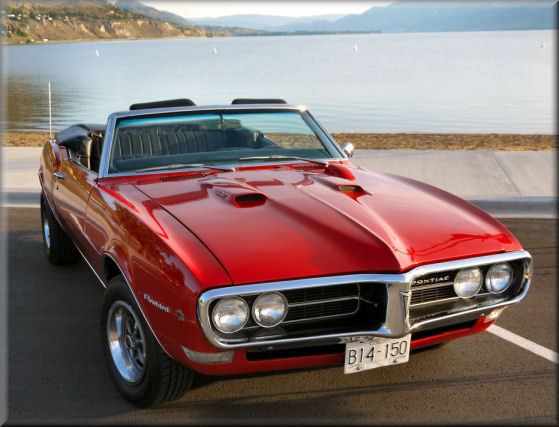
![[Linked Image from hosting.photobucket.com]](https://hosting.photobucket.com/albums/ss328/alvey_john/john-alvey-1968-Firebird-oct2012-2.jpg)
 Oh. LOL Lot's of similarities here....haha