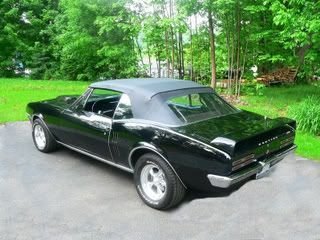
Bob, I installed one of those funky pumps. Not exactly a "bolt on" replacement. Had to do a little grinding. Let the weather heat up and I'll let you know how it works.
I'm a hobbyist. Not a professional. Don't be hatin'!
Beardog i'm not trying to steal your thread but i have a question why your talking about cooling systems, my car runs at about 210 all the time with a 160 hi-flow thermo and new waterpump, the divider plate mod thing radiator seems to be flowing well with no cold spots in core and i'm at my wits end! any other suggestions? Thanks
Well, I picked up a 68 bird, in very good condition with the 350 engine that I'm am rebuilding, and when I removed the waterpump and seen the divider plates, they were very bad. The only Firebird person I knew to ask questions about told me the plates were hard to come by, well I found them through this site. and I was telling him about all the info I was finding and we got on the high heat subject, and I told him I would find him some info. I have been kind of a Chevy/Dodge person before I got the Firebird, so I'm learning... Does this help.. This it new to me..
Beardog i'm not trying to steal your thread but i have a question why your talking about cooling systems, my car runs at about 210 all the time with a 160 hi-flow thermo and new waterpump, the divider plate mod thing radiator seems to be flowing well with no cold spots in core and i'm at my wits end! any other suggestions? Thanks
210° is where my convertible runs on a hot summer day. I upgraded from the factory 3 core radiator to a desert cooler 4 core. No change.
It did have a problem with the temp spiking up when idling. I installed the missing lower baffle which helped with the spike in temp, but still runs at 210°. I will be trying the divider plate mod this summer.
Are you running 4 spd or auto? Do you use a tranny cooler if you have the auto tranny? Have you tried any of the coolant additive that they have out to help run engine cooler? I See that my Bird has a single core raditor which I may have to upgrade.
My convertible is a 4 spd. No I haven't tried the coolant additives. The radiator you have is a twin core. I've never seen a single core rad except on small 4 cylinder foreign cars and motorcycles. You may want to have a shop look it over and do a flow test. Since your have a 350, you could upgrade to a 3 core. A 4 core would be overkill.
If 6were9, Where is this lower baffle you speak of suppose to go? heres my problem when i'm driving around town at lower r.p.ms the engine runs around 190-195 when i come to astop it cools down and then when i hit the gas it heats up? when it sits and idles it just progressively gets warmer and warmer like 220, when you can't take it on afreeway it just just heats up until i have to pull over? I'm lost and don't want to just start throwing money at it, new water pump, 160hi-flow stat,wallace racing divider modification,electric pulling fan,moroso electric water pump drive (tried both drive pulleys)hand built upper baffle.
There is some products out there called Redline Water Wetter, and Royal purple radiator coolant additive, suppose to cut temps down 15 to 30 degrees. those are 2 I have heard about that work.. And your right on the two core stock radiator.
If you're using an electric fan, make sure it's set up correctly. Also make sure the fan stat is turning the fan on at the correct temp setting.
Again, have the radiator flow tested. I had overheating problems with my cammer last winter due to a semi clogged two core rad.
The Moroso electric water pump drive is out of the realm of my knowledge. I’m doin’ just fine with all the factory parts. I may see what a factory 7 blade (GTO) flex fan will do. But that will be the extent of what gets modified.
There are 3 sets of baffles to help cool...i assume your engine is a 400? if the car was originally a 400 these 3 fillers would have been there at one time... 1) the lower bafle as talked about 2) the X fillers ,the metal thatovers the space between radiator support and bumper area 3) the so called "masticated" fillers or rubber as now sold ,that fit at the bottom ,one on ea side of the radiator...I think theese were std on all the cars ,but are often missing , mine was missing one, made a 5F difference when installed , the X fillers made almost 10F
(mine was orig a 350 car and did not have the X fillers, but for some reason it did have the lower baffle)
then ,the car could be running lean = hotter, I`d go with a 180 or 190 thermostat (make sure you have one, sometimes missing, but then water runs too fast thru radiator and doesnt have time to cool down) and if you run electrc fan`(s) ,make sure its a puller ,not a pusher (pusher fans block the air)
there is a gazillion things (these were just a few ideas)that could make it run "hot", but 210F is not hot , depending on your location and time of year...210 on a summers day in Houston ,Tx is NOT hot.... by the way ,you dont want to run too cool either (under 170),wears engine quicker
I'm seeing some contradictions in the engine cooling science here. Let's assume that the waterpump modifications are to move more coolant and to move it quicker. The thermostat is designed to stop coolant from moving or slow it's movement. A few years back the major thermostat manufacturer designed a thermostat that had better flow. It was designed for cars with overheating problems. In my opinion, and following the common sense of coolant movement, the optimum situation regarding thermostats and coolant movement would be to have no thermostat at all. That would allow the most coolant movement. Why would you tailor your waterpump to move more coolant and then restrict it with a thermostat? I have the answer: You only need a thermostat if you want your engine to warm up quicker. An unwanted side effect would be for the housing of the thermostat to partially block the flow of coolant. They do have those thermostats with a thinner body profile to help this unwanted side effect. For my situation, cooler is always better. There is no way a thermostat is going to make an engine run cooler.
Jim, the water pump mod is not to make coolant flow faster , It is to make it flow at it's designed speed. If the gap to the baffle in the pump is to large it causes cavitations and slows coolant flow. Cooler is better . It helps control detonation and allows more timing.
Jim, respectfully, the modification IS to make more coolant flow. Less bypass and more flow. And physics will tell you 'more flow means faster flow'. I'm in total agreement on cooler being better!
More flow does NOT mean faster flow. The Mississippi River flows more slowly than the Colorado, but carries much more water.
It's not how much water passes through, it's how efficiently the water removes heat from the block and heads and how efficiently the air removes the heat from the radiator. That's why, if you're borderline overheating, turning on the heat and fan blower even in summer can be enough to drop the engine temp just a bit; you're adding a little cooling capacity.
Cooler is better, to an extent. Automatic transmissions do well about 180-190 degrees, which is why the trans cooler is in the radiator tank. However, if the trans is hot, that heat also adds to the cooling load. Engines also have an optimal operating temperature, between 160 and 210 is typical. If you chilled your coolant so your engine ran at 80 degrees I don't think it would run as well.
Last edited by Yellowbird; 02/19/0702:36 PM.
Vikki 1969 Goldenrod Yellow / black 400 convertible numbers matching
Respectfully again, more flow in a closed system does mean faster flow. Rivers are not closed systems and are not the same. You could use your garden hose as an example. Increase the flow and it will come out faster. Watch inside your radiator and you will see that if you get more flow the coolant moves faster.
You can have more flow without faster flow by reducing the inefficiencies in the cooling system. That's where the baffle mod and the plated fins come in. Instead of water tumbling around and recirculating in the pump, more of it is forced into the cooling system. This does not raise pressure from designed pressure, and it does not raise volume. It just moves more water molecules that were stalled in traffic, allowing them to go out and gather heat.
Last edited by Yellowbird; 02/19/0702:39 PM.
Vikki 1969 Goldenrod Yellow / black 400 convertible numbers matching
The water pump is puling water from the radiator so if the pump is bypassing some water it is not pushing it to the heads fast enough to keep the temperature under control. Remember the thermostat is holding back some flow so it takes enough pressure to move a significant volume of coolant to cool motor. A plate that is bypassing may not supply enough pressure.
Thanks for the reply's guys and Fbody69 thanks for the photo, this car was pretty much dimantled when i got it and it was missing all the baffles, anybody know what diameter water pump pulley they put on the 400 cars? Thanks
Maybe in Michigan you can take the T-Stat out ,but In Texas heat water will not have time to cool enough if it goes too fast thru radiator....cars w/o T Stat here will run hotter than w/o...
Bjorn, Then why would you tailor your pump to move the coolant faster? In above flow rate equation you would alter variable A with a thermostat. Maybe you need a 'wetting agent' to use the quicker flow.
No time to cool fluid, even in closed, pressurized system.
You can have all the flow (mass) and fast (volume) but unless you have the capacity to cool it, all the flow and speed means nothing. You have to exchange the heat through a radiator. You can get away with fast and flow with a huge 4 core radiator and a pusher electric fan or a highly efficient aluminum radiator. pushing coolant at speed and volume will not, repeat will not cool the coolant any faster (nor will "water wetter" for the record). There has to be an exchange between the two for efficient exchange and cooling. Ever touch a red hot stove coil for a split second? It can be done without injury. Same principle with this. You need time and efficency for the coolant to exchange in the radiator.
Honestly, so much for such a common problem. The water pump mod (actually the way it was initially designed) is to efficiently move heated coolant past the radiator to be cooled. Coolant not being moved willl heat and reheat and not flow through a closed loop.
You must also ensure all air bubbles have escaped. Having air or collective volume of air can be enough to increase temps 10-30 degrees, maybe more depending on many variables.
Black absorbs and dissipates more heat, that is why radiators are painted black.
Si Vis Pacem Parabellum
1967 Starlight black PMD Engineering 400 Auto 1968 Alpine Blue 400 4 speed 1968 Verdoro Green 400 HO 4 speed 2013 1LE 2SS/RS Inferno Orange Camaro.
Bjorn, Then why would you tailor your pump to move the coolant faster? In above flow rate equation you would alter variable A with a thermostat. Maybe you need a 'wetting agent' to use the quicker flow.
just because my automotive engineer friend said so....he`s also the one saying you need a T stat....an old engineer , techinician ,racer....but only raced Chevies ,so he may be wrong ?
Just as our Pontiac engines are known for getting hot, Chevrolet engines are known for not reaching optimum peformance temperatures without help. You will not find an engineer that will argue the point that restricting the flow in a Chevrolet engine isn't a plus. Just as we can see the 'mindset' of a Chevy engineer, we can determine the 'mindset' of a Pontiac engineer with the way some parts were developed. Let's take the pullies for example; On air conditioned cars, the pullies on the crank and coolant pump are configured to move the coolant faster than on non air conditioned cars. This proves a clear vision by the consensus of engineers that worked on developing our Pontiacs. They reached a consensus that faster coolant movement would cool better. That is the only conclusion you can draw from the different pullies being on a car that would obviously be more prone to overheating.
Fbody69, do you know what the crank pulley diameters are? the engine i have is a later model engine and my lower pulley is 7 inch, that car had a/c so it easy to figure out if you used a 6 3/8 waterpump pulley it would overdrive it slightly and with a 8inch crank pulley it would underdrive it correct. So i would assume i would use the 6 3/8 water pump pulley.
Just as our Pontiac engines are known for getting hot, Chevrolet engines are known for not reaching optimum peformance temperatures without help. You will not find an engineer that will argue the point that restricting the flow in a Chevrolet engine isn't a plus. Just as we can see the 'mindset' of a Chevy engineer, we can determine the 'mindset' of a Pontiac engineer with the way some parts were developed. Let's take the pullies for example; On air conditioned cars, the pullies on the crank and coolant pump are configured to move the coolant faster than on non air conditioned cars. This proves a clear vision by the consensus of engineers that worked on developing our Pontiacs. They reached a consensus that faster coolant movement would cool better. That is the only conclusion you can draw from the different pullies being on a car that would obviously be more prone to overheating.
ok, I`ll buy that... missing fillers still a problem though...



![[Linked Image from hosting.photobucket.com]](https://hosting.photobucket.com/albums/ss328/alvey_john/john-alvey-1968-Firebird-oct2012-2.jpg)