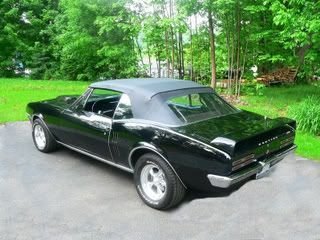
I can not take credit for this build. I got it from Cliff Ruggles, he builds motors and carbs. Here is some of what he has done.
would zero deck For medium compression engines built to use pump fuel it becomes much more important to maintain the quench distance of .035-.040". The engine will also run cooler zero decked. Without exception, every Pontiac engine I've had in here that had running hot/overheating problems had the pistons .020" to .030" in the holes.
The following is a recent example: We just finished a well prepared 400 engine for a 66 GTO. The owner is a very competant mechanic by trade, he owns several older high performance vehicles. Last year he completely rebuilt his 400 engine with catastrophic results. A set of #62 heads were used with stock replacement cast pistons, Summit 214/224 cam, Torquer I intake and Edelbrock 750 carb. The engine ran so hot he could not drive it. It also detonated under all circumstances, after an entire summer of tuning without improvement, he removed the engine and brought it here. We made a few minor changes.
The #62 heads were mildly ported, combustion chambers polished to a mirror finish and the exhaust crossover filled with aluminum. The cast pistons were the 8 valve relief replacements and were .030" in the holes, they were replaced with TRW forgings and the block was zero decked, a set of .039" head gaskets were used. A larger 221/229 cam was installed with HS high ratio rockers. The Torquer intake was replaced with an RPM. An 800cfm q-jet and HEI distributor were prepared for the new engine. The new engine manages pump fuel without problems despite being slightly over 10 to 1, compared to the previous configuration being closer to 9.5 to 1. It never gives the first indication of wanting to go past 190 degrees even on extended cruises at freeway speeds. The previous set-up would continue to heat up on extended cruises eventually reaching over 220 degrees where it had to be shut down to cool off.
I know that some of you suspect that it is the TOTAL package that changed the results. About 5 years ago I had a nearly identical 400 engine in here with the same history. I DID NOT rebuild the engine, but spent countless hours trying to tune it to get rid of the detonation/overheating. This included a new (expensive) radiator, waterpump/pulleys, several types of fans, etc. When I finally threw in the towel and pulled the engine, you guessed it, the TRW forgings were .032" in the holes. The engine was zero decked, slight cam change and no problems thereafter.......Cliff
Here, we use Crower's 60916 cam (221/229, .455"/.470", 112) with excellent results in the early 400 engines with small chamber heads. You may find the pistons end up well below the deck at TDC. Most of the 400's we've assembled with the forged replacment pistons have been .028" to .032" in the holes. We always deck for zero and haven't had the first problem managing pump fuel at or near 10 to 1 compression ratio.......Cliff