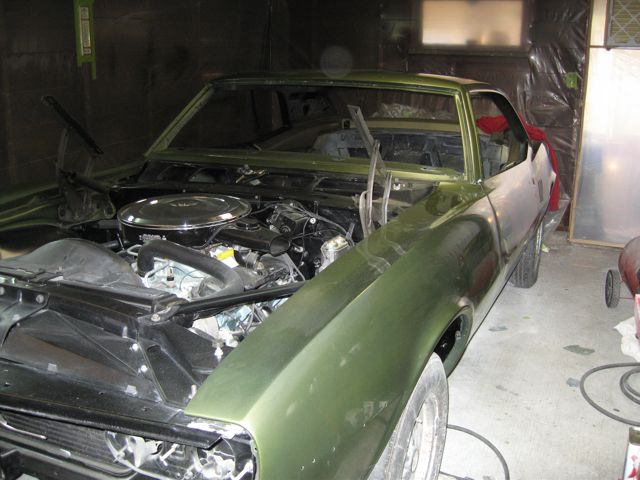
Would everyone give me their help and experience with Butt Welds vs Flange Welds. Has anyone had bad experiences with flange welds (panel expansion or lines showing due to stress.
And with butt welds will the area be weak from the heat deteriortion around the area?
I plan on using butt welds but I would like to hear everyone opion.
I can't think of any reason to do a flange weld except on an original flange. A flange weld cannot be metal finished to require minimum filler because the back side isn't flat. The double layer of metal may show when the car sits in the sun or after driving causes stress to show at the overlap and cause ripples. The extra thickness of filler needed gives you more chance of shrinkage. Repairs should be metal worked as close to the original shape as practical.
both repairs should be a good one to use but they should be used where the work to repair is easiest to do. butt welds are nice for outside panel repair however the weld is brittle so if you should need to hammer out a warped area having the knowledge on how to control the warps is key to a great repair. flange welds are stronger and less flexible should be for floors and structural areas.
So definitly do butt welds on finders, quarters and do flange on the floor or to repair the trunk area? Would it be best to just do butt welds for everything? Wouldn't water and dirt get into a flange weld on the floors?
Flange welds that are exposed to the "weather" will hold moisture , dirt etc in their crevices, and will promote rust...unless they can be 'covered' with paint ,rustproofing, etc
Floor patches should be butt welded if you're doing a quality restoration. That retuns the car closer to factory original condition than a flange welded patch. It takes longer because the patch needs to be accurately fit. For a first generation Firebird, it's worth taking the time.
If a flange welded repair is made, it should be seam sealed so it won't rust. Some seam sealers are not intended for use over bare steel, so epoxy primer is needed first with those. Check the package insert for the sealer product you use.
Bigbird: The video you reference shows someone TIG welding but your spots look like MIG work. TIG welds are not a brittle allowing you to do hammer welding but the greater heat into the metal almost requires that you hammer weld. If I do another big project, I'm going to get a TIG machine.
I have a TIG welder, but I'm not good enough with TIG yet to weld on the car. I've done some practice coupons like the one in the film using TIG, and patches can be done with lots less grinding. They warp somewhat more with TIG. The warp isn't hard to correct with hammer on dolly work. The key with either process is to weld in a short length of weld, then stop and grind and stretch the shrink back out. It's easier fix if you don't heat warp too much panel at once. Here's an example of a coupon with TIG with one end metal finished and heat warp corrected. I wish I could walk up to the TIG machine and do that every time. So far, I'm not consistent enough, so I'm using MIG.
The repairs I've done on the car are with a Miller 175 MIG, some using the Harris 0.03 "twenty gauge" wire and others with 70S6 0.03 wire. The Harris wire has an powder iron core that makes welding a little easier without burning through on thin metal and make it somewhat softer to work. Filling an old bodyshop pull hole is easier with the Harris wire. If you cut across welds made with twenty gauge compared with 70S6 using snips, you can feel the harder weld with the standard wire but not with the harris wire. That twenty gauge makes a softer weld and I think it would also be less likely to crack. Mostly the key is to grind the weld flat so you're not hammering on the weld much, but just correcting the heat warp. I haven't had any trouble with cracking.
Compared with TIG, the MIG creates a taller bead and that bead has to be ground nearly flat before you do any hammering. Then the warp needs to be corrected with hammer and dolly work just like in the TIG video example. The MIG welds don't crack if they are ground flat first. But as you say, you can't hammer weld it like you can a TIG weld (or a gas weld).
TIG would produce faster and better results because less grinding is needed. I would like to get good enough with TIG because it would be less work.
What TIG machine do you have? I first learned how to gas weld about 25 years ago and did a lot of body repairs back then with gas. The first time I tried TIG it felt a lot more natural than MIG which I've never quite mastered. I did have the benefit of someone setting the controls first though.
Vikki, when you talked about factory seals are you talking about the floors, trunk?
My floor will need one maybe two patches. If these patches are flange will it be noticeable after the work is complete compared to a butt weld? Also, if the floor and trunk areas are flanged can it be welded up tight on both the top side and bottom side so no water will enter the flange?
Ron, I belive Vikki was referring to the factory seam sealer used where metal overlaps, such as where the floor pans meet the rockers or like you'll see where panels meet on the firewall. Seam sealer is like caulking you might use in your home, except it's used to seal moisture out of sheet metal connections. There are many automomotive seam sealers on the market today. The better ones require a mixing gun for two part cartridges. There are single component seam sealer that brush on. Most will be better than the products originally used your Firebird. If you do a flang repair, you want to seal the joint overlap using a seam sealer product so that water or moisture don't accumulate in the joint and cause rust or rot. Seam sealers by SEM, 3M, Lord fusion etc will seal a flange joint against moisture. A butt weld is finished with primer and paint without need for seam sealer.
A flange repair in your floor pan won't show until you look from underneath the car. Then it will be pretty obvious. It won't be noticed through the carpet as a bump. The panel will be thicker by about the extra thickness of sheet metal where the overlap is. You will see it from below, but you won't see it through the carpet. You will need a flange forming tool or a bead roller. A flange repair is like a tire patch and is not a restoration level repair. If you have exposed body patches to make, the floor repairs are a good place to hone your skills. On body panels a flang repair can show through the final paint. The flange is like an I-beam down the length of the sheet metal. It can show through like the ribs on an umbrella as it heats in the sun. You'll read in the link below that a flange repair cannot be metal finished to completion.
I thought I would pass along a couple of links to help you understand the process and benefits of doing a butt welded repair. The disadvantage is the greater welding skill required and the additional fitting time. Butt welded panels should be fit as close as you can get, edge to edge before welding them in.
What Randy Ferguson explains here is the process I am using for all my rust/rot repairs. His explanation is where I learned this type of repair. Teach yourself this process and you'll no longer worry about a hole here or there on your car. You can teach yourself the process with some practice. Just practice before you start repairs on your project car.
I've never been able to master mig welding. Even after our body man set mine up for me, and gave me lessons at work on customers cars. No, i didnt mess'm up! Guess i dont have the patience. So i flange weld after properly flanging the edges with just enough overlap so i dont warp the panels. And dont weaken the panel after grinding smooth. Thats the only reason i havent restored my 67 yet. Hope'n with enough practice, i can do the 67 right.
I spot weld all along the join, letting the spot cool for about one second before doing the next one so I get good penetration without having too much heat and warping the panels. Patience is important as is consistency. Once you get the rhythm and the right amount of overlap you'll have a good strong weld that doesn't have warping and is easy to finish. I grind both sides back to the same thickness as the original and usually have an invisible join. Most times it doesn't need more than a little massaging (a few taps lightly all along the weld) to lay flat.
Just looked at the Ferguson link, do it just like that! The key is the fit before welding, time spent there will be rewarded at least two-fold when finishing the panel!
yes. tap the metal before it cools to release the stress in it. also mig welding is more about breakfast than most think. when you mig... listen to the bacon crackling in the kitchen. if you cant here your not set right!!!
tig is also ALOT like gas welding...both requiring both hands to control.
BIGBIRD, if your having problems making welds with the tig, turn on the pulsator switch and adjust to .250 over your base setting and begin adjusting from there. FOR TIG WELDING...A/C current is best!!! adjust the tungsten about 3/16" out of the end of the cup and you should get very good results. keep the tungsten 1/8" above your work and make sure it never touches the steel. make sure to have a point on the end of it for precision welds!!!
hope this helps all who posted on this.... this is my profession and has been for the last 12 years including 2 years schooling. need help...drop a jingle!!
Andy
due to budget cutbacks, the light at the end of the tunnel has been disconnected for non payment.
side work for the right price. if its someone here and i don't have to fit anything....just weld it and your close...i might make the trip for the gas money if you return the favor when i needed it. and poncho.... your close enough it wouldn't be too big a deal to come weld whatever you needed as long as you had all the tools to do it and i did everything bit of welding you had to do in one shot. also i'd teach you to weld while i was there as i have 2 welding outfit so i can teach someone else while doing it.
Andy
due to budget cutbacks, the light at the end of the tunnel has been disconnected for non payment.
It all depends on your goals, your skills and your ambition. It is your car and you have your own goals and expectations. It is not up to any of us to define your goals, but rather to describe your options. There is a difference between restoration and repair. Restoration means returning the metal as nearly as possible to original condition. Ambition means you can learn a different or new craft if you invest your time into learning new skills.
My goals of keeping my "historic" 82 Dodge pickup capable of fetching drywall sheets or mulch from the home center differ from my goals and expectations compared with my Firebird. I wouldn't bother with restoring my 82 D150 but I would keep this Historic truck going down the road. If the truck had a hole in the floor, I wouldn't restore it, but I would stop my feet from falling through the floor. (Well I might butt weld it for the experience gained, but not because the project was worth the time) It's a historic truck, but not really a collectable worth lots of time.
"Historic" does not mean a car or truck is valuable or worth heroic effort. That depends on the condition, the cost and the future or potential value. Shiny paint on my truck and repaired makes it worth around $1000 compared with $$750 as she presents without an undamaged panel anywhere.
If you never butt welded a panel, you won't likely walk up to your Firebird after buying the best welder on earth and repair rotted sheet metal parts on the first try. Lap or flange welds will be easier and take less experience, but without some experience, that's a disaster waiting too. Welding is about connecting with the liquid flow of metal, and you need to gain that through experience because while we describe MIG as hot melt gluing with metal, that's not really the truth. I guess I spent a few tanks of gas through the MIG welder before working on my car. You might be a better student and only need to spend one tank of gas before tackling your project, but your car is not the best place to learn the craft. Get a welder and practice first.
68Bigbird, I agree with you and I would never "experiment" butt welding on my car. I have a restorer completing the work on my Firebird. But I am going to ask him if he would show me the in's and out's of welding and let me practice on some old metal at his shop.
ok....lets give some advice on how to properly butt weld a panel. first cut the rust out of the car you intend on repairing. take the metal you cut out to the new sheetmetal you intend to make repairs with and size the panel up. take your new panel to the car and check for fitment. make sure you can place the panel inside the area you are going to weld it into. you should have a slight gap around the panel for penetration purposes. if your in doubt, cut a short peice of the mig wire your going to use to weld the panel and take it to 2 redge. a right angle of sorts. for example you should be able to slip the wire into the top edge and run it to the side edge and down. you should not be able to slip it all around. once you can slide it on 2 edges your ready to tack the panel in place. split the difference of the gap and make sure the new panel if flush in the hole you plan on repairing. tack it in place and begin to work you way around the panel flushing it with the cars panel until you have the panel tacked completely around the edge. then begin to tack the panel every few inches skipping around until the panel is fully welded. if you have a large panel, you will need to pay attention to the heat you put into the metal. if you cant touch the panel with your hand your too hot!!! sheetmetal will warp if too hot and it will take way too much work for the average hobbyist to get it back straight. just be patient and you'll get it done!! remember it will cost triple if you over heat it so walk away if you get in too much of a hurry. you'll be happy you did!!!
hope this help those of you looking to do a butt weld!! remember walk away if you cant touch it. its waited 40 years for someone to restore it, 4 more hours isnt going to send it to the scrap yard!!!
Andy
due to budget cutbacks, the light at the end of the tunnel has been disconnected for non payment.