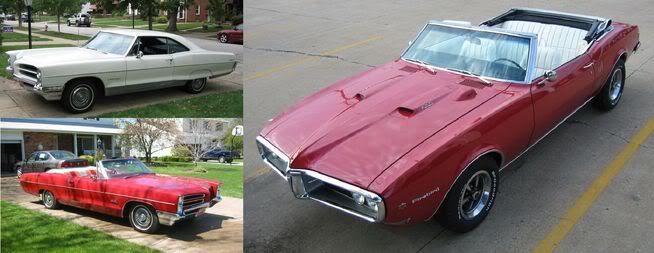
I was searching the forum, but did surprisingly find nothing.
In the mid-90s I changed my camshaft on my '68 350! Stupidly I forgot to remove the bolt securing the harmonic balancer while pulling it from the crankshaft. So it came apart, but I could push it back on and this worked for years. Of course the timing mark was not in the same place, but I knew it and it was no problem.
3 years ago I got my engine rebuilt by a German US-car service, but after it, it never run really smooth. They tried a lot of things, mainly adjusting the valves and the carb. Nothing helped, so I decided to do it myself.
I always thought, that it might be an ignition problem. And after a check with a timing light, I found out, that the original mark was a hit. But this mark was not at the right place, as I knew. But my changed mark was gone, because those guys have painted the balancer while rebuilding the engine. :-(
Now I needed to determine the TDC of my engine. I pulled the spark plug of cyl. #1 (left front) and inserted a long metall bolt to block the piston, when it touches the bolt. I turned the engine and waited till the inlet valve has opened for pulling fuel in and moving back up for compression stroke. Then I inserted the bolt and turned slowly till the piston touched it. I marked this position on the balancer. Then I turned it the other way till the piston touched again. I marked this postion as well. Now I measured the distance between my first mark and the second, divided it by 2 and think, that this should be the TDC-point. Is that right?
If yes, it would be about 3 inches away (early/advance) from the original mark.
Because those guys here in Germany are very unfamiliar with "early" Pontiac engines, there might be another chance, that they have put the spark plug wires to the wrong cylinders (Chevy style). Is there a chance, that an engine runs with one or two spark plug wires at the wrong place?
The engine does not run smooth. You can always hear a kind of spitting. It hesitates while cruising. It smokes a lot while accelerating and does definitely not have the performance it had before the rebuilding. The smoke is unburned fuel. You can see the unburned fuel on my garage floor, even when the car is warm.
Those are a lot of questions! I am still learning to use this forum. It so different to the forums I am used to, and I think it is a bit complicated and confusing. But I am very glad, there IS a forum with a lot of friendly, helpful people!
The firing order is 1-8-4-3-6-5-7-2 with the distributor turning counter clockwise. Do you need to pull the timing cover and check if the cam gear is properly lined up with the crank sprocket?
Also, there should be a key that locates the harmonic balancer on the crank shaft that should keep the timing mark in the correct location. So something is strange if the timing mark is off.
there is a kind of rubber seal between the inner and outer part of the balancer. While pulling it of, I just pulled the outer part, because the inner part was still bolted to the crankshaft. I could press the outer ring to the inner part by reusing the rubber ring, but while doing so, the timing mark was dislocated.
I know, the firing order and that the distributor turns counter clockwise, but I have to determine, where the finger should be for ignition of cyl. #1. After reading here last night, I am not even sure, they have build in the distributor the right way. I think, my vacuum-can is on the left side.
But I am sure, they lined up the cam and the crank gear. That's basic knowledge!!!
Best will be, I do all the ignition-stuff from ground up!
Get a new one before you do anything else. The balancer can become dislodged and cause all kinds of damage to the engine, car and anyone around it at speed.
You are luck it has not happened yet.
68' Firebird 400 convertible, numbers matching, solar red w/ deluxe parchment interior. 66' Pontiac Ventura Hardtop 66' Pontiac Catalina Convertible
Thank you Catalina for the warning, but I doubt it will cause a problem, because I use the "repaired" balancer for almost 15 years without any problems. I would have changed it, but the part is/was expensive (I was a student when I pulled it) and the shipping to Germany makes it even more expensive. Mostly shipping, taxes and customs at least doubles the price. So I never thought about changing it, and now: It works and works and works.... for about 20.000 miles till now.
15 years! Man, that surprises the heck out of me. Someone let me know if I'm way off base, but I wouldn't even consider reusing the balancer once it had come apart. Change the bad boy out man!
You make me think! But the problem 15 years ago was, that the car stood in someone elses garage and had to be moved! And ordering the part in the States could take a very long time at that time! And, I did not think about any problems with the balancer. I still think, it works in MY case. Why should it break after 15 years of running without a problem.
So if anyone has a balancer (used or new) for my 350 engine, feel free to send an offer to lehmann.markus@gmx.net
A relative of mine from California will visit us in fall, so I could save some postage, taxes, customs,...! :-)
But my main question is still not answered yet! How to find the TDC and if an engine could run with a wrong wire-setup.
68 and up ARE NOT 2 piece although it may look like it. The rubber ring should NOT MOVE at all. If it does, its junk.
And yes, there is a woodruff key in the crankshaft that locates the balancer and keeps it from spinning on the crank. MUST HAVE that.
As far as plug wires to wrong cylinders;
Doesnt really matter where #1 is on the distributor. After you know the balancer is on correct and torqued to 160 FT LBS, turn over engine till #1 cylinder is at top dead center. The balancer should be coming up on 0 at the timing mark. Now look at your rotor and determine where it points in relation to the cap wire. Make that your #1 cylinder. Then just go from there. 18436572
Remember, the drivers side is 1-3-5-7. Passenger is 2-4-6-8.
I'm thinking the only way to determine TDC exactly without replacing the existing balancer would be to pull the water pump and timing cover off to find the alignment points on the timing chain gears
And you would have to pull the harmonic balancer off to do that.
2012 Mustang Boss 302 #1918, Competition Orange. FGF replacement 2006 Mustang V6 Pony, Vista Blue. Factory ordered. 2019 BMW X3 (Titled to the wife, but I'm always driving it for her. So I'm claiming it) Old projects, gone but not forgotten: 1967 FB 400, original CA car. After 22 years of work, trashed by the guy who was supposed to paint it. I had to sell it. 1980 Turbo Trans Am 1970 Mustang fastback, 351C 4Bbl, auto 1988 Mustang GT, 5 speed 1983 F-150 4x4, built 302 1994 Chevy K2500 HD 4x4, 454 TBI
I work with a company that produces harmonic balancers. They are highly engineered pieces to cancel the frequencies that the engine produces. Just the wiggling of the balancer to pull it off the crank, can damage it.
do not reuse this balancer, take everyone's advice here. You are asking for trouble if you do reuse it based on it coming apart.
I have seen an engine blow up due to a failure of a harmonic balancer.
1) Replace the balancer, this has been covered already...
2) While balancer is off, pull timing cover to check timing chain condition, check cam & crank marks to make sure they are in right position. Straight up for the crank gear, straight down on the cam gear. Next, check position of rotor on distributor. The correct factory position is approx. 1 O'Clock, facing engine from the front. Next, check relationship of cap to rotor, going counter-clockwise. Sounds like the crank gear is 180 degrees off
3) To "static time" the engine, Have everything hooked up. Have distibutor anchor loose to adjust timing. Pull #1 plug wire & push out to expose the lead. Turn ignition to the "on" postion, as it would be if car was running. Hold plug wire close to something metal, like a bolt on block, turn distributor slowly watching for a spark from the plug wire. Stop when spark occurs, tighten distibutor slightly. Engine is "timed" at zero, but should start OK, from there you should be able to time your engine normaly. Hope this helps!
remove the coil wire and the #1 plug place your finger in the hole (to plug it not all the way in! ) then have someone turn the engine over in short spurts till you get at push of pressure on you finger the stop check the balencer and move it to the top ded center position. next remove the distributor cap and check the position of the rotor it should point towards the driverside firewall area. if not then remove the bolt that holds the distributor in and the lift the distributor and rotate the rotor slowly. doing this will cause the oil pump shaft to move also so when you do this the distributor wont seat properly when you place the rotor in the right positio so lift the distributor and place it in untill the rotor points and the distributor seats in the correct position. it should point to the driverside directly accross from the hole that opens up on the side of the cap that is used to adjust the points the vacumm advand should point to the mastercylinder.
i definitely had a 2-piece balancer, but it's the orginal-type with the rubber-ring. The rubber ring did and does not move anymore. But while pulling the balancer, I pulled the outer ring from the interior piece. Of course the rubber ring got loose while doing so. We managed to press the outer ring back on the inner piece with the rubber ring in between. That was hard, but it works for 15 years now.
I looked in my 93 parts catalogue from Classic Industries and the balancer was at that time at about 130$. Now it's a little more than 40 $, and they say now, that it is an original GM replacement part. On the other hand, Year One offers the balancer for about 140 $. I cannot explain the difference.
Thank you for the hint with the position of the distributor. That's what I thought for myself as well, but I just wanted to know, if I am right.
thank's to everybody! That was a lot of help and I should be able to do the job now. And I WILL replace the balancer!!! I never thought, that it might be such a problem!
Verify your ignition setup and timing, then check to be sure your choke opens fully. You can disconnect the choke linkage at the side of the carb, and use wire or a piece of elastic to hold it open. Be sure to secure the choke rod out of the way so it does not jam the linkages.
The car may be a little harder to start without a linkage, and may require a little gas pedal to keep running for the first few seconds, but once running smoothly check and see if your power is back.
Another thing to consider is that you said they shop did "valve adjustments". There are no valve adjustments on a stock Pontiac. So that may also need to be looked at.
Vikki 1969 Goldenrod Yellow / black 400 convertible numbers matching
you were right. While watching them rebuilding the engine, they tried to do it the Chevy way. Of course it did not work, so I told them to just bolt down the nuts until the rocker hits the valve. Then run the engine and adjust the nuts until the ticking ends and then go 1/4 further. That's how I did it several times and it worked great!
After determining TDC and knowing were the distributor finger points to at TDC, I rearranged the spark plug wires and wanted to start the engine. I just heard a tick and nothing happened. The starter did not run. I hammered the solenoid slightly, but it did not change anything. So, I cannot tell you about the results at the moment.
I've put in a new starter, found TDC by measuring the way between the lock of piston #1 by turning clockwise and counterclockwise and divide the way by two, put a mark on my balancer, turned the distributor a bit, so that the finger shows just slightly before the #1 cyl., got the spark wires to the right cylinders and turned the key.
It worked! The engine started and all I have to do now is to do some minor adjustments.
The engine runs way better than before, so now I know, that my machine shop did some mistakes - probably by doing it the Chevy-way.