Okay so if you've read my recent posts you'll know that I'mm finally getting the bird out for some test runs and working out the bugs. Here's another one. My front brake pads were a little tight going in, but didnt seem to be too tight. Guess I was wrong becasue about 10 minutes into the ride I could feel the brakes dragging the car down. By the time I got home (5 minutes later), the pads were producing a nice blue smoke and a smell that didn't please the wife.
Upon inspection I found the inner pad on both sides were burnt and thinner now.
I noticed that the distance between the caliper pistion and the disk for the inner pads seem to be smaller than the distance for the outer pads, yet the pads I put in are the same size.
So are the pads supposed to be the same size or are the the inner pads supposed to be thinner? If the are supposed to be the same size, why would the inner pads smoke?
One point I should make is that I rebuilt the calipers with all new pistons and seals. Maybe I did something wrong when I rebuilt them?
With the calipers off and unhooked, no pads installed you should be able to push the caliper pistons in and out and have free movement. One the pads are installed the pistons dont need to travel as much as when the pads were out, but if you have free travel with them out you should have it when the pads are in. If they are four pistons the pads should wear realitively the same. Single pistons will probably wear a bit more on the piston side, but not enough to notice in a few miles, over the life of the pads yes.
If there is free play in the pistons, maybe it is a master cylinder or prop. valve that is not releasing the pressure after you release the brake pedal, allowing the pads to continue to rub, and heat up, smoke, and wear.
The pads when new are the same thickness. BZ brought up a good question, do you have the single piston or four piston? Either way the piston(s) should slide in the bore with little restriction. What all did you do when you rebuilt them? Did you bleed the system correctly?
Sounds like the inside piston(s) are hanging up and not releasing like they should. They should be the same size. Even pressure on both sides of the rotor.
One additional thing to check will be to make sure there is no pre-load on the pads like I had when I first was doing test runs. Reach under the dash and try to spin the rod going to the brake booster through the firewall. It should have a tiny bit of play and not be tight. I found I had one turn to many on the screw and that was enough to cause the brakes to heat up. Over the course of 10 minutes, the brakes would slowly grab tighter and tighter until they started to smoke like yours.
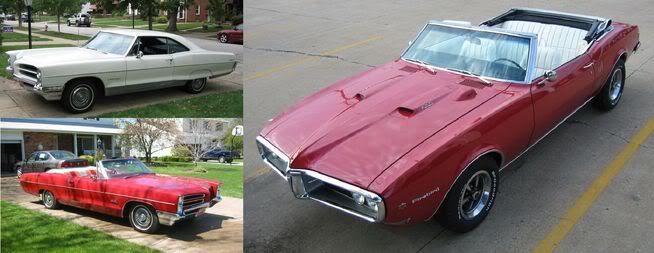
68' Firebird 400 convertible, numbers matching, solar red w/ deluxe parchment interior. 66' Pontiac Ventura Hardtop 66' Pontiac Catalina Convertible
I have four piston calipers. I replaced basically every part of the brakes. Also, I added a power booster. I bench blead the master cyclider and blead all four wheels using speed bleeders.
When I rebuilt the calipers, I seperated the caliper halves, removed the seals and pistons, coated the cylinders with brake fluid and instlled the new pistons and seals.
I'll have to check for pre load. If that's okay, I'll pull the pads and see if the pistons are moving back and fourth as they should.
Its strange that just the inner pads are having the problem though.
If you had the pistons pushed all the way in it should not be a tight fit when putting it together. You should have a little room to bolt it all on. Are the calipers slding freely on the shoulder bolts?
The back of the pads are pushing the pistions all the way in and the pads are against the disk. There is a little room now since they heated up though.
It's like the pads were too big.
I tried to turn the brake pedal pushrod with my fingers and I can't, so it could prbably use some some adjustment. I'll get to that this weekend.
By the sounds of it, don't do anything until you adjust the brake push rod. I am putting my money on that being your problem from the descriptions. You'll be cruising Saturday morning after a 5 minute job.
68' Firebird 400 convertible, numbers matching, solar red w/ deluxe parchment interior. 66' Pontiac Ventura Hardtop 66' Pontiac Catalina Convertible
The back of the pads are pushing the pistions all the way in and the pads are against the disk. There is a little room now since they heated up though.
It's like the pads were too big.
I just had to replace pads and buy new rotors for mine, when I put it all together it was tight! I could turn the rotors by hand but there was drag...the opened up after a bit of driving...as long as you didnt heat the rotor and warp them.
BZ - I remember having drag on the rotor on previuos brake pad replacements, but never had one smoke. Usually the pads would just wear down a small amount and they were fine.
Robert, I'm not sure what bolts are the "shoulder bolts". The pads move freely on the retaining pin.
The clevis pin... I have a bolt that holds the clevis on to the brake pedal. I take it that's wrong? :-) The bolt did slide right out and the clevis imediatley fell down.
I can turn the rotors with the pads against them. If I grab a wheel stud and give it a turn, the rotor will make it about 1/2 to 3/4 around.
That's a drum brake master cylinder. It has a residual valve in each port that prevents drum brake wheel cylinders from retracting too far and disengaging from the shoes.
If used with disc brakes, you experience exactly what you are experiencing. The calipers cannot release as the valve holds pressure in the line.
Change your master cylinder for one designed for front disc brake, or remove the seat and residual valve from the port connected to the front wheels.
Vikki 1969 Goldenrod Yellow / black 400 convertible numbers matching
Another idea Vikki had was to check the push rod in the power booster (different than the pedal pushrod). There are different lengths avalable and I could have used one that is a bit too long when I addded the power booster.
I pulled the master cylinder away from the booster and the pads still held agianst the disk. So next, I pulled the line off the dtribution block that leads to the driver's side front disk. Same thing. Then, I opened up the bleeder and pushed the pads back eoung so the the fliud came out of the caliper. The pads still went back to the same pads place.
The only thing left is the piston springs. I replaced them when I rebulit the ca;ipers, so could they be too strong?
I am going to guess at an amount but the pads should only release about a 1/16th or so on each side. There will not be a ton of movement there with new pads. the springs only help keep the piston expanded as the wear gets greater. I am working off knowledge of my manual brakes but the concept is the same i believe.
Is is possible that the rotor is wrong, if off by a few hundreds of an inch on thickness to big?
I will let someone else confirm, but I don't think anything is wrong at this point. The pads don't fully retract away from the calipers. As long as when you release the brake, they don't drag hard on the pads, you should be good. The at rest point is not all the way retracted.
68' Firebird 400 convertible, numbers matching, solar red w/ deluxe parchment interior. 66' Pontiac Ventura Hardtop 66' Pontiac Catalina Convertible
Correct, the 4 piston system has more "drag" then the later style single piston cal's. Although tight, should still be able to turn the rotors by hand.
Can they be turned now? If so, press down "normally" on the pedal a few times. Can they still be turned? If not, something is keeping the the pressure from releasing. Start at the brake hoses themselves and work your way back to the mstr cyl.
Unless the caliper piston springs are to long, i dont think that would be the prob. But never say never. Another thing could be the pistons are "rocking" in the bores and sticking. Not backing off(cylinder bores to large).
THe dual piston brakes were known for being very touchy. And if they are old it's possible they are rocking within the stock bore. Like mentioned above. When you let off of the brakes the pads should not really have any gap in between them and the rotor. It should just have a slight drag to them. The prop valve should only dictate where the pressure goes. The metering valve on the other hand could be the culprit. It is designed to feed pressure to the back first and once there is a set amount of pressure it lets the front brakes engage. It's set up so the car does not do a nose dive when hitting the brakes.
You mentioned piston rock. I remember seeing at least one piston do that before I put the calipers back on the car. If I take the pads out, I should be able to move the pistons in and out to test for piston rock, correct?
Regarding pressure issues, unless I'm missing something, if the pads are still held firmly agaist the disk after I removed the fluid from the caliper, then the issue can't be related to fluid pressure, right?
With all the fluid out of the caliper, I can only spin the tire about half way around using two fingers. Pressing and releasing on the brake doesnt seem to make any difference.
It sounds like the 4 piston calipers might be the problem. You should be able to move the tire around with only a slight drag. It shouldn't free wheel but it should move with little effort. Sorry, are both sides doing this or just one side? Are you running a metering valve/prop valve or a combination prop valve?
Robert, both sides are doing it. I think you may be right, its looking more like the calipers.
Sorry, but I'm not sure what a metering valve is, but I'm running a stock set up with seperate round proportioning valve and distribution block. If you take a look at the pictures I've provided, you can see them. http://gs106.photobucket.com/groups/m258/FO7JVC2QRD/
If I do have to replace the calipers, is there a better way to go than just replaceing the 4 piston calipers with the same stock ones? Would an aftermarket caliper be better given today's technology?
After looking at the pictures you do have a metering valve. If the calipers are the problem I would either buy rebuilt 68 4 piston calipers ($$$$$) at least you have cores or you can buy 1969 calipers which are single piston.
Robert, Thanks. If the calipers are bad, I will most likely go with the 69 calipers. I can't event find the 4 piston calipers anymore, where as the 69s are readily available and only cost $26 in the NPD catalog.
Question. I see there is a different part number for a 4 piston rotor (which I have on the car now) then for the 69 single piston rotor. If I switch to the 69 caliper, will it just bolt on and work with the 4 piston rotor? Or will I have to change my rotors too?
Catalina, you bring a good point. No I haven't taken a drive to see the affects of the new equipment. The reason I haven't is because by isolating the issue to the caliper level (no fluid in the caliper and the issue remained), it would seem that any equipment previous to the caliper wouldn’t affect the outcome.
I'll check for piston rock and then go for a ride to see where we're at. I have to run the engine anyway to continue to troubleshoot the apparent overheating issue I have.
How tight the spindle nut is also affects the rotor turning freely.
Another thought. A guy brought me his 94 GM-N body when the new pads on the R/F where worn out after only 2 weeks. Turned out the hose was turned the wrong way at the caliper. Pressing the pedal was enough for the fluid to get through, but it wasnt flowing back. Dont its your prob, but worth a look.
Checked on the price for 69 rotors, calipers, brackets, and pads. $250.00 Almost half of the cost was in the brackets - $103.00.
Pomchoshop, the lines are on the right way, so no issue there. If I pull the pads away from the rotor, the rotor spins fine, so the spindle nut is good. Thanks for the suggestions though.
I'll have to find the company that i got my brackets from. Have three (4"thick) binders full of info and companies They wern't to bad. Around $75. CPU Brakes come to mind? I used 69-72 A-body calipers, pads, and rotors. Best stopping power for the least amount of $.
Forgot some other stuff. You'll need to unbolt an arm from the knuckle(everyone calls it a spindle). Then the 69-72 brkt is a bolt on deal. BUT, the original factory 4" wheels may not clear the new brackets. At lest mine didnt, but they wernt original to the car. Some 14x6's will(i've been told), but dont know which codes will. Later 14x7's and 15x7's will.
One more thing. Unless you drive on dirty and/or gravel roads, toss the dust shields(backing plates). The brake rotors stay cooler. Learned that from Herb Adams( one of Pontiac's 1st gen engineer).
Checked on the price for 69 rotors, calipers, brackets, and pads. $250.00 Almost half of the cost was in the brackets - $103.00.
Pomchoshop, the lines are on the right way, so no issue there. If I pull the pads away from the rotor, the rotor spins fine, so the spindle nut is good. Thanks for the suggestions though.
Again, in the at rest position of the 4 piston calipers, the pads will touch the rotor. Especially when new. Put fluid in it and see if they grab and release. If they do, take if for a drive.
Last edited by catalina; 04/04/0912:05 PM.
68' Firebird 400 convertible, numbers matching, solar red w/ deluxe parchment interior. 66' Pontiac Ventura Hardtop 66' Pontiac Catalina Convertible