i was wondering what the pros and cons were regarding the use of tubular control arms???? Which ones were used sucessfully? Global west etc... Also is there an issue if you have stock body mounts and stock rubber leaf spring bushings and the front arms have polygraphite bushings??? Just looking at an upgrade, not interested in racing. Please let me know what you think.
Thank You
1967 400 Convertible 1978 Firebird 1980 Trans Am Pace Car (Sold) 2002 Ram Air Convertible (Sold) Mike
All you would really gain is a weight savings. However some aftermarket control arms do relocate the upper and lower ball joint locations allowing for better alignment characteristics. Bump steer was always a problem for the first gen birds.
To answer your question though, no, they are expensive and money can be spent in other areas more beneficially.
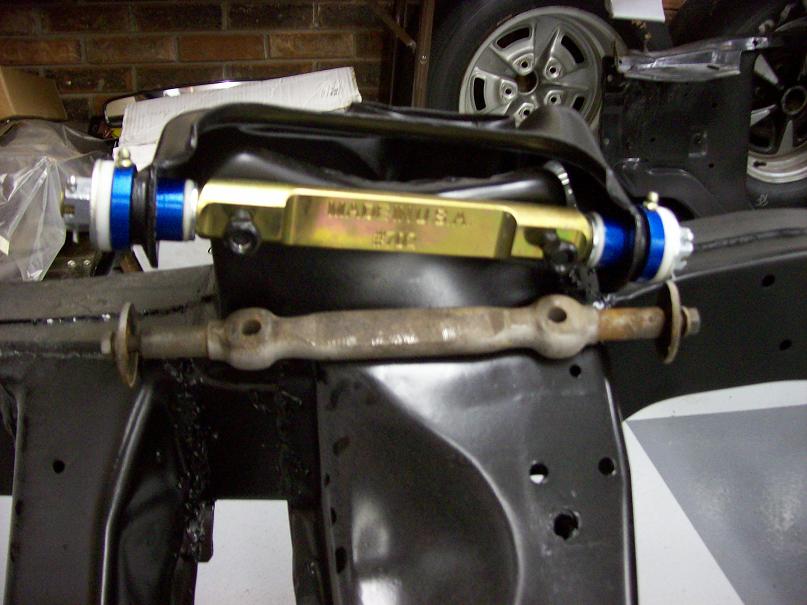
Energy suspensions makes a complete bushing kit to replace all the stock rubber, body bushings and all. I hear Polygraphites are a little stiffer but I've never used them, solids like global west are just that, solid. If your body mounts are original I'll replace them with urethane or OEM. GW makes a 1/2" drop mount but only in a solid. I used ES on my street car, and GW solid bushings and billet shafts on the race car. For a street car I'd just go with ES in the stock a-arms. Looks stock but stiffens it up. (make sure you specify black if you want a stock look, the red really sticks out. The GW stuff is nice but sticks out (appearence) when you pop the hood. I don't even run tubular A-arms on the race car. If you did on the street it probably won't effect the value much either way. Add for the preformance part, take back away for the non stock appearing part. And if it's the only mod done it'll look out of place. If you're doing the Pro-tour type build then I might consider them along with all the other suspension goodies. Nice trick pieces but not worth it on a street car IMO.
I don't know about the aftermarket A-Arms, never used them. Like most repops though, probably real close but not exact.
Wanting a Custom fit in an off the rack world.
I don't have time for a job, I just need the money.
I'm looking into this right now for my car. The whole suspension is shot on my car. So, it will all get rebuilt. I plan on going a different route and installing upper tubular arms with tall ball joints, offset cross shafts, sperical lower control arm bushings. Sub frame connectors,solid body mounts, new leafs and coils with all new hardware, PRO shocks and a 1 1/8 front bar with no back bar. Check out www.pro-touringf-body.com
Robert, That's pretty much what I did, less the tube a-arms. Global West makes a nice system using Billet offset shafts, and their rear spring set up is very nice.
I also used the 1/2" lower solid body mounts and added 2 x 3 welded subframes.
I have Global West upper and lower tubular control arms on my '67. I went tubular on the uppers because of the limits with the OEM upper arms that I found on this site:
Suggest you read what David Pozzi says in there. I wanted to be able to properly align my front end to work with modern radial tires.
I went with tubular lowers after I found I had to replace one of my originals and then finding the replacement I got from the junkyard was bent.
These are true bolt-in parts. If you are worried about resale value then just keep the original A arms.
2012 Mustang Boss 302 #1918, Competition Orange. FGF replacement 2006 Mustang V6 Pony, Vista Blue. Factory ordered. 2019 BMW X3 (Titled to the wife, but I'm always driving it for her. So I'm claiming it) Old projects, gone but not forgotten: 1967 FB 400, original CA car. After 22 years of work, trashed by the guy who was supposed to paint it. I had to sell it. 1980 Turbo Trans Am 1970 Mustang fastback, 351C 4Bbl, auto 1988 Mustang GT, 5 speed 1983 F-150 4x4, built 302 1994 Chevy K2500 HD 4x4, 454 TBI
Most tubular control arms are built from thick DOM tubing, and are as strong as, if not stronger than factory stamped. You do have to beware of the cheap made in you-know-where Ebay ones being sold (some have had issues), but the same can be said for factory repops.
Typical advantages: Available with delrin bushings (I'll cover this more later). Some are lighter than stock. Some have a reinforced pocket for use with coil-over shocks. Many have additional built in caster for improved high speed stability. (DSE are the only ones I've heard that include some additional caster in the lower as well. This keeps from having all the caster built into the upper). Stock arms are very limited in the amount of caster adjustment. ome have offset cross-shafts which reduces amount of shims needed to get appropriate static negative camber. Design allows Gulstrand mod without grinding off top of the a-arm mount. Gulstrand modification changes improves the negative camber gain, fixes the roll center, also adds some positive caster. http://www.popularhotrodding.com/tech/0607phr_car_handling_tech/index.html
A word about control arm bushings: Polygraphite will have a handling improvement. However, they tend to cause noise (if using them definitely get ones with greasable fittings), and increase harshness. The poly is fairly solid, but can allow binding due to deflection, therefore giving a harsher ride (stiction), and some have reported after removing the bushings having sever out of roundness (which will reduce handling benefits). Delrin bushings (solid bushing assemblies with delrin sleeve) are low friction. This improves ride quality by allowing the forces to tranlate to a rotation of the arm (rather than compressing the bushing) and the energy is absorbed by the shocks. Better ride, and maintains geometry. It's a way to get your cake and eat it too. Make sure the ones you get are greaseable. They also will not dry rot like rubber can.
My ride has DSE UCAs and Speedtech LCAs (DSE were not available at the time). Both were made of good quality, and my car feels like my 4th gen did in the curves. If I were to do it again, I'd probably go with Hotchkis UCAs because they have the caster bushing design like DSE, but also the offset shaft like GlobalWest. I would highly recommend using delrin bushings. And if you want to save money somewhere, stay with the tubular UCAs, but use stock LCAs with Delrin bushing conversions available from DSE or GW.
I recently had a C4 Vette owner in the car with me. He asked me what I did to it, so I started to rattle off the 455 engine specs. and interrupts, and says, "No, I mean to the suspension. This thing feels so smooth and connected to the road it's amazing!"
Personally I love being have the car corner without leaning, and yet not get beat up by a stiff suspension. (I even have solid body bushings -got mine through RamAirRestoration and they are stock height). Maybe if you're in the area sometime, I can take you for a ride.
I replaced everything on mine with stock rubber parts from Advance Auto. Everything fit perfectly and all of it has a lifetime replacement. I replaced upper/lower ball joints, control arm bushings, idler arms, tie rod ends etc. It was very reasonable as well...
Replacing everything with rubber is fine and is what I started to do with my car. After losing my other car in a fire I decided that I wanted the performance in my Firebird that I lost with my Camaro. The 1st gen design in suspension was not thought out very well. Castor on the front end is almost non existant(sp). Like mentioned before the delalum bushings (global west) for the upper and lower control arms are awesome. I think mine were torqued down to inch pounds and you could move them with your fingers up and they would drop right back down. Unlike rubber where you have to torque them with the weight on the car. Just remember to make the suspension work together. Some companies will sell stiff springs but soft shocks, some will sell soft springs and stiff shocks. It needs to be a matching kit to work the best. Most of the suspension shops that I have talked to recommended no bigger than 1-1 1/8 front bar and no back bar.
I guess all of that is way beyond me. For me, I just want a car I can get in and drive to the beach, beat up on some imports now and then and enjoy.
I guess if someone plans on taking their car to the track on the weekends or entering in road races then I guess all the aftermarket stuff makes sense.
Another way I look at it is until two summers ago all the ball joints and bushings etc. had last up to that point, almost 40 years so why try upgrading, I don't plan on getting another 40 out my car LOL...
The point is that there have been revolutionary changes in car design in the past 40 years. Some of these advantages can be put into our cars with a simple upgrading of some parts - parts that are pretty much hidden under the classic skin of these cars so that we are not altering their retro good looks.
For me upgrading was a must. I spent 4 years restoring a 1980 Turbo Trans Am and I was a stickler for originality. When I was done, I had spent a great deal of money and had a car I did not enjoy driving.
2012 Mustang Boss 302 #1918, Competition Orange. FGF replacement 2006 Mustang V6 Pony, Vista Blue. Factory ordered. 2019 BMW X3 (Titled to the wife, but I'm always driving it for her. So I'm claiming it) Old projects, gone but not forgotten: 1967 FB 400, original CA car. After 22 years of work, trashed by the guy who was supposed to paint it. I had to sell it. 1980 Turbo Trans Am 1970 Mustang fastback, 351C 4Bbl, auto 1988 Mustang GT, 5 speed 1983 F-150 4x4, built 302 1994 Chevy K2500 HD 4x4, 454 TBI