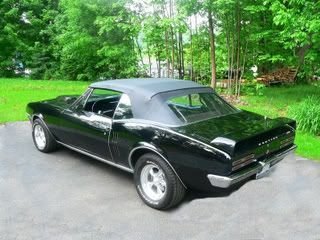
68' 400 auto convert. with a/c.and p/b. i haven't had it long, and i'm not at the knowledge level of some here. but i want more power/torqe. all stock parts on motor, other than carb.(1901 edelbrock) in 2nd. gear at 2000 rpm, when given full throtle. it doesn't bog, but it doesn't jump either as the rpm build i can hear the secoundaries come in at about 3500rpm. i have ajusted the spring tension for the secoundaries to the point they almost fall open. if i tighten it, the secoundaries come in even higher in the rpm range. per the 1/4 turns i put in them. in checking all tune spec. all the timing is in by 2600 rpm, it has a B1 vac. advance it's close to orig.spec., 9* btdc (no vac ), vac. at intake at 900rpm is 19inch. (seems high). copression average is 186 psi. i run 4 gal. of 112 to 10 gals of 93 for an octane level of about 98. i have spark knock on any thing 95 and under. could the lack of power, spark knock(dinamic compression), and high vac. be due to a tight lobe center and small cam. it has a every good and calm ideal i can turn it down to about 500 rpm with no problem, it just tends to die when put in gear. my rear is the posi 2.96 , 68' #16 heads.( cam and deck highth, i don't know) is it just what it is or is something missing. plans are a crowler 60916 cam, long branches, a cliff carb.,shift kit, and later a lower gear rear end. thank for input. lost
First, as you've noted, DUMP THE E-CARB! You're not the first, nor the last, to complain about them. The Q-Jet is FAR superior.
"Spark knock" is dangerous to the engine. Unless "steps" were taken to lower static compression, it's not spark causing the pinging, it's detonation, and it's KILLING your rings and pistons. 9.5:1 is tha absolute limit for static compression and 93 octane gas. I know... Others "successfully" run higher. No, they don't. Oh, maybe SOME, but for the most part, they simply retard the timing to take the ping out, which also takes out "the power" and significantly increases cylinder temperatures. And it really does little if anything to prevent detonation. Reducing compression or increasing octane are the only SURE ways of getting rid of this issue. Using a cam with more overlap is also a poor way to approach the problem. While it DOES "bleed off" cylinder pressure at lower engine speeds, it does NOTHING at higher engines speeds. "Time" is your ONLY "ally" up high, and sometimes, it isn't enough. We've seen MANY engines damaged by detonation, and the owner said "I didn't hear a thing!" Yet, the rings fall off the pistons in pieces when they're removed and ring lands show damage, as well.
As for getting the power "back" after reducing compression, we (CVMS) have found the Comp XE series of cams to be unequalled. I know, there ARE "nay sayers", but none of them are professional engine builders. Virtually every builder I know and/or talk to, agrees, for lower compression, XE cams can't be beat. And if your budget can "stand it", the XE rollers are INCREDIBLE! Avoid the "urge" to alter the specs, LSA in particular. Comp knows their product better than anyone else. The "tests" I've read where the XE grinds didn't perform "as expected" ALL had some parameters changed, usually LSA. Beware the tester. They will alter conditions prior to the "test" to assure the desired results, even if that "desired result" is a negative report.
As for lobe "failures" (heading this one off "at the pass") on XE grinds, well, we've installed no less than 100 of these cams in the last 10 years, and have lost a total of ONE lobe in an engine WE "ran in", and one on a customer's that HE "ran in". In both cases, we're at a loss to explain why. We have also lost one lobe on a Crower, even when using Rhoads lifters, which I was assured by the guy that "set up" the heads, it would "never" happen. Never say never... We no longer take another's "word" that heads are properly set up, we disassemble them and measure.
I believe one of the main reasons people have cam failures is they refuse to "follow instructions". When the cam grinder says to remove the "inner" springs for break-in, REMOVE THE INNER SPRINGS! Pop always said: "When all else fails, follow instructions!" I don't "buy" the oil thing being bantered about, either. We use Rotella T for break-in with no additives. Of course, we use a high-pressure lube on the lifter at install. Also, one of the main "points" for that argument is that all modern engines are "rollers", and that simply isn't true. VW, Nissan, Toyota, even GM, use "buckets" as cam followers in many of their engines, which are no different than flat-tappet lifters, except they act directly on the valve instead of going through a rocker system.
Not familiar with E-carbs, only mess with Q-jets and Holleys. But the plan sounds good. If the valve springs and push rods are stock, replace'm. Use 7/16 rocker studs and poly locks. If not pull'n engine, pull cyl hds and enlarge chambers for less compression. Or find #64 or 6X-4 heads. Theres a couple more, but cant remember what #'s right now. 3.42 to 3.55 gears should work well.
Oh ya. Unless Cliff's caught up, figure a lead time.
It will depend on where the cam lobes are when the piston is at TDC for its particular stroke. That is up to the cam grinder. Pontiac chose the original firing order.
At every "firing" position, two pistons are at TDC: 1 & 6 then 8 & 5 then 4 & 7 and finally 3 & 2. You can verify this with a short block. The firing order is ultimately dictated by the cam lobes. The power, smoothness and health of the crank are the result of the chosen firing order. Check the scavenging result: Odd, even, odd, even, even, odd ... it simply moves the two same-side pairs around, but it has an effect on the torque curve.
I recall some circle track and endurance racing groups playing with the firing orders back in the 70's and 80's to try to squeeze more out of the engines.
It was also common on reverse-rotation boat motors to alter the firing order to smooth out the torque ripple at lower RPMs, if I recall correctly.
i'm pulling the engine, mainly to detail the engine bay, and add long branches, didn't plan on going into the bottom end (10000 or less miles on rebuild)but want to get this right the first time so i'm open to anything. this deck hight issue! i have read that zeroing it out is better, because there is nothing above the piston to heat up and you get a better quench (what ever that is, please tell me) but it also increases compression. can this be over come by dishing the pistons and enlarging the camber on the heads. and is there anything to be gained by porting of the heads +/- 240 cfm. it's a driver, 5000 rpm is about it for me and not that much of it. do any of you know of an early q-jet for an auto.
I don't agree with Mr Pebody That you can't run more than 9.5:1. But if you are building motors that you have to garantee than it's best to be safe. My motor is set up with 10.:1 and I have put over 7,000 miles on it driving hard 93 octane. Hear is another builders opinion. Cliff Ruggles ( I would deck and square the block and set it up for zero deck height. It is not a step to be left out in my opinion. I've seen factory 400 blocks off .017" from one end to the other, and nearly that far off from one bank to the other. The added compression from the decking process will be offset by establishing a greatly improved quench distance. This alone will reduce the octane requirements of the engine, all else being equal.
Pontiac engines in particular do not fair well with the pistons way below the deck. The common denominator for every single running hot/overheating/pinging/detonating Pontiac engine we've been asked to help out has been pistons WAY below the deck at TDC.
We set all of ours at exactly zero deck height, and use a .039" gasket. With the right cam there will be less tendencies for detonation, running hot/overheating than having the pistons .020 to .050" below the holes at TDC with nearly a point less SCR.
Cripe, we've had 400's in here in the low 8 to 1 CR range that ran over 200 degrees at speed and the temps creeped up to nearly 220 idling at stop lights. Pull them down and you are going to find that someone used cast 8 valve relief pistons .050" down in the holes at TDC!
You can build a 400 at 10 to 1 SCR with zero deck clearance making 150 MORE hp than the scenario above and you'll have trouble getting it to warm up to temp's.
Cliff __________________ 73 Ventura, 455, KRE "D" ports, HR cam, RPM intake, 1977 Q-jet, TH-400, 10" Converter, 3.42's, 11.30's @ 120mph in full street trim on DOT's, 89 octane, 3740lbs.
I'll have to second Jim's post, I had quite a bit of success running more than 10:1 on a street 400, with a RAIV cam to keep things under control and really work the mid and upper rpm range.
Same thing, zero deck, attention to detail and proper tuning resulted in an engine that I had to purposely put heat into before running it hard. And yes, we do get above freezing up here!
That being said, doing the same things with a 9.5:1 engine gives more wiggle room if the tuning isn't as good as it should be. A little less compression is a lot better than a little too much.
Q, the jury is still out about the switched firing order, some engines like it, some don't. I haven't done any back-to-back testing yet.
Agreed. The longevity of the crank vs. any additional power developed per revolution (if any) is most of the debate that I remember.
There was a local guy with one of the few Pontiac powered jet boats here who ran a revers-rotation motor with a switched 7-4 firing order. He claimed that it brought the torque up "faster" coming out of the hole.
This is one of the changes between the LS1 and the common SBC if I remember right, so the guys at Chebby must see some value in it. It must also help smooth out intake pulses in single-plenum intake systems like many modern fuel injected motors. Without actual back-to-back testing it would be hard to quantify the changes and differences.
Right on with the zero deck and - in another related thread on crank bearings - rod conditioning also makes a big bit of difference. I had that one come up on me once many years ago.
Cliff and I agree to disagree on a few subjects. We ARE old friends, but we have completely different approaches to certain aspects of engines. I'm not interested in debating who's "right" and who's "wrong". He's a carb guy and I'm a motor guy. My point is practicality, not "pressing the edge". If you're willing to go through the tuning and care the higher compression needs, and the 5 or so HP you MIGHT gain from it is important, by all means, do it. The vast majority of hobbyists and even racers, are much happier building it to a practical point, rather than a "max" point. Think about it. If you already have 400 HP, do you need the headaches of constant attention to the tune to get 405 HP? And, God forbid, what if you're on a trip to California where you can't BUY 93? Only 91?
We've learned through experience, "flow trumps compression". That is, porting the heads to flow better will make more usable power than raising the compression. We routinely build 600 HP "pump gas" engines without pressing the limits of the fuel, that people drive every day. This goes against "old school" thinking where compression was "king" (probably a Chevy-related myth).
"Quench area" is defined as places in the chamber where the fuel mixture can "hide" from the burn. It "puts the fire out". Zero-decking an engine "on the edge" is good because it reduces turbulence in the chamber as the mixture is compressing. Reduced turbulence translates to less "friction heat" among the molecules in the mixture, thus reducing the tendency to detonate. When we "zero-deck" (CVMS), we usually keep the piston .005" "in the hole". The benefits of reducing quench are realized, but the chances of the piston "kissing" the head is drastically reduced. One missed shift is all it takes to rev so high so fast, the piston can hit, pushing the oil out of the rod bearing when it needs it the most. This ins't a "hard fast rule", but a policy. As another mentioned, it's part of my job to protect some folks "from themselves". We seldom consider warranty issues when designing an engine for a customer.
Pistons more than .015" "in the hole" (deck clearance) cause more of the flame "front" to be exposed directly to the cylinder wall, putting more heat into the top of the block. If all conditions are "good", the burn is "over" by the time the piston moves more than a few degrees "down".
The 4-7 "swap" is a good thing, almost without exception, for Chevys, Pontiacs, Chryslers, anything with the "traditional" firing order and cylinder "layout". It redistributes the power pulses to be a little more efficient, as well as moving some of the torsional load on the crank from the weaker "front" to the stronger "rear". Power output and longevity are both improved. This is not an opinion.
LSx is a completely different design, sharing ZERO architecture with previous small blocks. It much more closely resembles the Ford "Windsor" small blocks (289, 302, 351W) as far as layout and valve spacing. The firing order is not similar to any of them. The only two part numbers found in LS1 that were used in small blocks are the rod bearing and the hydraulic roller lifter, both of which are used in other modern GM engines as well.
I hope this helps clear up some of the technical issues being discussed here.
Thanks for fire'n order explanation. Soon as i read it, remembered another Pontiac guy that did that years ago.
Mr. P-body, glad your here. Can ask ya questions without 10 other guys argue'n like on PY and PZ. Oh ya, and try'n to sell ya some'tn at the same time. To bad we'r not closer, need a shop to do the machine work on my IAII. Dont trust the local's with it since my machinest buddy quite and went to work at a steel mill. May have to take it to Tony Bisoff.
Mr. P-body, We hear do reconize that there are menny ways to to things. what I don't agree with when someone comes here and states his way is the only way. Here is your Quote.
(9.5:1 is tha absolute limit for static compression and 93 octane gas. I know... Others "successfully" run higher. No, they don't. Oh, maybe SOME, but for the most part, they simply retard the timing to take the ping out, which also takes out "the power" and significantly increases cylinder temperatures. And it really does little if anything to prevent detonation)
Agree, 9.5 leaves a margin for error. Had #13 heads on a o-decked 400 at 10.0 with a 744HL cam. Used 93 for 2 yrs(about 5000 miles). Sold it to build a more powerfull engine. He wanted to see the crank-n-cam lobes after hear'n it run. They still looked new. That tells ya what good machine work, assembly, and tune can do. Should of never sold that engine...
I'm not sure I understand your point. I'm not saying "my way only", I'm saying what the laws of physics dictate. Octane and resistance to detonation are very specifc. As I said, SOME do "get away" with it. As a professional, I am required to give solid advice based on facts AND experience, not emotions or "brand loyalty". You WILL find, running 9.3:1 with the proper internals will make more usable power than a higher ratio and making "adjustments" to compensate.
10:1 with aluminum heads works okay. Aluminum "soaks" much of the heat from the combustion process, thus resisting detonation. The "downside" to that is not that you "can" run higher compression, but you MUST. All factors being equal (flow, static compression ratio, camming, etc.), iron heads will make more power than aluminum due to this "heat sink" property of aluminum. There have been tests done on Chevy engines regarding this. All the way through the tests, the author kept saying it didn't make much difference, until the "end" where the actual dyno numbers were posted, and the iron-headed engine made more power across the "board". Dart "Iron Eagle" and Dart "Pro-1" were the heads used.
LSx is a completely different design, sharing ZERO architecture with previous small blocks. It much more closely resembles the Ford "Windsor" small blocks (289, 302, 351W) as far as layout and valve spacing. The firing order is not similar to any of them. The only two part numbers found in LS1 that were used in small blocks are the rod bearing and the hydraulic roller lifter, both of which are used in other modern GM engines as well.
Jim
So what you are saying is that the firing order of the LSx is not similar to any of the Windsor Ford engines? We've already established that it's not the same as the SBC. Does that include the Ford 351W or the 5.0 HO, which have exactly the same firing order as the LSx?
Seems like the LSx is NOTHING like the SBC but is similar to the Ford Windsor. I wonder who else knows about this. What would cause such a monumental philosophical shift at a place like Chevrolet to cause them to make such a change to an ideal that's been around for over 50 years?
Zero-decking an engine "on the edge" is good because it reduces turbulence in the chamber as the mixture is compressing. Reduced turbulence translates to less "friction heat" among the molecules in the mixture, thus reducing the tendency to detonate.
"Analysis showed that main 4 had peak loads significantly higher than main 2. By changing the firing order, the peak loading on main 4 was reduced and the peak loading on main 2 went up."
One thing i've noticed on forced induction, the #2 main and rod bearings show more wear the the rest. So a 4-7 swap sould help in that situation. Probly why the guy i mentioned earlier did it.
Hard to say but could be a fuel distribution issue, lean on 3 and 4, lower coolant circulation around those cylinders, rotor out of phase allowing cross-talk on 3 and 4, etc., any of which can cause an earlier onset of detonation which is usually the cause of localized bearing wear.
As you say, not likely the problem if it is on more than one engine or intake. Kinda hard to pinpoint unless you move the engine a little closer to your computer so I can see it better.
man, i sure am glad i got my qustion answered, i think? i guess i should change my name from nonothing to "don't know sh!!t". but i think i get the gist of both sides. if your on top of your tune, compression can be delt with, if not and fuel quality is an issue that drop it a bit. as far as deck hight, i've found conflict in what the same person has said in post that are several months appart. but i'll see were mine is at next week when it comes apart. i'm still looking for a builder, there aren't many pontiac builder around the gulf coast as far as i have found. i guess i'll start looking more up north , but shipping will take away from goodies. but it is what it is. if anyone has suggestion on builders that are some what close to lowere alabama, that would be helpful. thank for your time and carry on.
i'm pulling the engine, mainly to detail the engine bay, and add long branches, didn't plan on going into the bottom end (10000 or less miles on rebuild)but want to get this right the first time so i'm open to anything. this deck hight issue! i have read that zeroing it out is better, because there is nothing above the piston to heat up and you get a better quench (what ever that is, please tell me) but it also increases compression. can this be over come by dishing the pistons and enlarging the camber on the heads. and is there anything to be gained by porting of the heads +/- 240 cfm. it's a driver, 5000 rpm is about it for me and not that much of it. do any of you know of an early q-jet for an auto.
Having an average compression reading of 186 psi is very high for pump gas.
If you don't want to get into the short block, you're pretty much limited to opening up the chambers or getting different heads. If you want to open up the chambers, do so by unshrouding the valves and rounding the machined edges, but try not to reduce the flat quench areas. That will retain the "squish" effect when the piston is at TDC. This essentially squirts the air caught between the head and the piston into the rest of the combustion chamber, stirring up the mixture and speeding up the burn. Since this accelerates the burn after TDC, the engine is more efficient and makes more power with less ignition timing. The slight compression increase that accompanies decking is greatly outweighed by the benefit of the squish effect.
If you are thinking about getting the block decked, remember that piston to head clearance is the key to attaining the proper squish effect and is set by the combination of deck height and head gasket thickness. Know which gaskets you're going to use before setting the deck height.
Porting the head to bring up the flow is always beneficial as long as the port isn't "hogged". A reputable shop that has and knows how to use a flow bench is usually your best bet. I wouldn't go much beyond bowl porting for street use.
I don't have access to the specific firing order of LSx. I'll look into it. It may or may not be similar to the little Fords, but it is COMPLETELY unlike any of GM's other engines over the years. The valve "spacing' and "layout" are similar to the Ford, but "opposite". That is, where an exhaust valve is on "front" on one side and in the "rear" on the other, the LSx has the intake on the same side as the Ford does exhaust. (I-E-I-E-I-E-I-E for one, E-I-E-I-E-I-E-I for the other, if installed on the same "side") Of interest, the Ford "W" deck plate bolts right to LSx...
TOHcam,
I believe I'm saying (at least TRYING too...) the same thing, just not as well "worded" as the article. The "turbulence" I speak of as "less" would be IN the quench area, not the overall chamber. It IS true, turbulence in the larger area helps keep the mixture "atomized".
The molecular friction, though, is one of the prime causes of detonation when sufficient octane isn't present, such as in a diesel engine (compression ignition).
Jim, the main thing that turbulence does in the chamber is increase the burn speed and also the completeness of the burn by exposing more of the air/fuel mixture to the flame front.
A quick illustration of the effect: fill two bowls with water and put a drop of red food colouring in each to simulate the flame front, and make one swipe with a spoon through the middle of one bowl. Obviously the one that has turbulence will mix much faster and more completely.
Turbulence in the form of tumble or swirl during the intake stroke aids vapourization and homogenization of the atomized fuel and air, however, the turbulence associated with the squish effect occurs after ignition and is meant to enhance the burn.
I think you're meaning compression heating rather than molecular friction. While there will be a minor effect caused by the extra movement of the molecules because of the turbulence, the vast majority of the temperature increase will be from adiabatic heating.
I don't have access to the specific firing order of LSx. I'll look into it. It may or may not be similar to the little Fords, but it is COMPLETELY unlike any of GM's other engines over the years. The valve "spacing' and "layout" are similar to the Ford, but "opposite". That is, where an exhaust valve is on "front" on one side and in the "rear" on the other, the LSx has the intake on the same side as the Ford does exhaust. (I-E-I-E-I-E-I-E for one, E-I-E-I-E-I-E-I for the other, if installed on the same "side") Of interest, the Ford "W" deck plate bolts right to LSx...
Strangely enough, the comparison was made in the article TOHCan referenced for the 4-7 swap information. It's near the end of the first paragraph on the second page. The little fords and the Gen III LSx have identical firing "patterns." (Using the word "order" will mess up most of the folks who forgot that Ford didn't number their cylinders correctly.)
I guess I need more of an "engineering" vocabulary. We're saying the same thing, just your version is more linguistically correct. Molecular friction is what we were taught in school IS "compression ignition". Thank you for the detail. I make no claim to actually BEING an engineer, as I don't have a full "load" of college. Bits and pieces over the years, trying to "piece together" a good enough education for more understanding of these issues. But I HAVE "engineered" a thing or three... (:-
Quenton,
Thanks. Looks like LSx really IS a "Ford in drag"... (:- Helluva engine, though! We'll be diving into an LS-7 in the next few weeks. I'm really looking forward to that challenge!
As you say, not likely the problem if it is on more than one engine or intake. Kinda hard to pinpoint unless you move the engine a little closer to your computer so I can see it better.
No, all the plugs look good. Havent burned one in 2 seasons. Just on tear downs the #2 main-n-rod bearings show more wear. Doesnt matter right now, he cant afford to race until job gets better.
Jim, I'm more at home using everyday terms instead of the correct technical jargon as well. Whatever gets the point across, but sometimes loosely phrased explanations can be misleading. Sounds like your instructor may have slipped some of his pet buzz words in. Normally I don't jump in but I wanted to make sure that everything was clear.
I'm sure we'd do just fine in person, and likely convey more with a few well-timed grunts and some pointing at engine parts than most others could in a ten page report! I are just a mekanic but I read a lot, and when the conversation takes a hard left turn into engineering-ese, I call in my good buddy Quenton as interpreter!
No, all the plugs look good. Havent burned one in 2 seasons. Just on tear downs the #2 main-n-rod bearings show more wear. Doesnt matter right now, he cant afford to race until job gets better.
I'd be interested in what you find out when you get back to it.
i'm so PROUD of myself for generating such an informative thread, on my first try, in which i have no idea of what yall are talking about. but please keep bessing us with your wisdom. nonothing
Something about converting a fgf into a Maserati...
I used to be indecisive. Now I'm not sure. I feel like I am diagonally parked in a parallel universe. 1968 400 convertible (Scarlet) 1976 T/A - 455 LE (No Burt) 1976 T/A New baby, starting full restoration. 1968 350 - 4 speed 'vert - 400 clone (the Beast!) 1968 350 convertible - Wife's car now- 400 clone (Aleutian Blue) (Blue Angel) 2008 Durango - DD 2008 GXP - New one from NH is AWESOME! 2017 Durango Citadel - Modern is nice! HEMI is amazing! 1998 Silverado Z71 - Father-daughter project 1968 400 coupe - R/A clone (Blue Pearl) (sold) 1967 326 convertible - Sold 1980 T/A SE Bandit - Sold
If I don't learn something each day, it's a wasted day.... Or maybe it was just ME that was wasted... I might have learned something, but forgot... (:- I often find people on these boards with either a higher level of education or expereince, or both. I post what I know, and if it's "wrong", I won't post it again! But I WILL learn from others! Thanks.