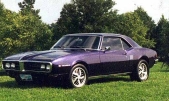
I'd like to know how to read the temperature on the rallye gauge. I have a '67, 400 and the gauge is marked from 100 to 250. What temperature are the intermediate hash marks supposed to represent? My car has been running in between the halfway and three-quarters area. Is this normal and at what temperature would this be, assuming the gauge is correct. I'm worried about overheating since I've heard the 400 is noted for it. The engine is 100% stock as far as I can tell.
I would say that the middle hash is 175. Your operating range should be between the middle hash and the next smaller one. The best thing you could do is use a thermometer to test the accuracy of your gauge and get a true idea of the temps related to the hashes. It would be normal to run up to 200 on a hot day when you put the car through the paces. Jim
That's what I was told also from a local mechanic but I wanted to make sure. If my temp. is running between the halfway and three quarter hash marks, then it should represent a temp. around 194 degrees, right? What's the best way to install a thermometer to check this for accuracy?
On vertical tank radiators, it's easy to buy a deep fry thermometer and attach a tether. Remove the radiator cap, start the car, warm it to operating temperature. You can check the temp in the tank and will see when the thermostat opens. This won't give you engine temperature but will give you a good idea of your hot idle coolant temperature to simulate cruising and stuck in traffic conditions. If the coolant in the radiator is over 200 degrees you're not cooling well. I have an infrared thermometer that can be calibrated when the engine is cold, then will accurately indicate the block and head temps when the engine is warm. Mine was over $700 when bought 15 years ago, but they are now down to $75 or so. Mine is capable of measuring exhaust manifold temps, though, and the cheaper ones only go up to 500 degrees. I can also use it to detect a misfiring or intermittently firing plug, because that plug will be cooler when pointed at.
Vikki 1969 Goldenrod Yellow / black 400 convertible numbers matching
Ken, Sounds like your engine is cooling well, 194 is ideal. Yellowbird has the temp thing down to a science! I use an infrared temp sensor at work and it is a wonderful tool. It sure makes it easier to troubleshoot a machine. Jim
Of course, that's if I can see past the A/C to the plugs...exhaust manifold temps work too if you check when engine is still almost cold and you can tell which are heating up fastest.
My IR sensor was designed to check fuser roller temperatures on a laser printer. Big investment, used it only twice for that, but I use it for just about everything else! Drafty windows, locating missing caulk around doors and windows, check my 70 year old oven's temperature, etc.
Vikki 1969 Goldenrod Yellow / black 400 convertible numbers matching
Just got my hands on an infrared thermometer from one of the boys at work. Just point and shoot. Any suggestions on the best places to point this puppy?
Checked out temps. with IR gun this weekend. Weather was mild, 82F and sunny. Got temp. up to just past the halfway mark (185-190F) and running for an hour at all speeds.
Block heads 210-215F Radiator hose at block 190-195F Top of radiator 178-182F Bottom of radiator 166-169F
sounds reasonable to me, thermostat is allowing hot coolant to pass into radiator, radiator is cooling coolant with only fan assist, cooled coolant is flowing back into water pump to remove more heat from the engine.
Do you have a 190 degree thermostat installed?
Vikki 1969 Goldenrod Yellow / black 400 convertible numbers matching
I'm not sure what the thermostat rating is. Since the car is mostly original, I'm assuming I have a 180F stat. But the temps seem a bit high for that rating don't they? This has always been an Illinois car so I can't see why the stat would be higher.
My '69 400 has a 190 degree thermostat (factory spec) and the temps run about the same at the heads, a little hotter at the hose, and about the same at the bottom of the radiator.
From the '69 service manual:
A new thermostat (190 degree) valve should start to open at a temperature of 187 to 193, and should be fully open or more at a temperature not in excess of 222 degrees. A used thermostat can be about 7 degrees above or below this setting without adverse effect and should not be replaced.
Unless you calibrated the IR thermometer for the emissivity of the black hose at room temperature vs. heated, and the same for the heads and radiator, the thermometer will not give you absolute readings, but will give you a good indication of whether your system is working as designed. I'm not sure which is the correct thermostat for a '67 400, but my heater is much more effective and the engine runs cooler with a 190 thermostat.
Vikki 1969 Goldenrod Yellow / black 400 convertible numbers matching
Why would the engine run cooler with a 190 stat? I would figure the opposite. The coolant would begin to circulate sooner with a 180 stat, and therefore run on the cooler side.
That's how it seems to work. I believe the water, by staying in contact with the engine longer, is able to absorb more heat from the engine and unload it in the radiator.
Vikki 1969 Goldenrod Yellow / black 400 convertible numbers matching
The only time you will have the problem with the coolant moving too quickly is if you have no thermostat at all. As long as you have the restriction of the thermostat body there is no problem. It is a myth that a lower temp. thermostat makes an engine run hotter. Jim