|
|
Joined: Jul 2003
Posts: 726
Member
|
|
Member
Joined: Jul 2003
Posts: 726 |
I have tried everything , change thermostat from 195 down to 165. My electric fan was only pulling 900 CFM at best , so i went to a larger fan 1500CFM. its 46 degrees outside car temp 220. I have a 3 core aluminiumn radiator. no blockages and i did the water pump impellor , divider plate its like .020 away from the impellor.
temp is the same just cruising at 50MPH no diff. if any it goes a little higher.
Could it be the pump ?
Last edited by Pci_raid; 04/08/12 11:56 PM.
|
|
|
|
|
Joined: Aug 2002
Posts: 7,495 Likes: 1
Premium Member
|
|
Premium Member
Joined: Aug 2002
Posts: 7,495 Likes: 1 |
|
|
|
|
|
Joined: Aug 2006
Posts: 1,458
Member
|
|
Member
Joined: Aug 2006
Posts: 1,458 |
Did you verify your temp gauge is reading correctly?
Harry 69 Firebird   _________________________________________________ 1969 firebird 350/auto 2012 mustang v6 (wifes car) 2012 jeep compass (winter vehicle) 2008 dodge ram 4x4 Hemi
|
|
|
|
|
Joined: Sep 2001
Posts: 2,902
Senior Member
|
|
Senior Member
Joined: Sep 2001
Posts: 2,902 |
<Could it be the pump ?>
Nope! The problem is misinformation. 220' is well within normal operating temperture. They have been running at this temperature long before anyone around here--except me--or any other internet site was interested in these cars.
Based on another post about engine heat, it's obvious that no one has a clue, so I will explain why some vehicles boil @ 220' and others don't. The ones that boil have defective cooling systems.
It's based on simple physical laws: The boiling point increases with temperature pressure. The cooling system, depending on what you have for juice, should hold up to about 265' without boiling, with 240' to 245' boiling point as adequate.
In other words, if it boils at temperatures below 240', it's because the rad isn't maintaing adequate pressure. The only relation to overheating is the obvious problem with the rad running dry.
Then again, you have to keep in mind that my goal, unlike others, is to try to phuck your car up as bad as possible, so you may want to listen to smoneone who givesashit.
|
|
|
|
|
Joined: Jun 2000
Posts: 20,054
Administrator
|
|
Administrator
Joined: Jun 2000
Posts: 20,054 |
Do you have a shroud?
is timing set right?
is this at idle or driving?
still to many unknowns....
I got mine from 215-220 to 190 2 yrs ago by changing my stock rad to a 3 core aluminum....
but had earlier added my fillers, removed a pusher helpr fan installed be prev owner, .
|
|
|
|
|
Joined: Jun 2000
Posts: 20,054
Administrator
|
|
Administrator
Joined: Jun 2000
Posts: 20,054 |
<Could it be the pump ?>
Nope! The problem is misinformation. 220' is well within normal operating temperture. They have been running at this temperature long before anyone around here--except me--or any other internet site was interested in these cars.
Based on another post about engine heat, it's obvious that no one has a clue, so I will explain why some vehicles boil @ 220' and others don't. The ones that boil have defective cooling systems.
It's based on simple physical laws: The boiling point increases with temperature pressure. The cooling system, depending on what you have for juice, should hold up to about 265' without boiling, with 240' to 245' boiling point as adequate.
In other words, if it boils at temperatures below 240', it's because the rad isn't maintaing adequate pressure. The only relation to overheating is the obvious problem with the rad running dry.
Then again, you have to keep in mind that my goal, unlike others, is to try to phuck your car up as bad as possible, so you may want to listen to smoneone who givesashit. 220 is well witihing working temps, yes , but at what outside temps? If thats at 95-100F or if its at 65-70 outside F , will make a difference , IF its at 70F and you then get to drive in the 100F of course you are correct with the pressure and bad systems....my 94 Eldorado , I had, SHOULD run at +-220 "normally' , pressurrized more, but also 'closed' systems , these old arent perfectl;y closed as they have the spewline (operateed by rad cap). so , checjking the rad caop may be a good idea.
|
|
|
|
|
Joined: Feb 2004
Posts: 1,480
Member
|
|
Member
Joined: Feb 2004
Posts: 1,480 |
My 455 has a 180 T-stat and stays at 180 unless it get really hot (95+) and I'm just ideling through traffic.
I might suggest this.
* Verify your temp gauge as was stated.
* HD 7 blade clutch fan as close to the radiator as you can with a tight fit around the shroud. Some people have luck with the electric fan and others don't. One thing about the engine fans and they can really blow the heat out of the engine compartment.
* Have you investigated the crank and WP pully sizes? I know there are two or three sizes of pulleys for each
*What type impeller?
*A\C?
Some odd ball stuff that I have seen in the forums over the years was quench distance (Head to piston), radiator height, timming advance and Lean condition.
|
|
|
|
|
Joined: Jul 2003
Posts: 726
Member
|
|
Member
Joined: Jul 2003
Posts: 726 |
its an automatic,its 46 degrees outside car temp 220,idling or driving at 50 mph temp 220, is correct i have one of those laser heat detectors , works great for checking for a misfiring cylinder. yes verified with laser heat detector , cast iron vanes. Did the water pump impellor distance, got it as close as i can.
pully sizes according to parts book are correct size.
16 inch puller electric fan 1500 cfm.
its a 400 .030 over CR reduced to 9.5to 0ne #16 heads.
it just concerns me to see the gauge 1 line below pegged.
|
|
|
|
|
Joined: Aug 2002
Posts: 7,495 Likes: 1
Premium Member
|
|
Premium Member
Joined: Aug 2002
Posts: 7,495 Likes: 1 |
I don't know if it would make any difference at all but I thought I'd throw it out there...
What if you installed an external trans cooler instead of circulating it throgh the radiator? If your trans is overheating it might be transferring some heat to your coolant? No idea but it sounds like you've tried just about everything else.
Know anybody with a wideband A/F meter that can check for a lean cond?
|
|
|
|
|
Joined: Apr 2010
Posts: 6,758
FGF Premium Member
|
|
FGF Premium Member
Joined: Apr 2010
Posts: 6,758 |
Try going back to stock configuration. Clutch or flex fan with a shroud.
Engine Test Stand Playlist: https://www.youtube.com/playlist?list=PLwoxyUwptUcdqEb-o2ArqyiUaHW0G_C88restoring my 1968 Firebird 400 HO convertible (Firedawg) 1965 Pontiac Catalina Safari Wagon 389 TriPower (Catwagon) 1999 JD AWS LX Lawn tractor 17hp (my daily driver) 2006 Sequoia 2017 Murano (wife's car) 202? Electric car 203? 68 Firebird /w electric engine 2007 Bayliner 175 runabout /w 3.0L Mercuiser__________________________________________________________
|
|
|
|
|
Joined: Jul 2003
Posts: 726
Member
|
|
Member
Joined: Jul 2003
Posts: 726 |
i think i'll try my flexfan setup i have the shroud.
|
|
|
|
|
Joined: Sep 2001
Posts: 2,902
Senior Member
|
|
Senior Member
Joined: Sep 2001
Posts: 2,902 |
I was expected to be blown out of the water. I guess people are seeking other places other than less-than-qualified sources.
<but at what outside temps? If thats at 95-100F or if its at 65-70 outside F>
It makes virtualy zero difference. You are comparing cooling based on ambient temperature compared to windchil factor, a whole different ballgame of ambient temperature.
Do what you want, but you quote @ 50 mph. Once you get moving, it doesn't need a fan because of sufficent air rush through the radiator. So it has nothing to do with the fan.
The point is that there is nothing wrong with this car!
|
|
|
|
|
Joined: Jun 2000
Posts: 20,054
Administrator
|
|
Administrator
Joined: Jun 2000
Posts: 20,054 |
<but at what outside temps? If thats at 95-100F or if its at 65-70 outside F>
It makes virtualy zero difference. You are comparing cooling based on ambient temperature compared to windchil factor, a whole different ballgame of ambient temperature.
You obviously do not live in Houston....LOL 100F "wind" vs 65F "wind" do make a difference on cars down here...... and "back home" in Sweden, with - 20F , yes outside temps do make a difference.... and I can tell now on my 69 400 , if I drive it on a hot summers day in 95-100F or if its a "cool" spring day at 75F...the engine temps do differ....from 200-205 now w new radiator , to down of 185-190.... Granted , "modern" cars dont get impaired much by the outside temps....but they are , even though not perfect, much better cooled than 40-45 yr old cars.
|
|
|
|
|
Joined: Oct 2009
Posts: 1,363
Premium Member
|
|
Premium Member
Joined: Oct 2009
Posts: 1,363 |
Windchill in the classic sense will have nothing to do with the cooling capacity of the radiator. Windchill is a combination of ambient temperature and wind speed. It is meant to take into account evaporative cooling effects of the skin. So unless the radiator is leaking or it is raining, there is no evaporative cooling effect on the radiator.
To say temperature has no effect in the ability of a radiator to reject heat is also not true. Take the extreme, if the outside air temperature was 100 degrees F and the radiator was running 100 degrees F, there would be no convective losses (still potentially would have radiation and conduction losses).
Now the real question is does humid air or dry air have more heat capacity. I want to say humid air does (I’m sure someone can chime in), which although this is counterintuitive means the radiator will reject more heat on a humid day verses a dry day of the same temperature (give all other conditions are the same).
Larry
1967 Sprint Convertible
|
|
|
|
|
Joined: Jun 2000
Posts: 20,054
Administrator
|
|
Administrator
Joined: Jun 2000
Posts: 20,054 |
agreed, "wind chill" is not part of it , I just uesd the 'wind' as part of my reply because Amervo talked about it...'wind' is what you get thru the radiator when driving if no fan is being used...and once you`re going at speed, no fan IS needed....
and hot humid air is typical here in Houston...100F is not extreme either is is fairly typical for afternooons in summer here
|
|
|
|
|
Joined: Oct 2009
Posts: 1,363
Premium Member
|
|
Premium Member
Joined: Oct 2009
Posts: 1,363 |
He used the term windchill factor not you. Not exactly sure where he was going.
Larry
1967 Sprint Convertible
|
|
|
|
|
Joined: Jun 2000
Posts: 20,054
Administrator
|
|
Administrator
Joined: Jun 2000
Posts: 20,054 |
thx, yes, agreed.
And he may be right , there may not be 'anything wrong' with the car....as it wasnt with mine either when I bought it and it ran 235F on my way home from Dallas after buying it....I still worked on it to reduce those 235 to 205 then to 190, by different means over the years. the setting of the idiot light is to come on over 245F so, at least up to that degree it should be safe
|
|
|
|
|
Joined: Aug 2002
Posts: 7,495 Likes: 1
Premium Member
|
|
Premium Member
Joined: Aug 2002
Posts: 7,495 Likes: 1 |
I don't know about "safe". Mine boils over at 240* and sounds really bad when it does it. Like you expect something to explode any second. 220 may not be too high but it's too close to the boiling point for my comfort level. When the needle reaches 210 my eyes are pretty much glued to the gauge till it comes back under. Doesn't happen often but sometimes on a hot day, idleing in traffic for 45mins or so, she will creep into the no no zone. Outside air temps definitely affect radiator temps. 40* air being sucked through has alot more cooling effect than 100* air over the surface of rad tubes.
|
|
|
|
|
Joined: Dec 2011
Posts: 101
Member
|
|
Member
Joined: Dec 2011
Posts: 101 |
Someone suggested timing and that would be where I would look. I had that problem once and it drove me nuts. My timing was right according to the light. What I forgot to take in account is the timing has to be set at the correct RPM. I couldn't cool the car down no matter what I tried. I put a tach on the car and found my idle set too high. I adjusted the idle down a few times and reset the timing while doing it. Car ran cool and fine after that. You've tried everything else, check your timing. My .02c worth.
Restoring a 1968 400 4spd, numbers matching Firebird Coupe, Verdoro Green. Larry  My old 68. Wish I had her back.
|
|
|
|
|
Joined: Jul 2010
Posts: 214
Member
|
|
Member
Joined: Jul 2010
Posts: 214 |
Ok... I've been through it. I'm all good now.
I was easily hitting 230 - highway or red lights... on 70+ F days.
Here were my factors and/or actions.
(I know the right mechanical fan is best - but I didn't know it before and was squeamish after having my clutch fan penetrate all 3 cores of my radiator... so I have an aluminum rad and dual electric fans... high flow..was still getting some hot temps)
- Timing
- Vanes behind water pump (replaced; corroded/holes/rusty)
- Went from 68 style pump & timing cover to 69 style (higher flow)
- Keeping mixture at 50% coolant or below
- Rigid bottom hose (non-reinforced radiator return hose was collapsing and sealing off!)
- Lower baffle (had the X upper baffles, added lower baffle behind camaro spoiler)
- 165 degree t-stat
The above items helped, but never gave a home-run. I even changed gauges, just in case. Mech checked with IR temp reader.... hot hot.
The home run actually came from having Ken Keefer rebuild my engine.
I haven't touched 210 since, and spend a lot of time at 180.
1968 Firebird 400 Convertible Original: Engine, Intake manifold, Heads, Body, Stereo, 3.08. THM400. Engine rebuilt by Ken Keefer early 2012. New: Holley 4bbl 670 HP, hidden iPod setup, RobbMC mini starter, A/C, front disc brakes 
|
|
|
|
|
Joined: Mar 2012
Posts: 1,539 Likes: 41
Member
|
|
Member
Joined: Mar 2012
Posts: 1,539 Likes: 41 |
Dealing with the summer air temps in AZ its harder to keep the water temps down where they should be, but the proper diver plate to pump impeller spacing has played a big role in keeping my temps in the 180 range.
Pontiac power
|
|
|
|
|
Joined: Jul 2002
Posts: 856
Member
|
|
Member
Joined: Jul 2002
Posts: 856 |
The best thing you can do to keep temps down is to do like Cliff says.
I would deck and square the block and set it up for zero deck height. It is not a step to be left out in my opinion. I've seen factory 400 blocks off .017" from one end to the other, and nearly that far off from one bank to the other. The added compression from the decking process will be offset by establishing a greatly improved quench distance. This alone will reduce the octane requirements of the engine, all else being equal.
Pontiac engines in particular do not fair well with the pistons way below the deck. The common denominator for every single running hot/overheating/pinging/detonating Pontiac engine we've been asked to help out has been pistons WAY below the deck at TDC.
We set all of ours at exactly zero deck height, and use a .039" gasket. With the right cam there will be less tendencies for detonation, running hot/overheating than having the pistons .020 to .050" below the holes at TDC with nearly a point less SCR.
Cripe, we've had 400's in here in the low 8 to 1 CR range that ran over 200 degrees at speed and the temps creeped up to nearly 220 idling at stop lights. Pull them down and you are going to find that someone used cast 8 valve relief pistons .050" down in the holes at TDC!
You can build a 400 at 10 to 1 SCR with zero deck clearance making 150 MORE hp than the scenario above and you'll have trouble getting it to warm up to temp's.
Cliff
__________________
73 Ventura, 455, KRE "D" ports, HR cam, RPM intake, 1977 Q-jet, TH-400, 10" Converter, 3.42's, 11.30's @ 120mph in full street trim on DOT's, 89 octane, 3740lbs.
|
|
|
|
|
Joined: Aug 2002
Posts: 7,495 Likes: 1
Premium Member
|
|
Premium Member
Joined: Aug 2002
Posts: 7,495 Likes: 1 |
You might have to adjust other things a bit as well after zero decking I would think. I mean my(iron headed) motor is at 9.7:1CR already. If I zero deck it and leave it the way it is with 75-76cc head chambers I'm looking at alot higher CR. I don't think it would be totally offset by the new quench. I'd have to figure it out but I'd bet it would put me in the 10.5-11 range. It's not going to live on today's pump gas.
|
|
|
|
|
Joined: Apr 2010
Posts: 6,758
FGF Premium Member
|
|
FGF Premium Member
Joined: Apr 2010
Posts: 6,758 |
The best thing you can do to keep temps down is to do like Cliff says.
I would deck and square the block and set it up for zero deck height. It is not a step to be left out in my opinion. I've seen factory 400 blocks off .017" from one end to the other, and nearly that far off from one bank to the other. The added compression from the decking process will be offset by establishing a greatly improved quench distance. This alone will reduce the octane requirements of the engine, all else being equal.
Pontiac engines in particular do not fair well with the pistons way below the deck. The common denominator for every single running hot/overheating/pinging/detonating Pontiac engine we've been asked to help out has been pistons WAY below the deck at TDC.
We set all of ours at exactly zero deck height, and use a .039" gasket. With the right cam there will be less tendencies for detonation, running hot/overheating than having the pistons .020 to .050" below the holes at TDC with nearly a point less SCR.
Cripe, we've had 400's in here in the low 8 to 1 CR range that ran over 200 degrees at speed and the temps creeped up to nearly 220 idling at stop lights. Pull them down and you are going to find that someone used cast 8 valve relief pistons .050" down in the holes at TDC!
You can build a 400 at 10 to 1 SCR with zero deck clearance making 150 MORE hp than the scenario above and you'll have trouble getting it to warm up to temp's.
Cliff
__________________
73 Ventura, 455, KRE "D" ports, HR cam, RPM intake, 1977 Q-jet, TH-400, 10" Converter, 3.42's, 11.30's @ 120mph in full street trim on DOT's, 89 octane, 3740lbs.
That's very interested and make sense. My 350 HO engine is disassembled with exception of the crank and pistons. The HO heads (18) coupled with the aluminum (Jahn's) pistons have resulted in higher compression engine. I do not know this by fact (has not been measured) but I suspect the compression is high. How would I measure my ? (deck) to confirm it's done properly?
Engine Test Stand Playlist: https://www.youtube.com/playlist?list=PLwoxyUwptUcdqEb-o2ArqyiUaHW0G_C88restoring my 1968 Firebird 400 HO convertible (Firedawg) 1965 Pontiac Catalina Safari Wagon 389 TriPower (Catwagon) 1999 JD AWS LX Lawn tractor 17hp (my daily driver) 2006 Sequoia 2017 Murano (wife's car) 202? Electric car 203? 68 Firebird /w electric engine 2007 Bayliner 175 runabout /w 3.0L Mercuiser__________________________________________________________
|
|
|
|
|
Joined: Jul 2002
Posts: 856
Member
|
|
Member
Joined: Jul 2002
Posts: 856 |
|
|
|
|
|
Joined: Jul 2002
Posts: 856
Member
|
|
Member
Joined: Jul 2002
Posts: 856 |
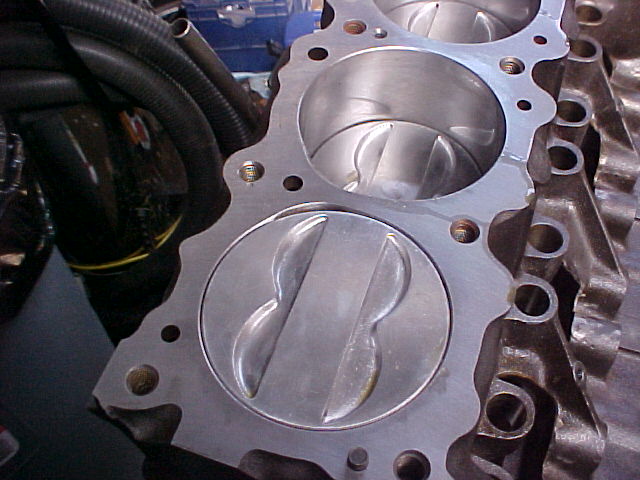
Above is my motor. It has #16 heads (stock)with crossover filled.
1.65 rockers,rhoads lifters,crower cam #60916
I have 6'000 miles running 93 octane(hard) with no problems.
|
|
|
|
|
Joined: Jul 2002
Posts: 856
Member
|
|
Member
Joined: Jul 2002
Posts: 856 |
OH! I have more trouble getting it up to temp. than running hot.
On 70 deg day it stays at 160-170. Most it gets is on hot days is 200.
|
|
|
|
|
Joined: Aug 2005
Posts: 1,923
Member
|
|
Member
Joined: Aug 2005
Posts: 1,923 |
I'd have to agree, he might be on to something there. I have my 350 running at zero deck height also and making about 9.8 to 1 compression and the only time it got above 180 degrees was when it was idleing and the outside temps were close to 100. (Of course, I've done all the other stuff too.)
Last edited by Mushroombert; 04/12/12 12:51 PM.
|
|
|
|
|
Joined: Jul 2003
Posts: 726
Member
|
|
Member
Joined: Jul 2003
Posts: 726 |
My engine is brand new rebuild with TRW forged pistons dished to reduce compression ratio to around 9.5 to 1, all balanced. Im using #16 heads with ss valves, running an 068 blue print cam. everything was machined by a knowlegable potntiac machinist. Only thing i didnt do was zero deck . decks were clean up cut .010 as was the heads. Im also using a performer rpm intake with a qjet, and headman headers into 2.5 inch pipe to flow master 40's with h pipe.
I'll try retarding the timing some, i dont hear any detination, but that doesnt mean its not happening. im at 10 degrees BTDC.
|
|
|
|
|
Joined: Feb 2004
Posts: 1,480
Member
|
|
Member
Joined: Feb 2004
Posts: 1,480 |
8-point Cool pics. Are the #16 head on a 400? Any work done to the chamber?
PCI-raid,
Do you have the close out panels installed, what about the lower valence and the rubber side close outs? These were all factory pieces that forced the air through the radiator.
|
|
|
|
|
Joined: Jul 2003
Posts: 726
Member
|
|
Member
Joined: Jul 2003
Posts: 726 |
Yes they are on a 400, no chamber work .Just pocket porting. SS valves and better springs and keepers.
After calculating out the set up with std flat top pistons with the 4 eyebrows which added up to +6cc the CR was going to be too high. so i calulated out what i needed for a dish in the piston and had the machined dishes. i wanted 9.5 to 1 9.75 to 1 max. I called TRW and they recommneded the piston and machine size needed. so they are forged TRW with teflon coated skirts .030 over bore.
The rad is bolted in such a way no air can get around it.
I do have the 400 top close out panels. i dont have the chin scoop.
|
|
|
|
|
Joined: Aug 2010
Posts: 232
Member
|
|
Member
Joined: Aug 2010
Posts: 232 |
Try going back to stock configuration. Clutch or flex fan with a shroud.
What he ^^^ said. You're not moving enough air. It's tough to compete with an 18" flex or clutch fan with the right spacers and shroud.
|
|
|
|
|
Joined: Aug 2002
Posts: 7,495 Likes: 1
Premium Member
|
|
Premium Member
Joined: Aug 2002
Posts: 7,495 Likes: 1 |
8point,
Did you cc the heads? Have you figured out what your CR is? I'd be curious to know. It sounds alot like mine except for the 0 decking and cam.
Best octane out of a pump is 91 out here and truth is it's probably not even that good. 6K miles isn't very much. I've had motors with 10K break ring lands and eat up bearings and I never heard any detonation. I'm not saying you're getting it, just that you don't always know until something breaks.
|
|
|
|
|
Joined: Jun 2000
Posts: 20,054
Administrator
|
|
Administrator
Joined: Jun 2000
Posts: 20,054 |
I know I checked my 5C heads before milling ,then got them redone...got 88-89 CC...CR is about 9.2-9.3 ,use "regular" gas , no pinging, runs good....now have 30,000 on that engine....Quenton helped me figure mine out ,on what to do.
|
|
|
|
|
Joined: Jul 2003
Posts: 726
Member
|
|
Member
Joined: Jul 2003
Posts: 726 |
Yes that may be true at stopped or slow speeds but even at 55 its the same. To me the only thing left is water pump. Im going to pull it this weekend.i have 3 ,2 cast iron and 1 steel.
|
|
|
|
|
Joined: Apr 2007
Posts: 547
Member
|
|
Member
Joined: Apr 2007
Posts: 547 |
pci_raid, before you go to all the trouble of changing water pumps...
When you start the car, take the radiator cap off, and wait until the thermostat opens. Looking down the neck, do you see coolant flowing, coming out of the rows of the radiator tubes?
If you do, put the cap on, and make sure pressure is building.
Make sure the lower radiator hose is not collapsing. Is there a wound spring inside the hose?
Check the above before pulling the water pump. If any of the above is the condition, it could be the pump, but it's VERY rare for a pump to fail without obvious telltale signs, like pissing fluid out the weep hole.
If fluid is not moving, it could have somehow detached the impellar from the shaft, but it's unlikely. Anyway, check the above first to make sure you're getting some flow, and check that bottom radiator for collapse after it's warmed up.
|
|
|
|
|
Joined: Jun 2010
Posts: 520
Member
|
|
Member
Joined: Jun 2010
Posts: 520 |
You know what I also can't get below 210 deg, I also go into vapor lock, before I had this engine rebuilt, I ran a 1975 pontiac 350, never went into vapor lock or overheated like this engine does, it was profressionally rebuilt over the winter season, and it will not run cooler, you got me wondering.
I am glad you solved it
Last edited by ragu's 67 bird; 04/16/12 10:46 PM.
|
|
|
|
|
Joined: Jul 2003
Posts: 726
Member
|
|
Member
Joined: Jul 2003
Posts: 726 |
i'll post my results when i find what it is thats causing this. The lower hose isnt collapsing. I dont think airflow is an issue as the temp doesn't drop even at 40 or 50 mph. Everything is brand new except the water pump. its not really that hard to remove. I may pull it tomorrow. Also when i was testing this it was 45 degrees outside. So the temp should have dropped some @ 40 mph.
|
|
|
|
|
Joined: Jul 2003
Posts: 726
Member
|
|
Member
Joined: Jul 2003
Posts: 726 |
JUST AN FYI
Ok my turn to eat humble pie and how easy it is to overlook the simple stuff.. LOL.
My running hot issue ahem,, ahhh , turned out to be the carb was loose causing the engine to run way lean. i didn't notice it until i was checking the vacuum for the primary rod power valve. Vacuum seemed way to low for the cam im running. tightened everything down.. 180 degrees ! yippeee!
Now i have a good stable vacuum 13 to 14 inches, so im going to change out spring this weekend.
remember to check bolts on carb to intake!
|
|
|
|
|
Joined: Jan 2010
Posts: 29
Member
|
|
Member
Joined: Jan 2010
Posts: 29 |
When I start mine and watch the radiator without the cap ,fluid starts to overflow almost immediately. Probably 3 or 4 ounces comes out. Any idea what that is showing.
1968 400/200-4R Tranny clone convertible
|
|
|
|
Forums57
Topics35,546
Posts298,896
Members8,865
| |
Most Online19,810
Feb 1st, 2026
|
|
|
2 members (Geoff, Jimc2002),
148
guests, and
19
robots. |
|
Key:
Admin,
Global Mod,
Mod
|
|
|
There are no members with birthdays on this day. |
|
|
|