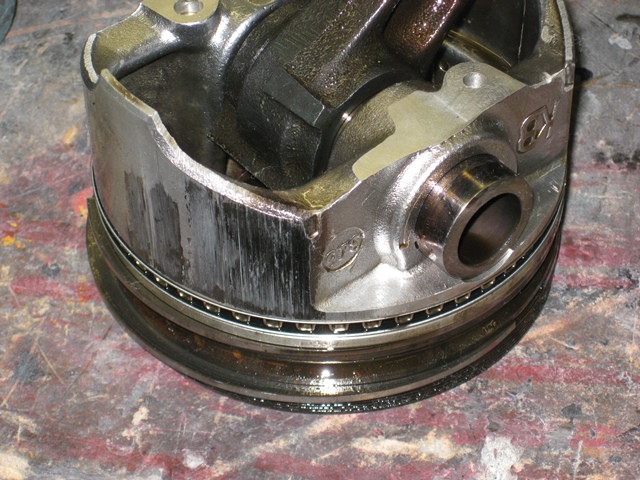
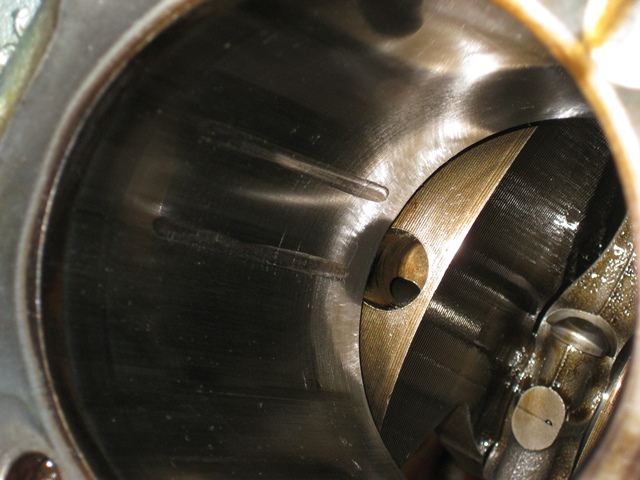
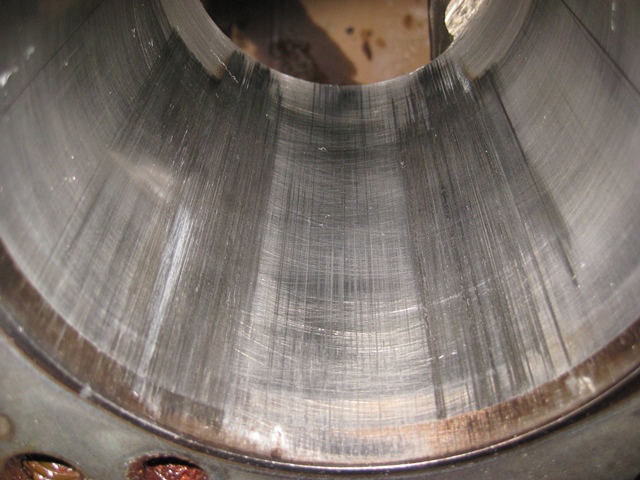
What would cause a wrist pin to come loose in the rod? The engine developed a knock and upon tear down I found that the wrist pin had moved back against the cylinder wall and gouged two grooves in it. It's a factory 68 400 with the exception of 9.5 pistons and a mild cam. The engine has 1,000 miles on it since a complete rebuild.
A little background:
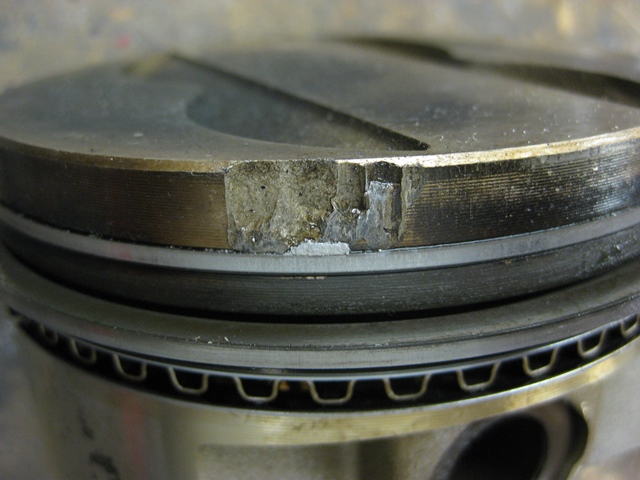
There have been two sets of pistons installed recently. The first set was during the first rebuild, 7,000 miles ago. The second set was after the engine overheated and the engine rebuilt again. The overheating caused piston and cylinder scuffing on two cylinders. The majority of the damage was with the same cylinder as the loose pin. The adjacent cylinder also had a little bit less scuffing.
I'm thinking the overheating had something to do with it. I'm wondering if the machine shop should have detected a little bit less force required to remove the damaged piston. I'm sure if the overheating did in fact cause the loose pin, it should have been noticed then.
At this time, the pin is loose enough to be pushed out with light tapping.
Who knows what caused it but it sounds like the smart thing to do is to install at the very least one new rod(I, personally, would consider a whole new set). Sounds like the piston was rocking around in the cylinder and eventually loosened the pin in the small end and then the pin started to travel. How did the skirts look on that piston? My guess is they were all scratched up where they were making contact with the walls. If it's bad enough for a bore you're looking at new pistons anyway. If it's just the one and you can find somebody good enough to sleeve it you might get off using most of the stuff you already have and a few new parts. I wouldn't take it on any long trips though unless you've got great towing.
When the motor was rebuilt were the rods recondition? The big ends should have been cut along with the caps, than honed to make it round, The small ends are heated than the new wrist pins are pressed in by hand. The pins should not have walked. You may want to think about new rods or ask who did the machine work if the rods were redone an checked that they were good.
Yes, they were reconditioned. The shop said they were "perfect" as I recall.
Since the problem pin and rod are in the same cylinder that was scuffed from the overheating episode, it sure seems it might have something to do with that. Might just be a coincidence, but that's the angle I'm going to use when I show them the damage. Maybe they overheated it when they installed the pins. All the rods seem to have the same discoloration from the heat, (If that's normal).
If excessive heat is a possibility, I don't know how hot the rod could have gotten when the engine overheated compared to the temps they put them through to install the pins. I suppose overheating them might make the end soft and then the hole could enlarge over time.
Yes that one rod is definitely trash. The piston is also scuffed and the pin bore is worn all to hell. A new set of rods is good insurance. I have no idea what the old ones have been through.
I'm thinking of asking them do some "test" presses to see if it takes less than the usual pressure to cold press the pins out of the other rods. If they start moving at a lesser pressure, then I'd say it's obvious they are ready to walk too.
The cylinders are already .060" over so a sleeve is in order. I'd hate to trash the block as it's numbers matching.
Without getting too detailed, sounds like some marginal machine work to me. Which number cylinder? How hot did the block get? Was the overheating because of a coolant issue or from the piston itself? Can you post pics of the piston, pin, wall?
If I were you, I would pull the block and find another to rebuild.
Once you grenade a block, there is no going back. If you have a very nice numbers matching car, the difference between having a usable correct block and not can be a difference of $3000-5000 if you choose to sell your car.
Si Vis Pacem Parabellum
1967 Starlight black PMD Engineering 400 Auto 1968 Alpine Blue 400 4 speed 1968 Verdoro Green 400 HO 4 speed 2013 1LE 2SS/RS Inferno Orange Camaro.
What Banshee said. It's usually a good idea to pull your numb match motor out and mothball it and use another if investment is a concern. Yours being bored that far already you might not have too much choice anyway. It sounds like you might be in for new parts for the build anyway. I don't really think the engine overheating had anything to do with it. The kind of heat it would take to fatigue cast or steel is way beyond the kind of heat generated when you boil over. Now, the kind of heat generated when parts fail IS enough sometimes to create this kind of havok.
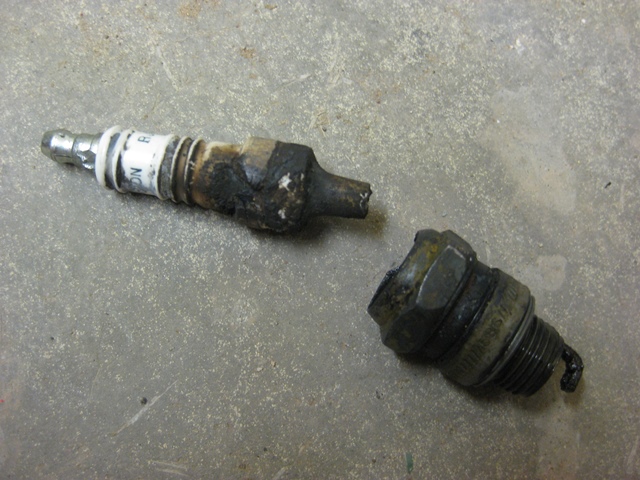
It was the #8 Cylinder on both episodes. The block overheated from a coolant leak. But, unfortunately, with no gauges I have no idea what the temps got up to. I wasn't driving it at the time. It got hot enough to blow the spark plug porcelain out, loosen up a couple exhaust valve seats, weakened all the springs, severely scuffed the #8 and #6 pistons/cylinders and froze the rings.
Surprisingly, there was no head or block warpage.
I'm not sure what they could have done other than overheat the rods when the pistons were installed. Maybe they honed the small end and while they were at it, too much ?
Still no word from the machine shop yet. In an earlier post, I mentioned the rod dis-coloration. This leads me to believe they were over heated, thereby causing the metal to soften. Is this normal?
The piston to wall clearance too tight or was out of round..
Heats up, pin becomes loose and walks out of the pin bore.
Scenario 2
Hell, I can't think of another plausible scenario.
Man, I'm sorry...I have so many different ideas/reasons flying through my head. Without having my hands on the parts and looking at them can I only speculate.
Crap like this is what I do for a living...yet only works when you can see for oneself and measure bore, journals, check pistons etc.
I learned a VERY valuable lesson a long time ago.
If you have an issue with an engine when it fails...tear down and rebuild the entire block. Don't mix/match pushrods, rods, pistons. It's like putting a crank in a block that you had to scavenge main caps from another block because you lost the originals.
You just can't use caps from another block without checking the alignment of bore. Can it be done? yes..will the engine last long? maybe...but I doubt for long.
Point?
If you throw a bearing but did not damage any journal surfaces...replace ALL the bearings. If you throw one rod bearing, replace ALL of the rod bearings. Hell, I would tear down the whole engine..and sanitize the whole thing..but you can get away with cleaning and soaking the block and just replacing the rod bearings. Is this proper or correct? depends..
Off my soapbox.
Advice? Measure twice, cut once.
Si Vis Pacem Parabellum
1967 Starlight black PMD Engineering 400 Auto 1968 Alpine Blue 400 4 speed 1968 Verdoro Green 400 HO 4 speed 2013 1LE 2SS/RS Inferno Orange Camaro.
Spark plug blown out? Can't think of a reason for that other than a hydraulic lock. I wonder if a pile of water got into the cylinder and then did damage on start up>
You are right, I will be basically rebuilding the engine for third time. With a sleeve in order, I tore it down to the bare block for repair, (.060" over already) I will be looking at a new set of rods as I don't know their history, (or if the other pins are loose too. I plan on experimenting with my press with a little pressure to see if it appears that the others are right behind this bad one).
I don't if the rods were bushed as I have never seen them apart from the pistons. I never thought of that. Is that a normal repair to resize the small end?
On the spark plug, that still has me scratching my head. There was no head gasket leak. It happened on the highway apparently as a result of overheating. There was nothing left of the center electrode; it was burned pretty good.
Did you replace your distributor and/or camshaft on the first rebuild? Is ther any possibility that this cylinder is running more timing advance than #1 cylinder? Possibly poorly ground cam causing different cylinder pressures? I know these are longshots