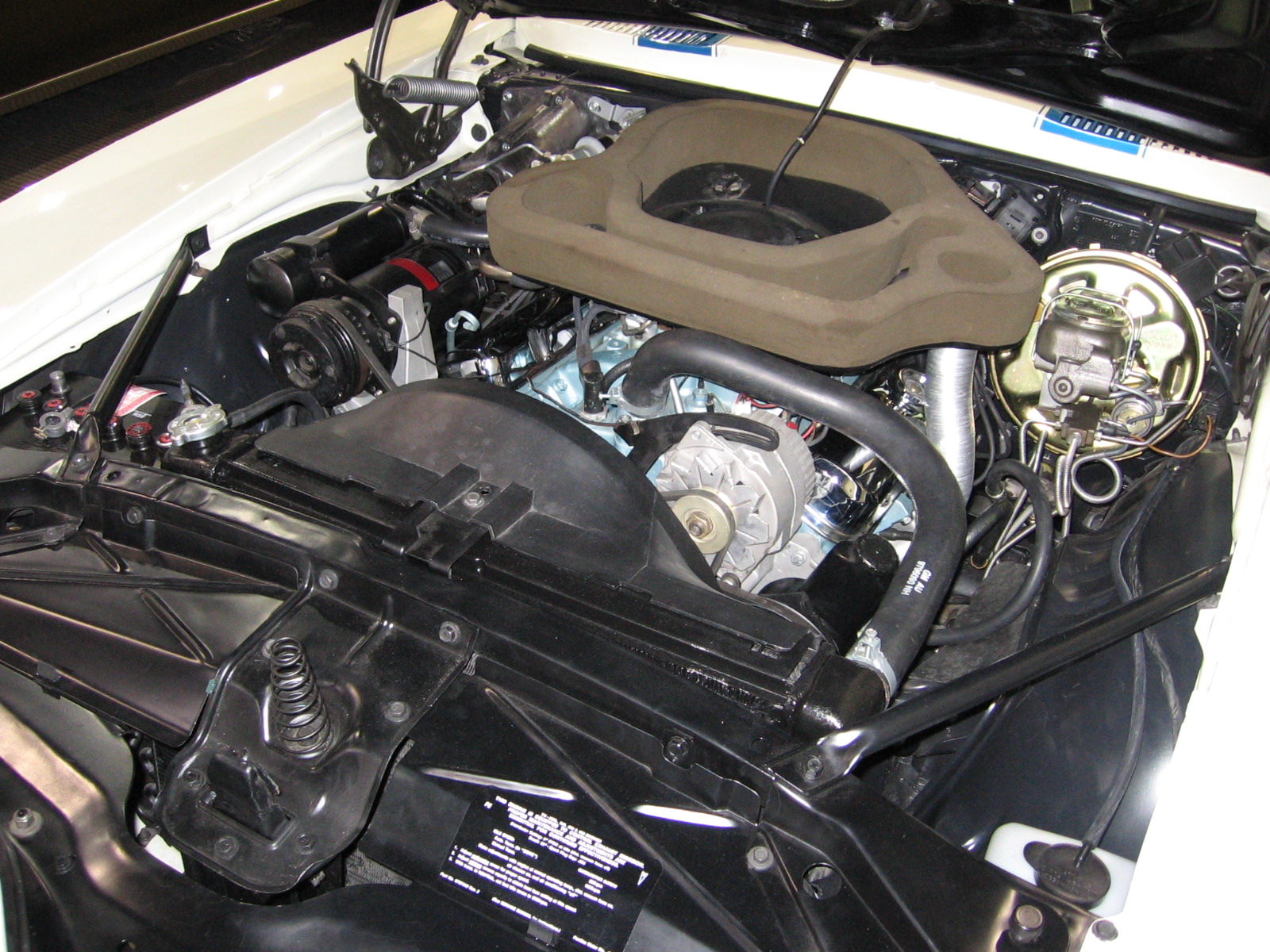
I have the front end of the odor apart and I am cleaning up a bunch of parts with new engine paint and Rustoleum Black #7777 which is supposed to be 60% gloss. The pulleys (steering pump pulley, water pump pulley, fan) are all getting the 7777 60% paint and it does look great.
After I get this project completed I a going to respray the rest of the motor with engine paint (Duplicolor 1616) and I am then going to paint the firewall, inner fenders, exposed subframe, battery tray, etc.
I am staying with rattle cans and have it down to two mgfs. Rustoleum and Krylon.
What I am needing is advice on what paint to use for the other parts and areas. The firewall is nowhere near 60% gloss and I doubt even was fro the factory. I would like to use something that will obviously clean it up but also have a look of a 45 year old driver.
Of these two mfgs which of their paints would be a good flavor to go with?
ETA: The subframe and suspension on my car has the typical rusty orange dusty white rusty stuff all and I would like to know f you guys clean that stuff up or do you spray right over it. FWIW I am not interested in taking this stuff apart and this is NOT a show car and will NEVER be entered at a show.
I have always used krylon with great results, but this next car I am doing I'm going with a spray gun and a single stage paint. Ends up more cost effective and durable than the 2 cases of rattle cans.
I used the rustolium for all the touchups on my '67 (body shop used chassis black epoxy) and it matched very well. I used it for the firewall and frame too.
I'd say at a minimum you should wire brush and wipe clean with grease remover before painting. I would not paint over anything that you can remove as it will not last very long.
I agree with chief that it may be more expensive with the rattle cans, but it is easier doing one area at a time like you describe.
I used to be indecisive. Now I'm not sure. I feel like I am diagonally parked in a parallel universe. 1968 400 convertible (Scarlet) 1976 T/A - 455 LE (No Burt) 1976 T/A New baby, starting full restoration. 1968 350 - 4 speed 'vert - 400 clone (the Beast!) 1968 350 convertible - Wife's car now- 400 clone (Aleutian Blue) (Blue Angel) 2008 Durango - DD 2008 GXP - New one from NH is AWESOME! 2017 Durango Citadel - Modern is nice! HEMI is amazing! 1998 Silverado Z71 - Father-daughter project 1968 400 coupe - R/A clone (Blue Pearl) (sold) 1967 326 convertible - Sold 1980 T/A SE Bandit - Sold
Alrighty. There are tons of threads on the interwebs about this paint and there even more opinions lol. I have it down to the NAPA paint and the Krylon Rust Tough paint. One of these will work since I am not going to try another ten flavors. I will spray some out and see what matches the OE black on my car and run with it. Will post my results.
I am happy to provide you with what I have been "told" is correct on all engine parts regarding % gloss. For instance, firewall is 30% gloss (so 70%) flat).
Marc, one more thing to remember, which a lot of resto shops overlook. Pontiac did not paint the engine compartment all at one time. A lot of resto shops make this mistake. Shooting the entire engine compartment one shade of black is of course easier, but when these cars were rolling down the assembly line, various parts were sourced from different suppliers.
The firewall is indeed 20%-30% gloss, but other components, like the inner fenders, core support, heater box, wiper motor, etc. were all sourced from different suppliers, and they used varying shades of gloss black. In fact, sometimes the level of gloss varied by batch and week produced.
I think just a general guideline of black levels is good for 99% of us. But if the heater box is a slightly different shade of gloss than the inner fenders or wiper motor, don't fret, just let people know that's the way they made them.
There's nothing specific I've seen relating to First Gen Firebirds, but the GTO Restoration Guide has a lot of info.
The assembly process for all GM cars (aside from Corvette) was pretty much the same. The body came from Fisher, while the other components, like the heater box, etc. were sourced from different suppliers. There was an excellent article in HPP a few years ago that focused on a Scott Tiemann restoration, and he listed some details about finishes under the hood of a 70 Judge. I think that's when I first realized, by looking at original road test photos (in b&w) of 67-69 Birds, that many "black" parts did indeed have different shades of black.
I'm fortunate enough to have my friend Dave Armstrong's 1969 Firebirds to use as a reference. His cars are perfect, and they've won national Pontiac shows, including the Top Honors, overall #1, at the 2009 POCI/GTOAA show. Amazing, considering that show was about 70% GTO's and Judges, and had 1,024 Pontiacs! I've taken many photos of Dave's pristine 1969 Firebird 400 RA ragtop, and his 1969 Firebird 400 hardtop. Nearly every part on his cars is NOS.
This is probably the most fascinating article ever created about the assembly process. Thanks to the Camaro Research Group for this.
Rattle can paint is not as good as spray paint, however, you can get the same paint the prof use in a custom spray boom. Eastwood even setup there cans with hardener.
Prep is the most important step.
1. Clean surface area with soap & water 2. Clean surface with degreaser 3. Clean surface with surface prep cleaner 4. Then start sanding/body work 5. Surface prep exposed steel with metal prep and etch 6. Clean surface with surface prep cleaner 7. Prime surface 8. Topcoat /wo sanding (if within same day)
If you skip this process don't surprised to see the paint wash away within a few years.
I can send you photos of what your a quick paint job will look like with poor preparation.
I think that's when I first realized, by looking at original road test photos (in b&w) of 67-69 Birds, that many "black" parts did indeed have different shades of black.
Was it differet shade or was it the % of gloss. I use the PPG flattening agent to dull out the gloss, it comes down to trial and error on a few test pieces to achive the correct gloss.
I have four different sources for advice on shades of gloss and the best is from a GTO publication (HPP I think). I know that the heat box was gloss and the firewall flat to no gloss. I have been restoring piece by piece pulleys/air cleaner/volt reg cover/radiator/etc. Since my car is 100% original (driver) I am trying to stay with paints that keep a little aged look (not to much gloss) but cleaning up the car overall.
At the same time I do not have the funds to pull everything apart, professionally shoot it, to then drag to a show and try to win trophies. My goal is to have and drive it with it cleaned up and running smooth all by my hands.
If I can find the digital copy of the GTO article I will post it.
That was the article I was thinking of! Glad you found it, and thanks for posting.
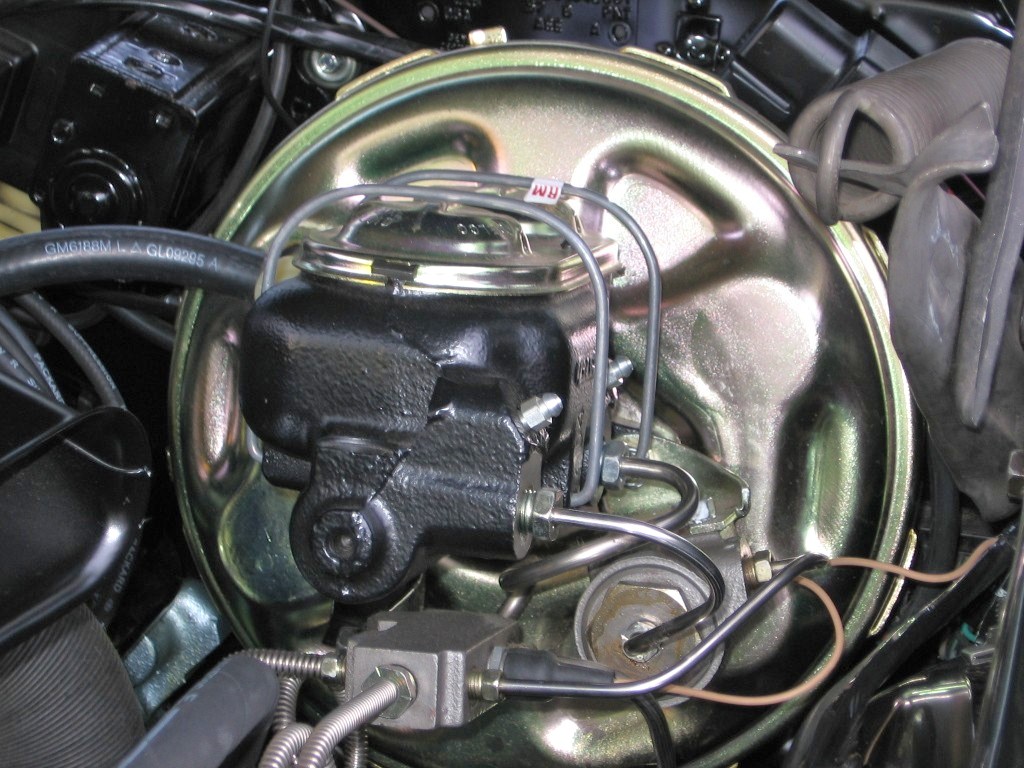
About the only thing I noticed that was different for the 1969 Firebird (over the list above) was that 1969 Birds master cylinders were black (about 60% gloss), not natural.
That was the article I was thinking of! Glad you found it, and thanks for posting.
About the only thing I noticed that was different for the 1969 Firebird (over the list above) was that 1969 Birds master cylinders were black (about 60% gloss), not natural.
[b][/b]
Really! What about the brake lines? LOL I painted the master cylinder 25 years ago because it was rusty and never knew they were supposed to be painted.
Looking at original underhood pics. Also, some of these guys have researched the assembly process quite thoroughly, and some have NOS master cylinders. The Firebird m/c was a different style than the A-body. It was fatter and lower, probably for hood clearance.
My master cylinder is actually a natural cast color (which I cleared using satin clear), and I've been meaning to paint it black.
Here's a correct master cylinder on a 69 Bird 400.
SB, Thanks for the picture! It looks like the brake lines are supposed to be natural and the master painted black. You mentioned using a matte clear? What brand and where did you get the matte clear? I can send you a copy of the GTO gloss file if you send me your eail.
Marc, I just cleared the natural gray master cylinder (which was new repro) using clear engine paint, I believe it was VHT or perhaps Dupli-Color. Like I said, my master cylinder is not correct, it's supposed to be black. The pic I posted above is from a show winning 1969 Firebird 400.
I do not pictures at the moment but I have tested the NAPA Underhood Black #7242 and Krylon Rust Tough Semi-Flat Black #RTA 9203.
The NAPA paint by far is a closer match to the Firewall. This was the one that has been the most difficult to match. It has a little touch of brown that matches the patina and flat color of the firewall.
The Rust Tough Semi-Flat Black has almost a touch of a purple tint to it and is nowhere near correct. I do not see anything that it matches to the car at all.
I remember going through something similar. The Krylon Rust Tough Semi-Flat (which is good paint) is much flatter than Dupli-Color Semi Flat Black. If I recall, I would say the Krylon is about 40% gloss, the Duplicolor is 60%. I made the mistake once of spraying about 5 brackets with Dupli-Color, then one bracket with Krylon (after I ran two cans of Dupli-Color dry), and they didn't match.
So I wouldn't forget this in the future, I took a few thin sheets of aluminum and cut them into squares about 2" x 2", sprayed them with literally all of the various spray cans I have on my shelf, then taped each piece onto the appropriate cap. I got tired of always guessing the differences between flat, semi-flat, semi-gloss, and gloss between the manufacturers.
Looking at original underhood pics. Also, some of these guys have researched the assembly process quite thoroughly, and some have NOS master cylinders. The Firebird m/c was a different style than the A-body. It was fatter and lower, probably for hood clearance.
My master cylinder is actually a natural cast color (which I cleared using satin clear), and I've been meaning to paint it black.
Here's a correct master cylinder on a 69 Bird 400.
This is interesting. Where the 68 masters black or natural. Mine is natural now.
I remember going through something similar. The Krylon Rust Tough Semi-Flat (which is good paint) is much flatter than Dupli-Color Semi Flat Black. If I recall, I would say the Krylon is about 40% gloss, the Duplicolor is 60%. I made the mistake once of spraying about 5 brackets with Dupli-Color, then one bracket with Krylon (after I ran two cans of Dupli-Color dry), and they didn't match.
So I wouldn't forget this in the future, I took a few thin sheets of aluminum and cut them into squares about 2" x 2", sprayed them with literally all of the various spray cans I have on my shelf, then taped each piece onto the appropriate cap. I got tired of always guessing the differences between flat, semi-flat, semi-gloss, and gloss between the manufacturers.
That's a GREAT idea! I'll look at the HD store to see how cheap I can find some plate. Not only that but a 2x2 swatch is easy to take to the car to check for samples.
I do think I have the rattle cans down for gloss, semi gloss and flat at the moment. Since this IS NOT a show car I have been trying to keep the car as close as possible to OE on a super low budget. These paints are not perfect but I have been checking around any other forums and these seem to be widely accepted.
As soon as I get some good samples and pictures I will post the colors.