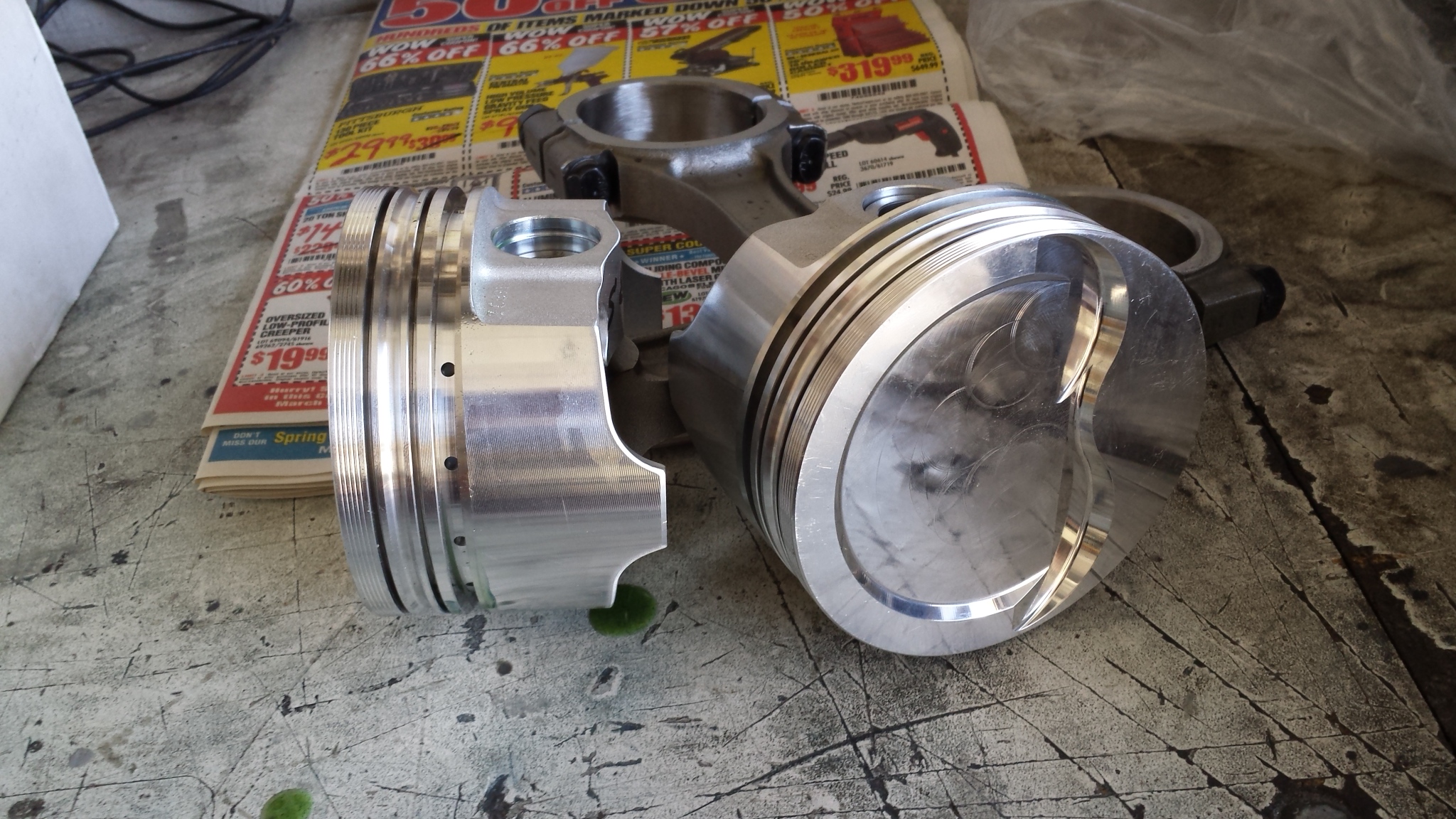
Can someone with more knowledge then me , please give me an idea of the compression ratio i could expect with #16 (k067) heads on my stock built 400 . It has standard bore pistons (4 valve reliefs) , Comp XE268H 51-232-3, lifters, springs, p/rods, t/chain and 1.5 Comp roller tip rockers. Ive used the Butler calculator and come up with 9.5 and 8.4 static.(im using Felpro head gaskets) Does this sound right or am i doing something wrong ?
Would 9.5cr suit pump gas (roughly 95 octane or 91 octane)
The static may be between 9.5 & 10:1. But that cam is one of the "steep ramp" cams, which will increase cylinder pressure. It could be borderline detonation, with 91 or less octane(93 is the highest in my area), depending on timing, quench distance, sharp edges in the chambers and valve reliefs, etc.
You MUST know ALL the specs, in order to get a good est of the static compression. There is no way to determine, for sure, without actually measuring some of the specs needed..
1968 400 Coupe, verdoro green, black vinyl top, auto 1969 GTO Judge coupe, Carousel Red, manual 1971 Trans Am, cameo white, auto 1970 Buick Skylark Custom Convertible 350-4(driver), Fire Red, white top, auto 1972 Buick GS Stage 1, Royal Blue, black vinyl top, auto
Your are on the high end of what I've seen for 16s. I've usually seen 75-76 ccs. Okay, my sample size is 3 sets.
1968 400 Coupe, verdoro green, black vinyl top, auto 1969 GTO Judge coupe, Carousel Red, manual 1971 Trans Am, cameo white, auto 1970 Buick Skylark Custom Convertible 350-4(driver), Fire Red, white top, auto 1972 Buick GS Stage 1, Royal Blue, black vinyl top, auto
So it looks like it will be too close. I ran the numbers through the calculator that Wovenweb (thank you) sent a link to, and came up with 9.6. (as 'oldskool' points out.) What is the best way for me to lower the static compression ?, 2 head gaskets, head work ( again) or find another pair of heads with larger chambers ?
The other and likely cheaper option is to change cams...
1968 400 Coupe, verdoro green, black vinyl top, auto 1969 GTO Judge coupe, Carousel Red, manual 1971 Trans Am, cameo white, auto 1970 Buick Skylark Custom Convertible 350-4(driver), Fire Red, white top, auto 1972 Buick GS Stage 1, Royal Blue, black vinyl top, auto
"What is the best way for me to lower the static compression ?..."
If it is indeed only 9.6, I'd go with a cam change. A cam with around 290 advertised intake duration will bleed off some of the cylinder pressure, thus making the engine more pump gas friendly. This would be cheaper than $500 dish pistons. Also, if you change pistons, you'll need to have the assembly balanced again, plus new rings, hone, etc. I would assume that it would cost you around $1000 or so to change pistons.
The cheapest small cam, which I believe would lower dynamic comp, for pump gas use, is the Summit 2801. It has 288/298 adv dur. It is similar to the Pontiac "068" grind, but with more lift. I'd consider it a good all around cam, for a mild street 400, with between 9:1 & 10:1 static comp.
I'll also add that if you get up closer to the 10:1 number, with iron heads, you may need even more advertised duration, to avoid detonation. There are lots of guys who have been running 10:1 for years, without problems. But, they have long dur cams and they keep the timing and carb in tune, to avoid problems. Most engine builders recommend around 9.5 max static, to stay safe.
Would also be a good idea to enlarge the chambers slightly. Just some minor grinding and removing sharp edges, will reduce static slightly. No need for a full head porting job. Using 78cc chambers, in the Wallace calculator, brings the static down to 9.33. 80cc chambers reduces static to around 9.16.
Again, I'm using these numbers: 4.12 bore, 3.75 stroke, 6.7 valve reliefs, .039 x 4.3 Fel-Pro #1016 gaskets, & .020 deck height. So, if any of the ACTUAL numbers differ, then, obviously, the ACTUAL static comp numbers will differ from those I got. For example: If you have the Speed-Pro L2262F pistons, they have a pin height of 1.714. This will reduce the deck height by .014, over a piston with a stock pin height of 1.7. It's recorded that many Pontiac engines came with .020 or a little more deck height. So, these pistons should reduce the deck height to somewhere around .006 to .010.
Then, if the block deck has been surfaced any, that would further reduce deck height. But, if the rods have been resized, they are slightly shorter, which will increase deck height slightly. So you see, EVERYTHING must be measured, in order to ACCURATELY determine static comp.
One other option is to switch to E-85, If it is available in your area. It will handle 10.5 comp with no problem. Lots of guys have switched. So, there is lots of online E-85 info. And, there are lots of E-85 carbs on the market.
If you don't do a lot of daily driving, and you are worried that you may have a bit too much comp, you may wanna add a couple of gallons of racing gas to your pump gas. Last I checked, 108 race gas was about $10 per gal in my area. But, since pump gas is down to under $2 per gal, a gal or 2 of race gas, may be a better solution for some, than a cam, and especially a piston change.
But, if you decide to go the dish piston route, a custom Auto-Tec / Race-Tec piston will be slightly cheaper. And, you can have the pins located to provide near zero deck height. That way you can have a good quench distance, without cutting the block deck any.
I will avoid going down the path of changing pistons because these are new and if i do another rebuild it will be taken out to 463 ci. l guess the cam change is the answer ( shame really, this XE268H pulls hard even with stock 7j2 heads, and sounds great).. We do have e85 around here (somewhere) but again, the Holley is new.
Im not sure of engine specs as this was rebuilt 2+ years ago by the person i bought it from. He did say it was built to factory specs with stock parts on a std bore. I threw the cam/lifters in as they were excess from a 79 T/A build.
Do you think chamber work alone will see me right? ...nothing major, only minor blending and cc'ing each chamber for consistancy, because that is easily do-able as the heads are on the bench
"...Do you think chamber work alone will see me right?..."
Any amount you add to the chamber size will reduce the static comp. As said, the ACTUAL final cc size is the number that counts. And there is no way to know that size other than to actually measure the chambers.
And that "factory specs with stock parts" deal, could mean lots of different things. One site I found says that most Pontiac engines came with .023 deck height. So, did they leave it at .023 ? Or did they cut some off the block deck ? Did they resize the stock cast rods. These things affect the static comp.
Also, you mentioned 4-relief pistons. The 8-eyebrow pistons will reduce comp. The L2262F Speed-Pro pistons will increase comp, over original stock pistons and the 8-eyebrow kind.
So, depending on EXACTLY what all the specs are, you may not need to enlarge the chambers any. Since the heads are off, you can measure the deck height, and get the part number off the top of the pistons.
I put that cam in a 68 GTO and it worked out great. The owner was looking for a smooth idle and a car to just cruise around town. Worked great with a stock torque convertor and 2.56 gears.
Dynamic compression is the number you should be concerned with rather than static. And, like others have already stated, unless you have actually measured all the components you are theorizing the results. Measure the volume of the chambers, deck height, valve reliefs, etc. to get exact numbers to calculate the compression ratio. Plugging in numbers obtained from a spec sheet gives you the compression ratio of the engine from the spec sheet, not yours. I measured everything the last time I disassembled an engine and not one measurement was close to spec. Remember, cylinder pressure is key. The higher the pressure the more chance of detonation. Compression does not start until the intake valve closes, knowing exactly when, in terms of degrees before or after bdc, the valve closes is paramount in determining the dynamic compression ratio. Your choice of camshaft no only determines the dynamic CR but also the rpm at which you will obtain peak power. I use a camshaft with a duration at 50 of 230-236, if I replaced the shaft with a duration of 236-240 the dynamic CR would be lower but the rpm at which I would obtain peak power would be higher. I would also expect a higher overall HP value and the torque value would lessen. Good quench helps to reduce detonation. I've never used Icon pistons but the ones shown above look like they have a good quench pad as well as a nice dish to reduce pressure. Just my thoughts, I'm not an expert.
Complicated subject, but Oldskool gave a nice short def as you asked. There is a lot of discussion around this subject and a lot of it on just the definitions of the different names of the event. Detonation, knock, pre ignition, surface ignition, pinging, pinking, spark knock, post ignition, etc. An event where the fuel air charge within the combustion chamber does not ignite at the appropriate time and/or does not burn in an orderly manner. During normal ignition the charge does not explode, once ignited by the spark plug the charge burns with the flame front moving across the combustion chamber in an orderly manner, until all the charge has been consumed. The time of the burn is as important as a proper burn. One usually aims to have the peak pressure at a certain degrees atdc for maximum work. In an engine with a proper charge ignition and burn rate the position of the peak pressure is controlled by the spark timing. Say 18 degrees btdc depending on the burn rate and the shape of the combustion chamber. If the combustion is not orderly with abnormal burning, the time of the peak pressure will not be controlled. Abnormal fuel air burn can be grouped into Pre-ignition or detonation. Detonation is the spontaneous combustion of the charge remaining in the chamber after the spark plug has ignited a normal burn. This spontaneous combustion will cause a sudden pressure increase. Detonation can be heard as pinging or knocking in the engine. Pre-ignition is the spontaneous ignition of the charge before the spark plug ignites. This causes a pressure build up before the piston has moved towards the top of the cylinder. Pre-ignition can cause serious damage quickly. Most of the time people refer all abnormal ignition burns as detonation. Not that it matters what you call it, detonation/pre-ignition is something we strive to avoid.
Some causes are: High compression ratio; lean mixture; fuel quality; timing; charge temp; incorrect spark plug; high engine operating temp; chamber design; carbon deposits; cracked plug; burned valve; high cylinder pressure; poor condition of internal components;etc.
Some results are: Overheating; bearing failure; burned valves; holes melted in piston tops; broken ring lands; seized rings; blow by; engine failure.
Too often builders chose a compression ratio then try to find fuel or adjust timing to run the engine, it's best to build the engine to suit the available fuel. If that requires a low compression ratio, so be it. One loses more power by backing off timing than lowering the CR.