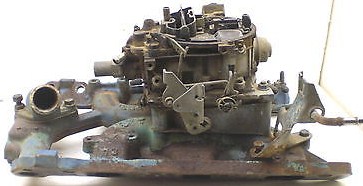
Stock 1969 Firebird 2bbl 350 that I put a Edelbrock performer intake on with a Holley 670 dual feed carb on top. I was told that I likely overcarbed the motor and I want to just buy something that I can bolt on and be done with. (just want a reliable street cruiser)
I have been told that getting a rebuilt Quadrajet is the best way, but I have an amazon gift card that I prefer to put toward the purchase of a carb so I can save money. This narrows my options to likely edelbrock or holley. Just need to know which one is the best application for a reliable cruiser close to stock as I can get
The CFM Calculators I have tried using online tell me to get a carb that is about 400-500 CFMs. Is that correct? I am guessing that my car's factory specs were the 265 H.P. V8-350 4600 RPMs on this website
He's done two Pontiacs for me and I will have him do at least one more for a Buick 350 build.
1968 400 Coupe, verdoro green, black vinyl top, auto 1969 GTO Judge coupe, Carousel Red, manual 1971 Trans Am, cameo white, auto 1970 Buick Skylark Custom Convertible 350-4(driver), Fire Red, white top, auto 1972 Buick GS Stage 1, Royal Blue, black vinyl top, auto
Maybe sell the gift card? I'm too partial to rebuilt quadrajets and have a good rebuilder who lives just up the road.
X2- I would get one from a reputable builder like cliffs or from someone that comes recommended first hand like wovenweb not from just anyone on ebay. I think you might be happier in the long run IMO.
Last edited by Sleddog; 01/31/1602:09 PM.
Cant wait for summer... 68HO4004spvert Sleddog Iowa
God Bless the men and women past and present that have served this country. Thank you. Support D.A.V. - it helps gives a life back to those who gave so much for us.....
Actually, a lot of Amazon sellers offer rebuilt Q-jets. I can't vouch for the quality of any of 'em. But there are lots of choices. Don't know if your Amazon card can be used to buy from Amazon sellers or not. But the Amazon store card can be used, including interest free, for 6 months.
If you don't mind rigging up the throttle linkage and running the return spring to the front, you can use a Buick or Olds carb. There is even a Chevy truck carb that had a front inlet.
Also, if you don't mind plumbing for a side inlet, they offer a lot of Side inlet models, including the Jet brand, which have a fairly good rep. They also have Jet brand front inlet Q's, though they don't look to have Pontiac type throttle linkage. Might require some riggin, to hook up the throttle cable.
Everybody that I've heard from has said Holley carbs normally run real good right out of he box. I really don't know what sizes the come in but I would say you should be good around 500-650cfm. Something wrong with the Holley you have? The motor is only going to use as much fuel as it needs. If your Holley is in good shape it should be able to be adjusted to run fine on your motor. Ask around to see if anybody in your area is good with carbs. Probably only take a few minutes to tweek it or drop some smaller jets in and you will be good to go.
1) is your engine running well? If it is, why change it. 2) What do you mean by " double feed"? Is it a " double pumper"?...or does it have vacuum secondaries? ...with dual fuel inlets(front/rear)?
If it's a double pumper, it's force feeding your engine fuel when you stomp the accelerator. If it has vacuum secondaries, the engine will pull what it needs. Depending on model, You can adjust with jets and springs.
While I agree the Qjet is the way to go for a cruiser, I have had good luck with the Edelbrock ... If you're looking for a "decent" running street cruiser.
Now, performance is a whole nudda' thing! 😉😎
I'm a hobbyist. Not a professional. Don't be hatin'!
Personally never had a holley that ran bad. Also did all the tricks to Q Jets and got them to run decent but the HP series holley is hard to beat for all out performance.
ive tried just about all the "name brand" carbs... holley has always treated me the best.. edelbrock 1406 has always treated me pretty good for right out of the box...
Thanks guys. I probably just go with a quadrajet and spend the amazon gift card on something else.
The consensus seems to be that I should be looking for a carb with about 600 CFM but how does one calculate that? How can you find max RPM without a tach?
If you look at my previous posts some said that my 670 holley street avenger may be too much carb and bogging down the engine. The model is an 80670 double pumper. I believe it is vacuum secondaries. Could be that it needs to be rebuilt from sitting (it sat for some years) but the rebuild shop quoted me as much as it would cost to buy a new carb so I opted to get something better suited instead of rebuilding it.
As for seeing how my car runs, I posted a quick video showing what I mean about acceleration hesitation. When I come from a dead stop and steadily accelerate on the pedal, you'll notice a pause where the engine "cuts out" . I am not moving my foot off the gas or flooring it. Sometimes the engine will die if it stays in that period for too long.
The Street Avenger is not a "doubler pumper" it has vacuum secondaries. Can't be both.
Those secondaries can be adjusted by changing the spring that controls its rate of opening. A 670 cam just ain't that big. You can save some $$$ by bringing to a good shop and have them tune it for you.
I'm a hobbyist. Not a professional. Don't be hatin'!
Bronze Bird, you just might be onto something. Mentioning the spring jogged my memory to about 15 years ago when initially installing this carburetor- I vaguely remember installing a spring that deliberately opened the secondaries later, to 'save on fuel' and through the years misplaced the other set of springs. Perhaps a secondary diaphragm spring set is in order. thank you
Stock 1969 Firebird 2bbl 350 that I put a Edelbrock performer intake on with a Holley 670 dual feed carb on top. I was told that I likely overcarbed the motor and I want to just buy something that I can bolt on and be done with. (just want a reliable street cruiser)
I have been told that getting a rebuilt Quadrajet is the best way, but I have an amazon gift card that I prefer to put toward the purchase of a carb so I can save money. This narrows my options to likely edelbrock or holley. Just need to know which one is the best application for a reliable cruiser close to stock as I can get
The CFM Calculators I have tried using online tell me to get a carb that is about 400-500 CFMs. Is that correct? I am guessing that my car's factory specs were the 265 H.P. V8-350 4600 RPMs on this website
You have a 2bbl with a 2bbl cam and 2 bbl gearing and 2 bbl manifold....and heads were small valve #17 (1968) or 47's (1969)
Unless you get bigger...meaning bigger heads and cam, will you extrapolate the need for ONLY replacing the carb and intake.
So, yes, in theory, you are inducing more air flow than the engine can efficiently handle.
The 350 HO had 2.11/1.77 intake/exhaust valves and were code #18 for 68 and #48 in 69. The Intake/exhaust on the 350 2 bbl were 1.96/1.66.
Unless you change the heads and cam to compensate for the additional flow...will you see a true performance benefit...All you have without changing anything else is a cool points 4 bbl carb and manifold that for lack of a better word, will not perform wella t all, even with the most conservative settings.
Si Vis Pacem Parabellum
1967 Starlight black PMD Engineering 400 Auto 1968 Alpine Blue 400 4 speed 1968 Verdoro Green 400 HO 4 speed 2013 1LE 2SS/RS Inferno Orange Camaro.
"...The 350 HO had 2.11/1.77 intake/exhaust valves and were code #18 for 68 and #48 in 69..."
Not to split hairs, but just to try and keep all the engine info facts straight, all the sources I can find, say the #18 '68 350HO heads had small valves and press-in studs. So, basically, about the only difference between those and the #17 2-barrel heads, was the chamber size, and maybe valve spring pressure ? If I'm wrong, then I stand corrected.
FWIW a set of small valve heads can match or even surpass the flow of a big valve head with the proper valve job and valves. Don't toss your 1968, 1969 small valve heads they are not that bad.
Well I can't help but throw my two cents in. First a few questions: You put that carburetor on 15 years ago, did it bog off idle ever since? Was the car running well before you replaced the carburetor? It's a 67, does it still have all the pollution control stuff attached? It's 49 years old, chances are it may have been rebuilt in that time. Do you really know what camshaft, pistons, bore, head/block machining etc. has been done to or in the engine today? What is your rear gearing? What tranny do you have? What diameter tires?
First you have to know what you have and what your intended usage will be before you can really choose a carb. All those carburetor selection charts will tell you the max cfm you need for a particular rpm not necessarily what you will use. If you are over carbed with a Holley 670 you will be over carbed with a 750 or 800 CFM Rochester.
That Holley dual inlet vacuum secondary is a nice carburetor, you should be able to tune it to your car. The Edelbrock and Rochester carburetors are nice as well. If after all your testing you feel you need a smaller carb there's a Holley 570 Street Avenger as well as a 500 or 600 Edelbrock Performance Series.
There are many reasons for bog on acceleration, not all carb related. May I suggest you check all possibilities before you take that 670 off and replace it with a new one? We wouldn't want you to spend time and money installing a new carburetor just to have the same symptoms. First check you induction for any vacuum leaks, leaks will lead you to make carburetor adjustment to offset the the effects of the leak and in turn give you poor off idle throttle response and incorrect vacuum advance. Do a compression test, the results will inform you of possible internal engine faults such as worn rings, burned valves, worn camshaft etc. Check you timing and operation of the mechanical and vacuum advance. Check plugs and wires, points, distributor cap and voltage to the distributor when running. Connect a vacuum gauge then check needle movement while running, that may lead you to an otherwise undetected fault. Replace your fuel filters and test your fuel pump. Check your exhaust for blockage. And of course check all those things I've forgotten to mention.
After checking and correcting any other problems start diagnosing the operation of your carb. Measure the float height, check the operation of the choke, the accelerator pump, throttle linkage operation, throttle plates achieving wide open, operation of the secondaries. The secondaries opening too early would be a main concern. The secondary circuit can be tuned with the use of different springs but operation of the secondary vacuum system should be checked. If you cannot inspect all the carburetor functions yourself do you know anyone who would give you a hand? If not the Holley help line may be of service.
Now to the camshaft and heads, as stated above the car was built with the camshaft, heads, manifolds, exhaust and gearing to compliment each other. The stock camshaft and heads were not made for high rpm high HP. But you want a reliable street cruiser. The camshaft won't make big power at 7000 rpm but it will supply you with good torque at lower rpm, just what you need in a street cruiser. As for the heads, it's true big valve heads with large screw in studs, nice fast burn combustion chambers and high flowing ports are sought after for max power engines. But most of us don't run our cars on the racetrack and don't have all the other engine components to support heads like that. For your engine a head that has more velocity is most likely better for you than a head that has high flow volume. Your valves and springs are not going to cause your studs to dislodge and they flow enough to feed your street cruiser 350.
"...If you are over carbed with a Holley 670 you will be over carbed with a 750 or 800 CFM Rochester..."
Well, I'm sorry, but I'll just have to disagree with that statement. Both 750 and 800cfm Q-jets came on LOTS of 350's. Hey, some of the 301's even came with the 800's.
That's one of the great things about the Q-jet. If properly tuned, it will provide everything from good street manners for a DD 301 engine to plenty of fuel for a 450hp street 455, or 9 sec ET's for Super Stock drag engines. Even some of the OHC six engines had Q-jets.
No apology necessary, I agree a lot of smaller cubed engines came with and/or use larger carbs. There are a lot of 355s making big power running at high rpm and sucking down every cubic foot of air the carb will give it. It's not just dependant on cubic inches but valve train, induction, rpm, etc. You missed the word "if", I said IF you are over carbed with a 670 you will be over carbed with a 750 or 800. I do not think MJ69 is over carbed with the 670 Holley. The Holley is a good carburetor, I belive he/she will get it, and the rest of the engine, tuned and running the way he/she likes. I was stressing often the carb is blamed for problems when it may another component or system that is at fault. But there are some who have the bigger is better mentality when bigger isn't always better. A 1050 dominator sitting atop a big honk'n single plane intake on an 8800rpm big cammed engine is great, not so much for a small cubed small cammed runabout. Once again, just my opinion.
"...You missed the word "if", I said IF you are over carbed with a 670 you will be over carbed with a 750 or 800."
Actually, here is what you posted, and the only reason I disagreed.
"...If you are over carbed with a Holley 670 you will be over carbed with a 750 or 800 CFM Rochester..."
Notice the word ROCHESTER, at the end of your sentence. I just assumed that you meant Q-jet. IF this is the case, then you would not necessarily be over carbed with a Q-jet, regardless of what cubic inch the engine is. If a 750cfm Q will work on a straight 6, and an 800cfm Q will work on a 301, then I see no reason why a properly rebuilt and tuned Q-jet can not work very well on a 350 engine, or anything else between 301 and 455.
That's one of the big advantages of the Q-jet. Properly tuned, they provide only the amount of fuel/air mixture the engine can handle. Obviously, this is not the case with Holley type carbs. Therefore their cfm must be matched to the size and intended use of the engine. Of course, as always, this is just my take on the subject, and I am not an expert, by any means. But, I have run 750 Q-jets on 350, 400, & 455 street and race engines, with good success. And there is a lot of online info that agrees with what I am saying.
But, there are a lot of Holley guys out there, who badmouth the Q-jet and always will. So be it.
I agree with Bluebird428 and have made this mistake myself. Check vacuum leaks, ignition timing, advance, leads, plugs etc before spending money on a carb....shame to spend big money and solve nothing.