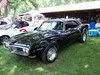
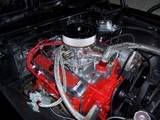
My 68 400 is overheating. New componenets: radiator, thermostat, fan clutch, water pump, water pump plates, engine completely rebuilt. Timing is at 9 degrees BTDC; fuel is appx. 98 octane. Fan belt is tight; fan shroud, and all 400/AC air diversion baffels are in place. I can't figure it out? Any additional ideas?
Over heating in traffic or while driving? Do you have a vac adv can and is it on ported or full manifold vac? If it's on ported, try swapping to full manifold. More advance will help it run cooler at idle. You could try richening up the idle on the carb as well. Did you "burp" the radiator after the rebuild? I'm having same issue, but I think on mine it's the fan.
This is a story I hear all the time from the various boards. Pontiac's apparently are notorious for running hot.
Since I live in the Valley of the Sun, I'm going to go straight to a Rodney Red aluminum radiator when I put my car back together.
2012 Mustang Boss 302 #1918, Competition Orange. FGF replacement 2006 Mustang V6 Pony, Vista Blue. Factory ordered. 2019 BMW X3 (Titled to the wife, but I'm always driving it for her. So I'm claiming it) Old projects, gone but not forgotten: 1967 FB 400, original CA car. After 22 years of work, trashed by the guy who was supposed to paint it. I had to sell it. 1980 Turbo Trans Am 1970 Mustang fastback, 351C 4Bbl, auto 1988 Mustang GT, 5 speed 1983 F-150 4x4, built 302 1994 Chevy K2500 HD 4x4, 454 TBI
It's overheating while driving at highway speed. I drove it about 15 miles last night to add a little racing fuel. It wouldn't turn over when I tried to restart; after it cooled about 5 minutes it turned over slowly and started. It sounds like the timing it too high; I'll try to back it off a bit and see what that does. Regarding the richness of the carb. The shop manual says to back off needles 5 turns from seated to begin setting procedure. I've got mine at about 4 full turns out. Does that sound right?
Too rich will make it run cooler than too lean, so starting out rich isn't as much of a problem. 4 Turns does souns like a lot, though. I'm used to starting at 2 turns then usually open them less than a turn after that.
When you shut her down, did it try to run on, or did she shut right down?
Thats odd, cars are supposed to run cooler on the highway??? At what temp is your car running? If you have a temp gauge watch it and see when the car starts overheating on you. It will tell you a lot about your problem. Does the car overheat only when driving at continuous highway speeds or is it a matter of time? I second the suggestion of "burping" the cooling system. Air in the system will also cause the engine to overheat.
How far away did you install the divider plates? I know it will cause an overheating problem if they are too far away from the impellers of the water pump. You can also try and lessen the clearance to improve cooling: http://www.wallaceracing.com/water-pump-mods.php
How do you know that it is overheating? Visable engine signs, warning light lit, or gauge shows temp? Could the gauge or sender be bad?
Again, I've driven mine 178,000 miles over 36 years and it overheated once, from a bad thermostat. One other time the light lit but the sender was bad. I drove in -30 to 100+ temps in all traffic conditions.
Also, if it turns over slow when hot that may be the starter overheated not the engine. Some people put shields over the starter for that. I've lived with the "hot starter" problem for 36 years.
It shuts down immediatly...no dieseling. I think the newly rebuilt motor is still very tight. I'll back down the timing to 6 degrees BTDC and see what that does and run it a while to let the motor loosen up. As far as the temp sender...I've got the gauge type in right now...waiting on a correct single prong unit. With this sender hooked up, my idot light comes on slightly. The engine still runs like a stipped ape. It burped about a half gallon out of the overflow hose.
Do you have a new/good 15 lb cap and running about a 50/50 antifreeze mix? If your not at pressure you'll boil over. At 15lbs of pressure the boiling point of the coolant raises to 258 degrees.
If you rebuild the engine it's going to be dry inside. When you fill up the radiator there will be air pockets in the engine. After initial startup you leave the radiator cap off. You'll see the coolant rise and fall way down and big pockets of air will "burp" up and you will have to keep adding coolant until it stops.
Jim, do you have a coolant recovery bottle on your car? If not...how full do you fill your radiator? I know these old cars need some room for expansion.
Jamiel, 1st gens did not come with fluid recovery bottles so I don't have one. I fill the radiator at the cap. I periodically check it to see it it's close to full. If I drained it all for a coolant change; I fill it, start the car and let it warm up until the thermostat opens and you can see coolant flowing. The fluid level then drops as the system fills. I keep adding coolant until it's near full.
In all my years and miles I don't recall having pressure pop the 15# cap and have fluid dump out the overflow.
I've never thought about expansion but would think the heater and radiator hoses offer some expansion as well as some trapped air and as mentioned earlier, when cool it's full down 3".
the "trick" as I read it was to take one baby aspirin and use it to hold open the thermostat, forcing it to stay open during filling. The aspirin will dissolve and the thermostat will then operate normally. 80 mg in several quarts of coolant should be reasonably safe.
Vikki 1969 Goldenrod Yellow / black 400 convertible numbers matching
Hi Jamiel I also had some overheating problems recently and this is what worked for me. First I bought a liquid product at my local speed shop called WATER WETTER,this goes into the rad, ADDRESS Red Line Synthetic Oil corporation 6100 Egret Court Benica CA94510 USA Phone 707 745-6100. WWW.redlineoil,com. I then bought a spacer to move my fan further into my stock shroud. The fan blades should be roughly half way into your shroud and approx. 1/2 in. clearance between top of fan blades and shroud. Then i made sure I had a 50/50 mix water to coolant and kept the water level about 2 1/2 in from the top of my rad. I hope you try these cause they sure worked for me. No more overheating. Good luck Jimbo
I checked my timing last night, I was at about 10 degrees; I bumped that back to 8 degress BTDC for now. My engine is still very tight (only about 50 miles on rebuild). I'll run it that way for about 100 miles and see how that does. The car cranks much better at 8 degrees, it also seems to be staying cooler. I'm still going to have the 15 pound Radiator Cap checked.
There is a huge thread on performance years about over heating problems also in the Jim Hand book there is a section talking about Divider plate spacing. The thread and the book come to the same conclusion. The spacing is critical and many times it is over .250 and it should be .100. Check your spacing on water pump to divider plate and bend in to minimum spacing.
when i put my firebird together it was over heating on me and had air pockets in it i took the upper radiator hose off and thermostat and filled engine then put thermostat and hose back on and filled radiator worked great
UPDATE - I dropped the timing down to 7.5 - 8 degrees BTDC. Installed a new/correct temp sender. I drove the car hard for about 8 miles; it didn't get hot and restarts just fine. I think the motor is still very tight; I'll run it this way for 50 to 100 miles and then bump the timing back up. Thanks.
one sugestion: check your total timing, if it is advancing to much you motor will run hot should be at like 34-38 degrees at full advance oh right to check your total timing, leave vacuum advance hooked up and just check the timing while you slowly raise the rpms until the timing stops advancing my friend had an overheating problem like yours, we checked he was 8 at idle and 54 at like 2800rpm, changed distibutor and problem solved
The best way to check what your distributor is doing is to also check the total mechanical advance as well, then subtract that from the total with the vacuum advance to find out how much advance you are getting from each. This doesn't tell you what the actuation profile is. To properly set up a distributor you need to tailor the rate of advance and the starting points for both the mechanical and vacuum advance. The easiest way is with a distributor machine, but you can do the same thing without taking out the distributor with a dial timing light, a tach, and a hand operated vacuum pump. Typically, the timing numbers for a normal engine would be around 10-12 initial, 20-24 mechanical (to get 34-38 total) starting at 1500 rpm and finishing at 2500-3000 rpm, and 10-14 vacuum advance (starting at 4-5 inches and ending at 10-12 inches) for around 50 all in. This gets you close on 90% of the combos, and then the fine-tuning starts.
A tight engine will crank without issues. In addition to heat and timing, another thing to keep in mind is other-than-ACDelco rebuilt starters.
Megastarters notwithstanding, if you don't have a new--not rebuilt--ACDelco starter, get a rebuilt built by ACDelco. The problem is the armature. Other rebuilders set their own specks for turning down armatures, the thinner the armature, the less cranking power. ACDelco has specks that it follows, and if the armature doesn't speck-out, it's crapped-canned.