|
|
Joined: Jul 2017
Posts: 43
Member
|
|
Member
Joined: Jul 2017
Posts: 43 |
Hi all,
My mechanic recently repaired my Rochester 4 barrel. Apparently, the bimetallic strip on the choke had broken, and somehow someone had bypassed it or done some other bad repair. Even so, before the latest repair, the car started and ran beautifully...no smoke. But now, although the car starts very quickly, it also sounds like it's flooding almost immediately, before stalling completely. If I touch the accelerator a bit just to keep it going, I find myself fighting it to keep going. Invariably I also get plumes and plumes of black smoke, so much so that I have to turn it off and evacuate the garage! The only way I can get it going cleanly without any smoke is to take off the air-cleaner cover and use a pen to hold open the butterfly to let more air in, until it warms up. This works fine, but is a pain in the neck.
Also, I noticed the air cleaner has two small hoses under the its body. Is this part of the emission system? Maybe they have been re-connected wrong. Both fastening points on the air-cleaner seem to be dummy attachments, because they don't actually open back into the air cleaner(?). Anyway, one hose leads back up to the round bit on the snorkel, whilst the other one goes to (what I think is called) the PCV valve(?) a little metal tube on the manifold in front of the carby. So if they both lead to dummy points on the air cleaner, why are they there at all?
If someone could help on both these questions I'd be very grateful. My apologies for not understanding this stuff, but I'm not a mechanic....
|
|
|
|
|
Joined: Aug 2002
Posts: 7,495 Likes: 1
Premium Member
|
|
Premium Member
Joined: Aug 2002
Posts: 7,495 Likes: 1 |
Those vacuum hoses operate that little round thing which is actually a valve that opens and closes to either block cold air coming in through the snorkel or hot air from the heat riser from the exhaust manifold on the drivers side. If they are not hooked up its not working properly.
|
|
|
|
|
Joined: Apr 2010
Posts: 6,758
FGF Premium Member
|
|
FGF Premium Member
Joined: Apr 2010
Posts: 6,758 |
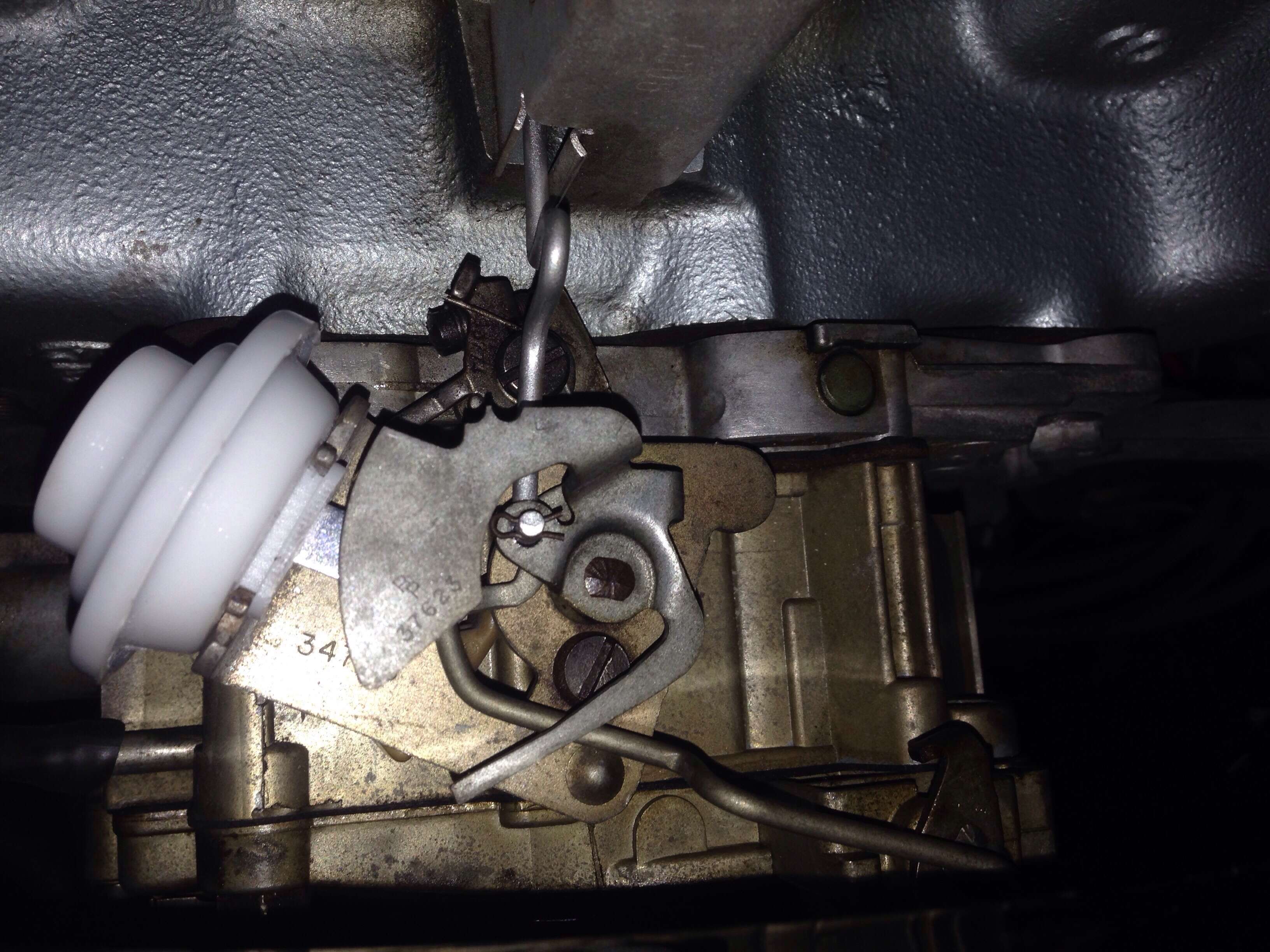
You have a choke issue. Do you know what type of choke you have installed? If your not sure attach a pic of passenger side of your carb.
To start a carburated engine:
push gas petal to floor and then let off your foott
choke (butterfly valve) will close
fast idle engages
turn key to start
If it fires up right away on fast idle she's bang on
Engine Test Stand Playlist: https://www.youtube.com/playlist?list=PLwoxyUwptUcdqEb-o2ArqyiUaHW0G_C88restoring my 1968 Firebird 400 HO convertible (Firedawg) 1965 Pontiac Catalina Safari Wagon 389 TriPower (Catwagon) 1999 JD AWS LX Lawn tractor 17hp (my daily driver) 2006 Sequoia 2017 Murano (wife's car) 202? Electric car 203? 68 Firebird /w electric engine 2007 Bayliner 175 runabout /w 3.0L Mercuiser__________________________________________________________
|
|
|
|
|
Joined: Jan 2009
Posts: 3,049 Likes: 10
Senior Member
|
|
Senior Member
Joined: Jan 2009
Posts: 3,049 Likes: 10 |
It's not adjusted properly, find somebody who knows what a Qjet is and can tune them.
-Jeff
|
|
|
|
|
Joined: Sep 2015
Posts: 50
Member
|
|
Member
Joined: Sep 2015
Posts: 50 |
I agree with Gus68, it's a choke issue. Most likely the carb was adjusted to operate with the damaged bimetallic strip. Now it is running Super Rich on start up, or going to full choke when it is not needed . ( If your in a heated garage or a warm area choke should set to partial, not slam to full choke ) Choke rod was also most likely mis-bent to compensate for the problem with the bimetallic strip. The low idle screws may also have been messed with for the same reason. A mis-tuned Rochester can drive you crazy. Just as a properly tuned one purrs like a kitten, in my opinion.
|
|
|
|
|
Joined: Jul 2017
Posts: 43
Member
|
|
Member
Joined: Jul 2017
Posts: 43 |
thanks guys for the info so far.
For Gus68, I've attached a photo of the choke. Hope it's ok. Sounds like it's not just as simple as adjusting the mixture to lean it off.
|
|
|
|
|
Joined: Apr 2010
Posts: 6,758
FGF Premium Member
|
|
FGF Premium Member
Joined: Apr 2010
Posts: 6,758 |
That's the correct choke and it appears to be installed properly. Did you try starting the engine method I stated above? Did your mechanic try the carb out after fixing it?
|
|
|
|
|
Joined: May 2001
Posts: 3,615
Premium Member
|
|
Premium Member
Joined: May 2001
Posts: 3,615 |
Looks like it's installed upside down...LOL
I'm a hobbyist. Not a professional. Don't be hatin'!
|
|
|
|
|
Joined: Apr 2010
Posts: 6,758
FGF Premium Member
|
|
FGF Premium Member
Joined: Apr 2010
Posts: 6,758 |
Looks like it's installed upside down...LOL Pic taken down under. They are upside down relative to us Lol
Engine Test Stand Playlist: https://www.youtube.com/playlist?list=PLwoxyUwptUcdqEb-o2ArqyiUaHW0G_C88restoring my 1968 Firebird 400 HO convertible (Firedawg) 1965 Pontiac Catalina Safari Wagon 389 TriPower (Catwagon) 1999 JD AWS LX Lawn tractor 17hp (my daily driver) 2006 Sequoia 2017 Murano (wife's car) 202? Electric car 203? 68 Firebird /w electric engine 2007 Bayliner 175 runabout /w 3.0L Mercuiser__________________________________________________________
|
|
|
|
|
Joined: Jul 2017
Posts: 43
Member
|
|
Member
Joined: Jul 2017
Posts: 43 |
Oops!. Next time I'll stand on my head  My token Aussie joke...Q: What kind of music do kangaroos listen to? A: Hip hop. (thank you very much I'll be here all week.) Yes, I have tried that starting procedure. When I turn the key, it fires up immediately, but only purrs for about 10 seconds before it sounds distressed and stalls. If I give it a bit of gas to keep it going, it has the opposite effect and stalls quicker. If I look at the butterfly it appears to close off about 90%. If, on the other hand, I start the car with a pen holding the butterfly flap open, she purrs like a (big) kitty cat and doesn't blow any smoke at all. Warm it up and off I go. I didn't pick the car up from the mechanic myself, so no feedback there, but they're good guys and there won't be any problem with them taking another look, but I was just hoping to improve my understanding of it, so I'm on the same page.....
|
|
|
|
|
Joined: Jan 2009
Posts: 3,049 Likes: 10
Senior Member
|
|
Senior Member
Joined: Jan 2009
Posts: 3,049 Likes: 10 |
The way is should start dead cold is;
Step on the gas to set the choke.
Cranks and start the engine, choke should be at the first step of the cam.
After about 5 to 10 seconds, tap the throttle to set the choke at the second step of the cam.
Try adjusting the tension of the choke thermostat spring first, then move on to bending the choke rod if necessary.
Once you get the choke ironed out, double check your idle speed mixture circuit;
Engine fully warmed up, run each screw in (one at a time) until the engine speed drops/stumbles slightly, then back out 1/2 turn.
-Jeff
|
|
|
|
|
Joined: Apr 2010
Posts: 6,758
FGF Premium Member
|
|
FGF Premium Member
Joined: Apr 2010
Posts: 6,758 |
I agree with Jeff and Wayne, best thing to do at this point is to return to shop for fix. You might have a faulty choke component somewhere.
Let us know how you make out.
Good luck to our aussie cousin!
da Canuck dude...
|
|
|
|
|
Joined: Jul 2017
Posts: 43
Member
|
|
Member
Joined: Jul 2017
Posts: 43 |
Will do. Thanks for all your help everyone! I'll let you know what the result is
|
|
|
|
Forums57
Topics35,546
Posts298,897
Members8,865
| |
Most Online19,810
Feb 1st, 2026
|
|
|
0 members (),
143
guests, and
23
robots. |
|
Key:
Admin,
Global Mod,
Mod
|
|
|
There are no members with birthdays on this day. |
|
|
|