The engine color is definitely wrong which makes you wonder about 'numbers matching'. Ya never know. The HO's were called ram air 3 but didn't have the functional ram air. I did think it was kind of funny that the engineers would pick a car to work on with all those options. Why not choose a basic version so they could swap parts easily? What would seem more likely was that it was a personal car for an exec.
I learned something about '69 RA3 today. Didn't know that. Interesting they used the term ram air when it doesn't ram the air. perhaps my '68 400HO should be called a RA 0.
My engine is not "Pontiac Metallic Blue" in my November '68 built '69 400. Based on the information on this forum telling me it was wrong when I first signed on, I repainted it with the Hirsch blue. But every single component has the same paint underneath. I know mine is now wrong, but it's what people expect to see. When the engine is rebuilt I will try to find the original color.
Last edited by Yellowbird; 10/14/0603:49 PM.
Vikki 1969 Goldenrod Yellow / black 400 convertible numbers matching
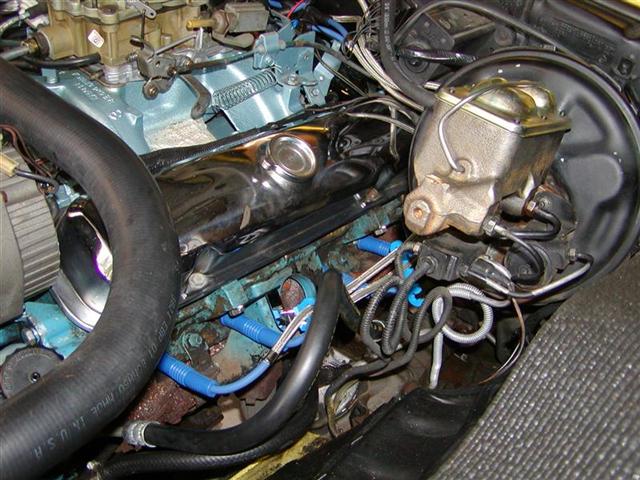
I went back and pulled up pics of my engine from the underside. It's not that dark blue...but it is also not Hirsch Metallic Blue. It is a turquoise non-metallic. See power steering pump bracket and the lower side of the head.
Last edited by Yellowbird; 10/14/0603:47 PM.
Vikki 1969 Goldenrod Yellow / black 400 convertible numbers matching
That's older Pontiac blue, IMO. A good builder will only have one coat of paint on a rebuild. That was the only color available for years and years for spray cans. Why would Pontiac revert to an older color for your engine? How many miles and years were on your engine when you first acquired it?
Plenty of years and miles to have a rebuild or two. Question; I see in your pic that the threads are painted on the one stud that holds the heat riser bracket. Did they paint the engine after that bracket was installed?
Looks like someone painted it after that bracket was installed. It doesn't look like factory paint on that stud. If someone painted a part that color then your 'original factory paint theory' is out the window. Probably just a detailing in the 20 years that you did not own it. And as far as a Michigan title documenting miles.... Well, we both know how unreliable that can be.
Dog ate my homework, best friend took my VIN tag and the engine came from the factory restamped with the VIN.
I also have the missing number 8 ram air bird in my garage. The distressed 38 year old lacquer is nearly dry.
All seriousness asside, I think trim and vin tags are only part of the process. They are not much problem for a capable craftsman to fabricate with the right tools and experience. The other seven senses will come into play and smelling a rat may be one of those senses.
This Firebird is NOT the test 455ho Firebird the seller states it might be. I busted him on this yesterday and he has not updated his auction that it is not, so not to decieve any potential buyer. The test car was in the Fabulous Firebird book, Car Craft Jan88 and High Performance Pontiac Apr86. Although all the pictures are in black&white, it clearly shows the actual test car as having a light colored interior, probably parchment, also it has a front fender antenna, blacked out front grilles and no wheelwell moldings plus a 69 Trans Am rear spoiler.
The auction car has a black interior, power rear antenna, standard painted grilles, wheelwell moldings, no rear spoiler and not even holes in the trunk lid where a spoiler might have been.
The best clincher is that the HPP article states the actual test car is Engineering number 9723 which is different from the Engineering number 9749 on the auction cars PHS.
It was a lie that told a small truth. The car probably has a 455 in it that started all this thinking. If you have ever talked with Jim Mattison you would know that he doesn't go 'out on a limb' like this guy says. Did you ever notice that a bad lier tells you that somebody said something? And you can never prove that somebody did not say it because they don't expect you to ever talk with that 'somebody'. Makes me sick!
I've often wondered about the color of my engine being wrong. I've never pulled it to actually inspect it all over, but since I bought it in 91, the engine has been a non-metallic blue. The only part I can detect had the metallic on it was the 68 4bbl intake manifold that was installed at some point after it was no longer new. I've since gone over the valve covers and parts of the heads I could reach with the 'proper' metallic blue, but now wonder whether the non-metallic may have come from the factory. I find it strange that someone would have gone to the trouble to repaint the engine block and heads, but not the intake manifold when they installed it.
One easy answer is the original paint wasn't available in spray can until the 80's. The engine was painted before that and the intake was last switched after the spray cans were available in the correct color. You say you purchased the car in 91? We need some old pics for the early 70's not 90's.
JimC, what's your take? I'm sure you know the original color on your 68?
Here's Rodericks 'time capsule'. No doubt it's the original 68 color. But, then again, there's a slightly different shade on the water pump than on the timing cover.
Below: Yellowbird with questioned original paint lower and new accepted paint on intake.
Notice how the head is a slightly different shade than power steering pump bracket.
Yes. I have had the opportunity to handle a large number of OHC engines. Some were very low mileage engines in continual light use, some that were pulled and stored when relatively new (to be replaced with V8), and some that are still in use with many, many miles. The paint color does change under the influence of heat, fuel, oil, coolant and other chemical reactions.
Many of the early engines show a color change to a more green shade over time. However, metallic paint does NOT lose its metallic properties.
Oh...and at least three different factory paint colors were exhibited. A very pale blue metallic, a turquoise-blue metallic, and a turquoise blue non-metallic. Along with some having black ribs from the factory, others not...
Last edited by Yellowbird; 10/16/0602:26 PM.
Vikki 1969 Goldenrod Yellow / black 400 convertible numbers matching
Yellowbird's Quote: "Many of the early engines show a color change to a more green shade over time. However, metallic paint does NOT lose its metallic properties."
What proof do you have that metalic paint does not lose it's metalic properties? Do you have old metalic painted engine parts that have been subjected to heat that have retained their metalic?
Yellowbird's quote; "Oh...and at least three different factory paint colors were exhibited. A very pale blue metallic, a turquoise-blue metallic, and a turquoise blue non-metallic. Along with some having black ribs from the factory, others not..."
So, you agree that there were metalics used but not on your engine?
Metal does not stop being metal. The flakes may oxidize but they are still there. Look at Roderick's...you can see the metallic luster.
Yes, I have old metallic engine parts that have been subjected to heat that have retained their metallic. A 1968 intake, which was a turquoise metallic, not "Pontiac Metallic Blue". Also numerous OHC timing covers and intakes.
Vikki 1969 Goldenrod Yellow / black 400 convertible numbers matching
Exactly, you can see the metalic luster on Rodericks and with some age darkening. So, which are you willing say is correct? Roderick's time capsule or your, non'metalic?
IMO Roderick's timing cover is the only 'real deal' displayed. You can see that the forward edges that have not received much heat are quite light colored. It looks as though someone changed the water pump and painted it with available early spray can paint.
To the best of my knowledge, my engine was never rebuilt. The only areas that have more than one coat of paint are those upper surfaces that I sprayed with rattle can "Pontiac Metallic Blue", and a few areas with a dissimilar blue which was sprayed over the black of the power steering reservoir and the natural power steering bracket.
It is highly unlikely that even if the engine was rebuilt, that the rebuilder would have taken the time to strip all the paint from the timing cover, valley pan, water pump, balancer, exhaust heat riser, brackets and repaint them. There is no overspray on the distributor, none on the exhaust manifolds.
My opinion differs from yours.
Vikki 1969 Goldenrod Yellow / black 400 convertible numbers matching
You still haven't addressed your exhaust heat riser being painted after assembly?
Yellowbird's Quote: "It is highly unlikely that even if the engine was rebuilt, that the rebuilder would have taken the time to strip all the paint from the timing cover, valley pan, water pump, balancer, exhaust heat riser, brackets and repaint them. There is no overspray on the distributor, none on the exhaust manifolds."
Whatever, Jim. Just because you declare something right or wrong does not make it so. If we were to poll this forum (which has a very good sample population) and ask each person who has a numbers matching unrepainted engine to submit photos, you would find more than one color, more than one shade. And I am quite certain that you would declare any that don't match your engine to be wrong.
Vikki 1969 Goldenrod Yellow / black 400 convertible numbers matching
Yellowbird's Quote: "Whatever, Jim. Just because you declare something right or wrong does not make it so. If we were to poll this forum (which has a very good sample population) and ask each person who has a numbers matching unrepainted engine to submit photos, you would find more than one color, more than one shade. And I am quite certain that you would declare any that don't match your engine to be wrong."
I'm not declaring anything here. I have asked questions and stated opinions that have been labeled 'IMO'. My engine color is definitely wrong. It has had no time to age since it was hot tanked and repainted 6 years ago and only ran a few hundred miles. The color changes are already starting though.
Jim, why would anyone hot tank an engine without disassembling it or rebuilding it? It did not happen.
I have some Pontiac photos of red and polished aluminum OHC engines. They never delivered one to the customer that way. I have Pontiac photos of engines in "Pontiac Metallic Blue" and have other photos of untouched cars with a distinctly more blue non-metallic paint.
There is much that is not known, but too much that is assumed to be true just because someone claimed it to be so. As time goes by, original details like this will disappear into history. Would anyone like to contribute their "before" info to feed this discussion?
Vikki 1969 Goldenrod Yellow / black 400 convertible numbers matching
I forgot to mention that mine is also a Lordstown, 4th week of October 68 car. I agree that the light blue metallic is the 'correct' color, but it wouldn't be the only time in Pontiac's history they had a shortage of the correct paint and used whatever other similar color they had lying around.
My heat riser was not painted. Yours definitely looks like it was installed and then painted. At least your stud was painted after assembly. You are saying they did this at the factory? This would be helpful information for detailing.
I will pull the engine at some point, and will continue to document it as I pull it apart. Although it's unlikely the engine would have been pulled and painted without being rebuilt, especially with the car's low mileage, anything is possible and until I inspect the rear face of the block I won't come to any conclusions. I have only had it apart as far as the timing chain. The timing chain was original GM and the cam is original GM 067, and it's likely that even a re-ring would have replaced these items.
The bottom of the intake runners had remnants of turquoise blue non metallic paint visible on the runners.
Vikki 1969 Goldenrod Yellow / black 400 convertible numbers matching


![[Linked Image]](http://i23.photobucket.com/albums/b376/restorium/mpaint_edited.jpg)

![[Linked Image]](http://i49.photobucket.com/albums/f288/firebird4004spd/000_0879.jpg)


![[Linked Image]](http://205.240.39.91/albums/Firebird-Before/firebird_011.sized.jpg)
![[Linked Image]](http://205.240.39.91/albums/Firebird-Before/firebird_012.sized.jpg)
![[Linked Image]](http://i23.photobucket.com/albums/b376/restorium/enginecolor.jpg)
![[Linked Image]](http://i23.photobucket.com/albums/b376/restorium/mpaint.jpg)


