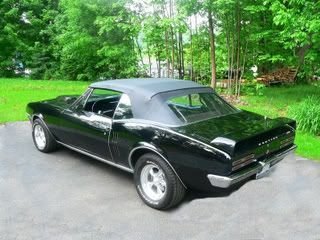
I've had a good day today.. I rewired the 455 correct for a Pontiac (someone else wire it for a chevy and it was back fireing) I put a new holley carb on it and got it running today,, and thanks to you guys/gals I have learned alot... you have answered alot of my questions that have been bothering me for over a year now.. I really do, greatly appreciate all of your answers and for putting up with my questions..,, But,, I have to warn you now,, this is only the Begining.. I am restoring two firebirds 1969 vert/1968 coupe.. And I am busting at the seams for answers.. I am from the old school, I was around when these cars were daily drivers.. I do remember alot, but I have forgot ten times as much.. Like I said before,, I can't thank you enough.. I hope you will have patience with me over the long haul... Dale
And it only takes a bit of math to determine what any particular chamber volume will yield on any displacement; if you have stock pistons or can adjust for what you have you can get a close estimate with this chart: http://www.wallaceracing.com/cratio0001.htm
Vikki 1969 Goldenrod Yellow / black 400 convertible numbers matching
Best answer to any engine question I can give you is this.
What is your intended purpose?
If it is a car, like mine for example. I am rebuilding it to stock specs, stock compression with a Comp Cams OEM regrind which has better centerline and overlap. This motor will run 104 to 108 octane. Will it be a daily driver? no, but maybe a few times a week.
If you are looking for a motor to run pump gas, your machinist will tell you what you need to get there.
If I may be so bold to assert this bit of information, Pontiacs are very different than Chevys, Fords and Mopars. I will suggest you find a Pontiac only machinist (Butler/Kauffman/Nunzi/Bischop/Spotts/Jim Taylor) You will pay a little more, but the overall result is that it is built right.
Si Vis Pacem Parabellum
1967 Starlight black PMD Engineering 400 Auto 1968 Alpine Blue 400 4 speed 1968 Verdoro Green 400 HO 4 speed 2013 1LE 2SS/RS Inferno Orange Camaro.
Obviously I don't have a "Real" 1969 Trans Am vert,, And this will probly be as close as I'll ever get to owning one.. ( by the way I forgot to mention that I have a real nice authentic all steel 69 Trans Am Ram Air Hood That will go on my car when I get that far..) I figure that will hopefully be the most expensive Trans Am part that I will have to buy,, and the 1969 400cu/#48 heads born a couple of weeks from when my car was dated is as close to a "Real" Ram Air III that I will get to also.. So you see I hope to keep everything as close to original as financialy possible, when I talked to the guy who did my motor I told him I was wanting to drive the car around and he thought I meant be able to use pump gas,,, I just was'nt thinking when I should have given him the specs for a Ram Air III.. He and his shop guys has an excellent reputation for building engines, so I "Assumed" he knew about Pontiacs... duh.. He's a chevy man I believe.. Ever hear of Watson/Ruppel..???.. Thats why I am here now trying to figure my best way to fix the situation without spending a ton more of $$$$$,, and throwing away $$$$ already spent.. This car is far from being perfect, but it's what I have, (since 1983)... If the compression is above 10 then I am close, now what about the cam and the lifters??????
Unless you are prepared to buy and blend 110 octane, forever, and limit traveling with your car to routes where you can readily purchase this fuel, you may not want to precisely duplicate the original build. If it's just an occasional cruiser and fuel is readily available, then go for it, but be aware of the repercussions if you do encounter detonation, and its effects.
Given that the car is a clone, if it were my build I would design for 93 octane and give up a few horsepower to have the freedom to drive it.
And with those Speed-Pro pistons, you won't have an exact build.
Vikki 1969 Goldenrod Yellow / black 400 convertible numbers matching
Vikki,, Giving the specs on my motor, do you think I'm going to have to blend my gas now,??? or should I just put the #48 heads away for awhile and buy aluminum heads for the pump gas..????? Whadda ya think???????
I have #62 72 cc on a non-rebuilt '69 400 4 bbl, and it won't run on less than 100 without heavy detonation. These are the stock factory cast pistons, standard bore. Original factory cam, stock valve timing. It's a slightly tired 75,000 mile engine.
All I would need to do is drop in lower compression heads or pistons and solve the problem. Factory advertised 10.75:1, it's been determined that this figure is overrated and the actual was about 10.25:1. I would target for a maximum of 9.5:1 for 92/93 octane.
I have #62 72 cc on a non-rebuilt '69 400 4 bbl, and it won't run on less than 100 without heavy detonation. These are the stock factory cast pistons, standard bore.
All I would need to do is drop in lower compression heads or pistons and solve the problem.
Why don't you buy a set of #64 heads with a cc of 87, probably been cleaned up to 80-85 over the years. That way, you have a streetable motor, 91-93 octane and you are all set. Only a handful of people will be able to tell the difference in head codes. As well, you will not lose any value with these heads..they are great. With your pistons, and those heads at 80-82 cc, you are roughly at 9 to 1.
I don't use aftermarket heads or intakes and cannot comment on their application. Again, I'd suggest reading Jim Hand's book, or discuss your build with someone who truly knows Pontiac builds, as mentioned earlier.
Vikki 1969 Goldenrod Yellow / black 400 convertible numbers matching
The cam you are using is very close to the RAIV cam (230/240 vs 232/237, .468" vs .481" lift) and will work well. You didn't post the LCA and I don't remember it offhand, but I'll assume that it is 112 degrees. That should get you around the 360-380hp mark on the dyno. It'll be borderline for running on pump gas depending how it is tuned; most likely you'll need to play amateur chemist and mix up your own blend.
Yes, using the 72cc aluminum heads with that cam would put you close to using straight 93 pump gas depending again on tuning, altitude, etc., and should make about 430-450hp. By using the 87cc heads you'd be sure of running pump gas, still make about 400-410hp and would eventually pay for the heads in lower fuel costs (about 30,000 miles!). Best of everything - except the correct look.
The cam will sound quite nice!
Oh, I didn't ask, what transmission are you going to run? An auto with a higher stall convertor will help ease the detonation woes as well.
Don't brag too soon Jim. Just because you have had it running for three years doesn't prove that you have no detonation from burning too low of octane fuel. You may not hear it due to your headers. And keep in mind that even inaudible detonations can break the lands out between your piston rings. We have the same build but mine doesn't have zero deck. Mine never overheats either. I will keep adding some racing fuel just to be safe. Besides, I get better performance with the mixture. Remember that just because you zero decked it doesn't make it bulletproof.
Mine never overheats either, although thanks to the TH400 it does run a little warm after extended idling in gear at the Dream Cruise, but if you try to run 93 there is an audible difference in the sound of the engine and power underfoot. Plus, of course, the detonation.
No, my block has never been machined. All the parts are original, all the way down to the head gaskets, with the exception of the timing chain. Simply changing fuel makes all the difference with this as-built engine.
As soon as any modification--whether it be head gaskets, pistons, decking the block, or heads--are introduced, the entire formula changes. That's why the machinist is the key to the build. Everything has to be done right, and documented. And, more importantly, there has to be a plan, and it should be provided by someone with extensive Pontiac experience.
Vikki 1969 Goldenrod Yellow / black 400 convertible numbers matching
It's nice to have a couple fresh builds to compare between. I have the stock build in my 69 and the above mentioned build in my 79. They run almost exactly the same. They like the same octane. I have stock exhaust so you hear every little noise(ping). The thing about headers: I had headers on my 79 and then switched to stock exhaust. My engine didn't ping until after I installed the stock exhaust. Ah, oh, maybe it was that I wasn't hearing it? The 79 runs cooler than the 69. I attribute this totally to the manual trans in the 79. It's going to hit the 70's today. The biggest challenge with having these two is driving both! OK I'm bragging(again), sorry.
I have built and run 10:1 engines on 87 octane with iron heads and very mild cams on several different makes and sizes, so I know how to do it - but not everyone does. I started doing this over twenty years ago. I've always been after power with good fuel economy, and overall engine efficiency is the path I've chosen to achieve both goals.
I also regretted running too much compression in a couple of street engines because it cost more in higher octane fuel than the extra power was worth. I still will build to the edge but only run 87 octane in my drivers. The extra cost in Canada is at least $.10 per litre for mid-grade and $.20 for premium. That comes out to $.33 and $.66 per gallon in US measure and money.
Until all the engine builders are willing to do more than a quick rebuild, the best advice is to keep the compression down or find someone who will build it right.
No wives' tales involved, just common sense.
Tom, I suspect that the .023" down the bore was to allow the proper piston to head clearance (around .040") with the steel shim head gaskets. I know that is definitely the way the engineers designed the OHC engines. When using the thicker Fel-pro gaskets, zero-decking will bring the clearance back to factory specs and compression.
It all depends on what you want. The only time I've ever been disappointed in having too much compression is when I damaged an engine because I was too stubborn(stupid) to pay for the high octane fuel. In my book there are two rules when planning a build: 1. There's no replacement for displacement. 2. Except, maybe, compression. Picture a new Caddy passing you with your pedal to the metal.... This will happen with low cubes and/or low compression. It will not with high cubes and/or high compression. I'll pay the extra for high octane. Because it's fun to have too much power!!!!
And I'll do the same - to the level I want! That's always the key, figuring out what you're willing and able to live with! More power to you (and I sincerely mean that!)!
Not fair, Jim, I still have to wait another month or so before I can start having fun!
I should be waiting too. The freaks around here went wild with the salt this year. I saw a pile on the side of the E-Way yesterday a foot tall! I'll keep it to the neighborhood today. Give the neighbors a show, they have been waiting.....
(I also regretted running too much compression in a couple of street engines because it cost more in higher octane fuel than the extra power was worth.)
How much is to much that you regretted?
( I have built and run 10:1 engines on 87 octane with iron heads and very mild cams on several different makes and sizes, so I know how to do it - but not everyone does. I started doing this over twenty years ago. I've always been after power with good fuel economy, and overall engine efficiency is the path I've chosen to achieve both goals.)
If you have built good runing engines 10:1 on 87 octane why did you stop?
Jim maybe switching from headers to log manifolds is what caused it to ping? The rest of your combo in the 79 is set up for headers.
Set up for headers? Tell that to the endless 11's out front! I don't believe in headers anymore. I've got enough extra horsies that the 10 or 15 you get from altering your exhaust is pointless. I can already fry the tires at will in any gear. That's with full traction bars.
I'm telling that to the race gas you have to use to run that way.
And not believing in headers doesn't have any thing to do with weather it pings or not.If you have to run a mix of 110 octane then that throes the hole pump gas thing out the window.
I haven't stopped, that's what I run in my personal street engines - when I get a chance to build one for myself! The last one was for my wife's van that we tow our holiday trailer with. I also build more torque from smaller engines than others so that I don't have to sacrifice performance for fuel ecomony. 12% higher fuel cost for 5% more power doesn't make sense to me but it might for others.
In my engine building business I mostly build racing engines with the occasional high-end street engine thrown in, so I do know what I'm talking about. I also dyno and tune all my engines. On my list this month is an alcohol Sprint car engine with 14.5:1, a couple of ministock engines with 10.5:1 (pump gas class), a twin-turbo EFI 4.3l V-6 8.3:1 with 12 psi boost and pump gas - and if I ever get to it, a twin-turbo Pontiac OHC 250 for myself.
I'm telling that to the race gas you have to use to run that way.
And not believing in headers doesn't have any thing to do with weather it pings or not.If you have to run a mix of 110 octane then that throes the hole pump gas thing out the window.
Never thought it had anything to do with the exhaust. Only that you can hear the ping better without headers. It's pump gas. I drive up to the pump/pumps. Just as soon as the racing fuel pumps disappear I'll have aluminum heads.
TOHCan, I truly believe you, you do know what your talking about.
I just wonder why in your other post you give the impression that one would need to( play amateur chemist and mix up your own blend.) And in your own cars you run 87 octane and higher compression?
Because of the precise tuning needed to run high compression on low octane, I don't recommend or build engines that will be on the edge unless I have easy and continuous access to the car after installation. That means just my friends! A sticking mechanical advance mechanism can stab your engine in the back awful quick! And it's also a case of "do as I say, not as I do".
Too much: more than 9.5:1 with iron heads or 10:1 with aluminum heads on carbed engines with mild cams makes the move to mid-grade necessary. Add .5 to those numbers if running EFI. This assumes that the engine is specifically built and tuned for low octane.
Most people don't have the feel or the patience to set up a carb and distributor properly and typically use what they have, and would be totally intimidated by an EFI system, so I tend to advise a conservative approach that will work for the majority. For someone like yourself or a few others out there, I'd definitely build an 11:1 (or maybe higher, what's your altitude?) 400 that would make 450+hp and get 15+mpg on the highway all on 93 octane pump gas - but it wouldn't be cheap!
If you want to get more pump gas engine building tips, start buying Engine Masters and locate as many back issues as you can. And Jim, I apologize for getting my knickers twisted, I took your questions the wrong way! Ask away - but be warned, I tend to be pedantic!
Helloooo.... I'm Baaaaack... I know,, I Know,,, Thanks for the warning.. I've got another one for ya.. Remember I told ya that the heads were shaved 20 thous. what I am wondering is am I going to have to use 20 thous. shorter push rods, and should I have the intake shaved the same amount to match the heads,, will my intake manafold fit and torque down okay,???.. If I use hyd. lifters do I have to use shorter push rods,??????
Sorry about the side tracking, no, shorter pushrods shouldn't be needed, and if the heads have only had .020" off during their entire life, the intake should fit fine. However, if your heads have had several valve jobs, you may find that you need to use Polylocks (adjustable rocker arm nuts) to keep from bottoming out the lifters and hanging some valves open.
"He stopped just before stepping off the boardwalk, noticing the sudden hush on the street. Glancing around, he saw the tall stranger in the dusty black hat staring at him from the doorway of the saloon two doors down. The sweat broke out on his brow as the man started towards him. If he could only get to his horse before - but it was too late. The glint of the star on the man's chest caught his eye. He felt a brief moment of relief, but that was short-lived. "Your horse is double-parked again, Mich", said Sheriff Branford as he drew his gun - and shot him in the face! Even though he moved fast enough to receive the shot on his cheek, he knew he was marked for life! Or at least until he could wash off the green water colouring."
Hard to believe that I beat Michigan Jim to the post, but hey, it happens!


 I rewired the 455 correct for a Pontiac (someone else wire it for a chevy and it was back fireing) I put a new holley carb on it and got it running today,, and thanks to you guys/gals I have learned alot... you have answered alot of my questions that have been bothering me for over a year now.. I really do, greatly appreciate all of your answers and for putting up with my questions..,, But,, I have to warn you now,, this is only the Begining..
  I am restoring two firebirds 1969 vert/1968 coupe.. And I am busting at the seams for answers.. I am from the old school, I was around when these cars were daily drivers.. I do remember alot, but I have forgot ten times as much.. Like I said before,, I can't thank you enough.. I hope you will have patience with me over the long haul...
  Dale
Dale 


![[Linked Image]](http://i23.photobucket.com/albums/b376/restorium/birds0zueo8hp2.gif)
![[Linked Image]](http://i23.photobucket.com/albums/b376/restorium/t_peelout.gif)
 I've got another one for ya.. Remember I told ya that the heads were shaved 20 thous. what I am wondering is am I going to have to use 20 thous. shorter push rods, and should I have the intake shaved the same amount to match the heads,, will my intake manafold fit and torque down okay,???.. If I use hyd. lifters do I have to use shorter push rods,??????


