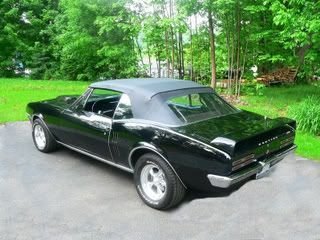
Hello all, I have a 326 with a fresh rebuild, I bought the car off this sites classifieds.
The motor is strong, 3K miles on it. 4 speed behind it.
Since it's purchase I have had to slip the clutch at take off from a dead stop, or the car will kill.
The previous owner put in an Edelbrock cam, intake and carb. I have the paperwork for the cam at home, so I can find out it's specs if needed.
The gears in the rear were 2.50's, I swapped out the axle this last weekend to a '79 TA rear with 3.23's with a posi. This made a pretty good difference in the gearing, but it still seems to lack take off power from a dead stop.
I replaced the distributor with HEI, the previous distrib the bearing froze up on.
I'm wondering what would be some good things to look at, once the rpm's get up this car screams, runs very well.
What rpm/mph does it come alive? If its over 3000 rpm, you'll need more rear gear, or advance the cam so the power band will come in at a lower rpm. Of course you'll lose the same amount of top end.
I would advance the tmg 1st as suggested above to see how much it changes.
Could just be carb issues too or a combination of that and gearing. Get an edelbrock owner's manual for your carb, and read through it. Seems like a 326 ought to be more than fine w/ a 3.23 if the carb is OK. Swap the acc pump link to the hole closest to the carb... should be in the center of 3 holes right now. This will give extra stoke/more fuel. If it makes any difference, swap it back and get the instruction manual.
try timing as it seems you dont have enough. may be advanced too much. start there and try the carb as you might not be getting enough fuel.. just ideas but might help.
Andy
due to budget cutbacks, the light at the end of the tunnel has been disconnected for non payment.
There are a bezillion reasons, including driving technique. Without the endless list, how can anyone even start to suggest solutions?
My first thing in the can would be the intake. Even the dual plane one (if you want to call it a dual plane) I cannot see how the thing can provide low end torque.
There are a bezillion reasons, including driving technique. Without the endless list, how can anyone even start to suggest solutions?
My first thing in the can would be the intake. Even the dual plane one (if you want to call it a dual plane) I cannot see how the thing can provide low end torque.
You condemn all Edelbrock intakes now? I can show you some low end torque with an Edelbrock intake. That's right!
Hey guys, I think I have a combination of issues. I rotated the distrib. clockwise a bit, and it had better throttle response, went to far and it sounded like the valves rattled on a higher end. I rotated back to a happy medium, less lag and still nice on the top end.
I think the carb needs tuned to Colorado altitude also.
While idling (very smoothly) if I slam the accelerator linkage it waits a second with nothing then steadily ramps up in rpm's. Sounds great, but that hesitation is not what I'm looking to get. Now I know this is not a Fuel Injected motor, but it's healthy with nice pieces on it. With the 3.23's it should be good gear wise. Definitely feel the difference when cruising around, very responsive in the upper RPM's, just initial stomp of the pedal is lag.
I'm thinking the Primary jetting might be off, there are 3 items to consider here, the jet, the metering rod, and the Primary springs, I might buy a kit for the Edelbrock Performer 1406 600 CFM electric choke carb.
I just cannot decide if I'm lean or fat on fuel.
I'm going to take the previous advise and adjust the pump link as Sixstarved suggested, this will dump fuel for a longer or shorter duration depending on the setting.
I appreciate all advise. This is a nice setup, I'm just not a Carb tuner, Holley, Edelbrock, etc...., I have no preference as yet, and I've dealt with both. The Edelbrock tuning book is a good read, kind of leaves me in the dust though.
I ordered a tune up kit for my 1406 Edelbrock, very first thing I will do is go to the extremes with the Primary springs, takes 2 minutes tops, and then hopefull I can guage if it is lean or rich on the front end of a accelerator plant.
That's a nice start, but it fails to take into account the effects of displacement on cam profile. What would be a radical cam on a 326 would be mild on a 455. What would be radical on a 455 probably wouldn't run on a near-stock 326.
The cam shown should be a very streetable cam in a 326.
If you accelerate moderately fast to full throttle, do you still have that stumble?
Vikki 1969 Goldenrod Yellow / black 400 convertible numbers matching
The site that I put the link up for does comment on what the differences in displacement can do. You must have 'speedread' right over it. It's a really good site for cam selection. There are some other related pages that talk about specific cams. The site owner will also help out with specific questions.
The site that I put the link up for does comment on what the differences in displacement can do. You must have 'speedread' right over it. It's a really good site for cam selection. There are some other related pages that talk about specific cams. The site owner will also help out with specific questions.
Unfortunately the exact portion of the site it's directs to only makes a comment that the effect would be at idle. Displacement effects more than just idle quality.
Anyways it's a very healthy cam for a 326 but not over the top.
Coyote, sounds like a lean condition on tip-in. Check to make sure you're getting your "pump shot" when you hit the throttle and try more fuel. You may also try adjusting the secondaries to come in a little slower.
well guys here's where it stands, and check my rationality. Right now I do not know if it's a lean or a rich condition right of idle, car came from Missouri (but never really driven) to Colorado (no oxygen whatsoever 8^) ):
I have adjusted timing by feel, right now to best running, but real close to where I had it dialed in off the timing light, so that I'm good with.
I have a Edelbrock carb kit coming in the mail, tons-o-rods jets, and springs. Here is what I intend to do
A lean condition can result from the primary spring not extending quick enough to lift the primary rod out of the jet orifice, rich can be just opposite.
Also the primary shot of the accel pump can be adjusted for a longer shot of fuel, or a shorter shot, as mentioned earlier. I seem to be getting a good (visual) shot of gas when I snap the throttle open.
Here's my plan, I'm going to put the stiffist spring in first and gauge results, if poor I will put in the lightest spring for the primary's. This should tell me I'm lean or rich, then I can also adjust the accel shot accordingly also to supply a longer or lesser shot. Then for fine tuning I can look to the jets.
How's that sound? This will be the first carb I mess with, but I've done a ton of reading on it. Just thought I'd run it past you guys, as I know a bunch of you have experience with carbs.
P.S. I really appreciate all the responses, good to have a sounding wall.
Sounds like a good plan. I have to say all my Edelbrock carbs worked great right out of the box. Can you go back over exactly the condition that you are trying to correct? So we get a solid 'before' the adjustments.
Comp Cam, near to stock specs (should not hinder performance)
Edelbrock kintake manifold (don't know the type)
Heads say 140 (or 740, but I think 140) on the center exaust dump (don't know if the heads are good or bad performance wise)
HEI distributor (last one bearing froze up at car show 80 miles away, thank you AAA), new 8mm (I think) wires, and plugs.
Car brought from Missouri to Colorado, plenty of oxygen to little oxygen.
Car idles great, all day long.
I was told the primary and secondary stock jets only were directly swapped (don't know why)
Electric choke plug to constant hot wire, instead of ignition on hot wire (don't know why, will change this as book says keyed 12 volt source) This shouldn't interfere I would think.
when under hood, simulating stomping the pedal like from a green light race, the car has a flat spot for a second then increases in rpm at a very respectable climb (maybe a touch slow, but I'm used to a FI LT1 that is super responsive)
So it's the immediate right off idle transition from the idle circuit to the primary, not a stumble like bad timing or rough idle, just a dead spot, poor responsiveness.
So as you come of idle circuit and transition to the primary circuit, I've wittled it down to a few factors. Lean or rich condition caused by primary metering rod open up to fast or to slow, simple spring swaps should answer that. Accel pump not giving a long enough shot, or to long a hot of gas. Then jets for fine tuning.
As soon as I swap the springs (2 minutes) I should get a great indication of lean or rich, and adjust with accel shot, and jets and rods. I think the springs will hopefully cause enough difference where I can determine lean or rich, then it's all tuning in. Like I said, not a carb guy, but with the homework I've done, I think this might get the ball rolling in the correct direction, what do you think?
Next step if the springs don't give a good indication, I will do jets and rods on the primary circuit to go 2 steps leaner, and 2 steps richer over stock settings and keep working in the best direction.
I should be able to start letting the clutch out and if I wanted stomp and spin the tires with all this combo. With 2.50 gear I used to have to feather the clutch and gas to get going. With the 3.23's it's much more driveable, but you aren't going to lay rubber unless you rev high and dump the clutch. Now I'm not one to tear up tires for fun, but if I want to leave a light with some speed I should be able to.
Man I'm long winded today, but wanted everyone to know it all, heck for all I know these heads could suck so bad that it's not all carb at all.
the bog never goes away, distributor is completely rebuilt unit with vac advance hooked to the pass side vac port on carb, book states this is the EGR equipped side, but idles smooth as heck on that side, idles rough on the drivers side port. Seemed to bog less as I rotated further clockwise, but then the top end sounded realy poor (like a lot of valve rattle), and top end power was down.
I just taught myself about carbs a bit, now you're hinting at timing and vac advance, I don't know those yet, hehehe. More to read more to read.
I also suspected timing could be an issue, that's why I rotated the distributor a bit. Don't know what to check on that.
Let's start from the beginning. We are still lacking a ton of details.
Which Edelbrock intake exactly. Camshaft you said Edelbrock and then gave us specs on a Comp, so which cam do you have. Cylinderheads what year and what is you compression? If you don't know tell us the codes on it. Were they modified (bigger valves, some porting). Ignition what is your current initial and how much total do you get and at what rpm both values with the vacuum port disconnected and plugged. Is the "EGR" port pulling from full vacuum (sees vacuum at idle) or ported (no vacuum at idle, vacuum once the throttle is opened). Are you running headers, long branch manifolds, or stock log type.
Please answer all the questions and as througly as possible so that we can make more informed suggestions.
Try going to leaner primary rods. I am running .110 jets with 75/37 rods on my 400. Lean and mean!!! The leaner I go, the more power I seem to generate on the bottom.
I'm a hobbyist. Not a professional. Don't be hatin'!
For your combination of compression, engine displacement, elevation, and gearing you have too much camshaft intake duration.
Try swapping in a Summit K2800. The split pattern will help the exhaust side while promoting cylinder filling to where it is needed.
The earlier heads on the 67 tend to like more total timing. With that compression ratio and head design you probably should run about 91 octane, but max mechanical timing can be 40-42°with the correct octane. Borrow a dial-back light, because adjusting the max without knowing what it is, is Russian Roulette. Ignition timing curve will be dependent on the camshaft and with the 2800 I'd start with around 14° and see what it likes (have it all in by 3000rpm). Since the HEI max advance is not really adjustable you'll need to elongate or shorten the advance slots by grinding/brazing to adjust the total. Remember the shorter mechincal range will mean higher spring rates to slow the rate otherwise you'll reach max advance too quickly.
Once you have mechanical set (keep the vacuum advance disconnected up until now) get an adjustable vacuum can (Crane makes the best since you can adust teh spring load and the total) and adjust it per their recommendations.
Once you have these dialed in correctly you can fine tune the carb.
One more note, because you've switched to an HEI, you may want to try opening the spark plug gap up to .045". Maybe try this before you do teh other stuff and see if it likes it.
Since it bogs when you are just simply rapping the accelerator it's not a gearing problem(yet). I don't think it's elavation either. Since you already have the parts, try that accelerator pump idea. It's worth a try. It could be the only problem. Try a slightly higher idle too. That cam likes a higher idle.
thanks all, I will try to tune what I have prior to a cam swap, just because I have another motor that's going in anyways soon. But I want this one running very well before I pull it.
I very much appreciate all the suggestions and recommendations (except for "maybe it's the driver" lets leave it at I know how to drive a car or bike with exceedingly good results). My biggest problem is I always had a crew to do my tuning, they set them up and I ran them. Now I want to know how, and do it myself.
My biggest hope is that there is not a huge enough mismatch in this system, and I can successfully tune the setup to have some pretty reliable performance, doesn't have to scream. That's what the next motor is for.
UPDATE, got my tuning kit, leaned my primary jet from 98 to 95, went with a leaner stepped rod. Bumped secondary jet to 98 from 95. Tuned everything to what seemed optimal, then started swapping out spring, unreal the difference those make. Went to leanest spring (so to speak) and the car performed really well but have a bit of a stumble a touch up from where the dead spot was, figured by this time I was pulling some air, so I added a spring to allow rod lift easier and have it dialed in great.
I went thru the spectrum of springs with test runs, it worked really well.
Car brought from Missouri to Colorado, plenty of oxygen to little oxygen.
When we used to take mine out to Colorado and up into the mountains in the early 70's, it was unbelievably dead on acceleration. On startup, it would barely run until the choke could be kicked off and thick rich smoke billow out the pipes.