Actual testing? On a dyno, under controlled conditions, where the only variables were the load and the fuel? No, purely subjective opinions that echoed what I posted the year before when I ordered the case of MaxLead 2000, and had likewise been posted the year before that. Not without value as observations, but not "actual testing".
In your own words, my results echo everybody elses up to this point. And now you have changed your mind because of what? Someone said they can do something nobody else can? You will defend this new idea to the point of cutting down everyone who has taken the time to understand how much octane it takes for our high compression engines? People who have taken the time to calculate, test drive their cars, and carefully observe the results in a real life road situation. Going directly against all your past posts on the subject. Truely amazing....... I know, you have a right to change your mind..... Go buy some 87 for your Bird and change it back. When you can show me that you can burn straight 87 in your yellow Firebird with it's stock engine then I will buy the theory. I bet your testing results will still match mine.
Jim, your "testing" was the same as my observations from the previous year, except that I bought a case of the MaxLead and tried two different brands of "racing fuel". In no scientific community, heck, not even in junior high, would that qualify as "scientific method". Not mine, not yours.
If the same tests were performed with documentable, reproducible, measurable OBJECTIVE results such as those obtained on a chassis or engine dyno, they would be better received and would provide useful information.
It is important to test for one and only one variable at a time. For instance, baseline the car/engine as is with a fuel of a known grade. Then tune for maxiumum output without detonation. Record temperatures and timing curve. Change ONE element and record the effect. Alter the profile to better the output, or go back to the previous profile and try another variable.
You've also pointed out before that your car is stock "except for the pistons". That one minor variable won't change in your own personal assessments, but that means that I cannot compare your results to my results. There may be other minor things under your hood, like HEI, to alter the formula.
If anyone is looking for a miracle in a bottle of MaxLead, they're not going to find it. That said, I still add a quart to every tank because it DOES give valve recession protection.
Vikki 1969 Goldenrod Yellow / black 400 convertible numbers matching
I think I handled it. This was a 'Car Guy' kind of test. Not a lab test, remember. I actually had pictures of my testing, had a partner and she made some significant observations! I have just asked her to recall and she agrees on the results. More octane = more power.
You handled what? Being an [censored]? Yes, admirably.
I know you do like to argue, to change the subject, to twist and distort the truth to fit your view. I did not say that I could, would, or should run my 'bird on 87. Could I? Of course. I could change it to comfortably run on 87 octane in a couple hours time. Did Pontiac design it to run that way? No, at least not in '69. It took a few more years for that "design evolution" to come into play. And I choose not to compromise my engine to that extent. However, I will rebuild to run 93 without issues. I like to DRIVE, foot to the floor. And I can buy 92/93 everywhere I go.
How far do you travel from home in your 'bird? Will you take a 400 mile jaunt just for the joy of it? I put 3000 miles on the '66 Le Mans in summer 2005, and 1500 on the 'bird the same summer. I only put 12000 on the daily drivers all year.
Oh, and I can name SEVERAL people who can wring incredible amounts of power from combinations that most would laugh at. I, unfortunately, am not one of them.
I did have one heckuva sleeper in a '71 Impala 400 2 bbl...big gold boat...that car could move. 100% stock, 100% responsive. Only a 2 bbl, but while bigger badder engines were still winding up on a Gratiot launch, we were nearing the next light. Sometimes more (cam, carb, displacement, gear, compression) is not better.
Last edited by Yellowbird; 06/08/0709:55 PM.
Vikki 1969 Goldenrod Yellow / black 400 convertible numbers matching
I didn't read anything about it stopping at a higher RPM. If I would have known that.....
".... maybe I wouldn't have gotten myself into a hole (again)."
Remember where we started? The only reason I'm persisting with this thread is to debunk your myth about more octane. So I guess alcohol and propane both have more power as well?
And just who is blowing smoke on this one, Jim? If all else fails, start mocking people? If you have some data, let's see it.
Tell all the guys who compete in the Engine Masters competitions how impossible it is to tune an engine for max torque and hp on 93 octane fuel. The rules had to be changed to restrict them to only 10.0:1 to more accurately reflect real life conditions.
Tell all the guys who compete in the Engine Masters competitions how impossible it is to tune an engine for max torque and hp on 93 octane fuel. The rules had to be changed to restrict them to only 10.0:1 to more accurately reflect real life conditions.
I'm talking apples and you are talking oranges. If you build an engine to run on 93 it will. Ours were not. They do not run well on 93. Fact. Add racing fuel, Sunoco 110 ect., they run better. Better meaning less knock and more power. What I posted as data was proving a point that we all well know.
I checked the thread, the data you listed were your impressions and some indication of the way the engine acted. What was your total ignition timing for the tests? What was your mechanical advance curve all in at? Jetting? 60 foot times? 0-60 mph times?
Twenty years ago, I ran my mostly stock spec 400 (I listed the specs several times recently if you want to check) on a mixture of regular leaded and premium unleaded with no pinging. Built the same way as the factory with one exception, zero-decking the block - which you don't accept as being a factor in detonation control, but I thought I should mention it for clarity. It ran very well once I tuned it. Fact. No 1/4 mile times, 0-60 mph in 6.3 seconds with a TH400 and a 2.56 open diff, max acceleration rate of .41 gs in first gear, 19 US mpg, 140+ mph topend. Are those the apples you're talking about?
I'll state what you should be stating so that what you're saying is clear: more octane makes more power - if you're using too low an octane fuel and either have detonation or have retarded the timing to prevent detonation. But only because it allows the engine to make its maximum power. Adding more octane than that will not increase the power.
Once again: fuel that is rated at a higher octane does not have more energy than a lower rated fuel.
You keep complicating the issue. The issue was (and is) that Doug's engine should be identified as a stock(apple) engine or an engine built to run on 93(orange). This should be done before and mods are recommended. Especially when the issue is spark knock. The answers are different for apples and oranges.
The issue is not being complicated by me. I stated from the beginning that his mechanical advance curve was coming in too fast, and it is. The fix is to get it slowed down so that the engine is not getting so much timing in the mid range. If he does that, his engine will run fine on the fuel mix that he is using. Simple. Doesn't matter what colour his engine is.
Say you have a 10.5 cr engine. Most stock 1st gen's. Take to the track with 93 octane, see how it runs. Then add 110 to the 93 without changing anything else. About 50/50. Bet you find it likes 98 the best all things considered. This will be very close IF the engine, gearing and outside air is ideal. Know it's hard to get ideal on all catagories, but a 10.75 DOES NOT need 110. From 75 thru 83, i never went faster with my RAIII using anything higher then 98. 400 with 69cc #12 heads, stock 744 cam.
Right on. I suggested a mix of 93 and 110. For the testing, not in the lab mind you but on the street, I used 99 octane. Here's some of it;
First, I have to fill in the blanks on the test subject. It's a 69 Firebird that is so close to stock that it's easier to point out what's not like original 1969 equipment. The original 400 engine has a stock rebuild meaning original pistons, heads, intake, carb, exhaust..... So, it's running 10.75 to one compression. It has less than 1000 miles since rebuild so it's just broke in. The one part that's not like original is the distributor. It has the Accel electronic HEI and the Accel Supercoil. To accommodate these components, they are hardwired to the full output of the charging system(18-24 volts while running). The trans is the original TH400 with a fresh rebuild. The rear end has the original, special order, 3.55 safety track and that too has been freshly rebuilt. So, what you basically have is factory 1969 Firebird 400 non ram air exactly like you would buy it in 68/69 except for the ignition upgrade.
Test materials: BP 93 octane unleaded pump gas.
Sunoco 110 octane racing fuel.
Max Lead 2000 Tetraethyl Lead Additive (Donated by Greg Fielder for the purpose of study)
The first test was done some time ago and that was straight 93 octane alone. The car ran ok on this fuel up to about 150 degrees when it started spark knocking to beat the band and I scurried over to Sunoco to add some octane.
Since I had 10 gallons of 93 already in the tank I decided to add 5 gallons of 110. This calculates out to about 99 octane. With this octane level, the car came to life! I'm going to use this level as a base line for the rest of the test for comparison. It's difficult to describe performance without experiencing it first hand. I will use three tests to try to convey the results. First and foremost, sparkknock. Second, what kind of a burnout it would do from a dead stop. Third, how it hits the gears.
Results at baseline 99 octane: No sparkknock at all. It burns the tires for just under a second and then scoots. The tires break loose momentarily when it hits second and third gears.
Results with 12 gallons of 93 octane unleaded fuel and one quart of lead additive No sparkknock at all. A slight burn out from a dead stop. Definitely a drop in performance. The tires still have a slight chirp when hitting the gears. I noticed a slight bogg at times when trying a heavy acceleration. There was a noticeable drop in operating temperature. The temp never reached 180 which is passed when using baseline 99 octane. Temps reach 220 at times with 99 octane.
Results with 12 gallons of 93 octane with 5 gallons on 110 octane and one quart of lead additive. Same performance levels as baseline 99 octane with one difference, lower operating temperature. Again, the temps never crept over 180.
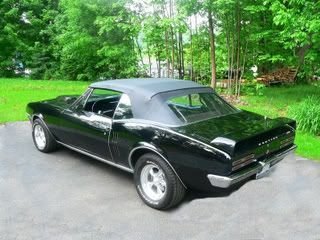
Of course it was more interesting the first time I posted it because it had pictures. Hey I found one of the original pictures from the testing.
There are maybe three cars on this forum that are stock? As in every nut, every bolt, valve job, gasket untouched since Pontiac first assembled the car?
Anything else is fruit cocktail. Saying that this car likes 100 (what they were designed to run, RON rating which is approximately 95 or 96 (R+M)/2) or that another car likes 98, or that 400 likes 36 degrees total timing all in at 3500 rpm with a 3.55 or this 350 likes it all in at 2800 with a 2.76 isn't going to help the owner of a 326 2bbl or a RA IV very much, stock or not.
I don't have the background to do more than record what I have, make a best-guess change in a small increment, test, and either refine or reverse course until I get what I'm looking for. But this takes time, it takes good recordkeeping, and sometimes it takes inspiration from others to get past a roadblock.
If there's one thing I've learned, it's hard to improve on the original design without a plan and thorough knowledge of what each change will effect.
Vikki 1969 Goldenrod Yellow / black 400 convertible numbers matching
Jim, an average of three 0-60mph times per fuel mix would have been more indicative of performance gain or loss. Easy to do with a copilot. Also some notes about the weather conditions, time of day, temp, initial and total timing and some indication of the mechanical advance curve, jetting, cam, stuff like that so we can try and relate some of your data to what's on other cars. Obviously the tests weren't all completed on the same day unless you did an awful lot of driving that day.
If you are running the 068 cam, your set-up will likely be the most demanding regarding octane in comparison to the other 400 engine combos.
If your charging system is running that high (18-24 volts), either you need a new voltmeter or you'll be frying batteries like crazy. Proper charging voltage is 14.7 volts.
There are maybe three cars on this forum that are stock? As in every nut, every bolt, valve job, gasket untouched since Pontiac first assembled the car?
Anything else is fruit cocktail. Saying that this car likes 100 (what they were designed to run, RON rating which is approximately 95 or 96 (R+M)/2) or that another car likes 98, or that 400 likes 36 degrees total timing all in at 3500 rpm with a 3.55 or this 350 likes it all in at 2800 with a 2.76 isn't going to help the owner of a 326 2bbl or a RA IV very much, stock or not.
I don't have the background to do more than record what I have, make a best-guess change in a small increment, test, and either refine or reverse course until I get what I'm looking for. But this takes time, it takes good recordkeeping, and sometimes it takes inspiration from others to get past a roadblock.
If there's one thing I've learned, it's hard to improve on the original design without a plan and thorough knowledge of what each change will effect.
Again you prove me right. We need to know about the engine before we give advice. It's really a simple concept that I'm sure you can grasp. I like to keep it simple, really. It's a total waste of time to give spark knock advice without having an idea of the compression ratio. And I think that the type of fuel used plays a huge part in determining the cause of spark knock.
Jim, an average of three 0-60mph times per fuel mix would have been more indicative of performance gain or loss. Easy to do with a copilot. Also some notes about the weather conditions, time of day, temp, initial and total timing and some indication of the mechanical advance curve, jetting, cam, stuff like that so we can try and relate some of your data to what's on other cars. Obviously the tests weren't all completed on the same day unless you did an awful lot of driving that day.
If you are running the 068 cam, your set-up will likely be the most demanding regarding octane in comparison to the other 400 engine combos.
If your charging system is running that high (18-24 volts), either you need a new voltmeter or you'll be frying batteries like crazy. Proper charging voltage is 14.7 volts.
Hey man. The results were so darn obvious. It would be totally rediculous to go into even more detail on this testing. We all know about how octane helps power in high compression engines anyway. I wanted to add a little 'rubber on pavement' observations since my engine and car were brand new. Just like '69. Go figure that when you get fuel in her like they had in '69 she would run the best. It's a no brainer. Greg asked me to do it and I did. He told me that he was very happy with my testing and it helped confirm his suspicions. He has since done more testing and concurs that higher octane fuel gives him more power in his car too. His car also has high compression(stock 670's with original style pistons).
We need to know about the engine before we give advice. It's really a simple concept that I'm sure you can grasp. I like to keep it simple, really. It's a total waste of time to give spark knock advice without having an idea of the compression ratio. And I think that the type of fuel used plays a huge part in determining the cause of spark knock.
It's also a total waste of time to claim you have test results or data when you can't even provide the simple numbers that properly describe your baseline. I notice that every time I ask you about something as simple as the amount of timing you have, you "smoke and mirrors" or "complicate" your way out of answering. Buy a timing light and check it.
I'm glad you and Greg are happy with your seat of the pants impressions. If you want to learn how to do proper testing, PM me. You need to know more about testing before you spout off about "analysis" and "data".
It's also a total waste of time to claim you have test results or data when you can't even provide the simple numbers that properly describe your baseline. I notice that every time I ask you about something as simple as the amount of timing you have, you "smoke and mirrors" or "complicate" your way out of answering. Buy a timing light and check it.
I'm glad you and Greg are happy with your seat of the pants impressions. If you want to learn how to do proper testing, PM me. You need to know about testing before you spout off about "analysis" and "data".
Back off and go lay down Mr. Scientist. This was a fun study and it did what it was intended to do.
Smoke and mirrors. Why do you think they sell racing fuel? I know, for all the dumbies like me that don't know how to tune our cars. To think that I could be burning 87 in my stock 69 engine all these years if I was as smart as you. Goll Lee!!!
To think that all I had to do all these years to tune my engines was to use the most expensive fuel I could find. Gosh, all that time and money I wasted on the dyno actually adjusting the timing and jetting. If only I were as smart as you!
It could also be a good learning experience for you if you didn't get so far off base with your comments.
And the rest of us - the ones who like to quantify things and are probably a little conservative when it comes to claims and such - appreciate the tire smoke that you produce in the name of FGF's. Keep spinning your wheels! Seriously!
Cool! And I will gladly oblige that request! HINT: If you could ask a few specific questions about a engine before you shoot from the hip with advice you would be a much more credible scientist.
Doug gave specific results from his testing, pinging between 2300 and 3500 rpm. A simple problem with a simple solution. If you did some actual tuning, you would know that.
Bigger hint: if you would write down a few specifics before you shoot from the mouth you might be more credible. Learn about proper testing before you criticize others.
I have to chime in here now. The most important thing you can do when trying to figure the octane your engine will need (no mater stock or modified) is to know what your cranking compression is. If you have around 175 LBs you can tune it to run on 93 octane or below (Jim Hand and Cliff Ruggles both run their high compression 455 daily drivers on 87 octane and run at the track in the 11's) If you have around 210 compression it will probably need 98 octane to perform the best.
There are a several ways to get to the 175 range. Dished pistons, cam overlap,larger heads.
I have high compression heads (16s) 0-deck block, crower 60916 cam,1.65 rockers, forged pistons. I have around 419 HP and run on 93 octane with no problems at all.
We should all post are cranking compression and what octane we need to run?
I have to chime in here now. The most important thing you can do when trying to figure the octane your engine will need (no mater stock or modified) is to know what your cranking compression is. If you have around 175 LBs you can tune it to run on 93 octane or below (Jim Hand and Cliff Ruggles both run their high compression 455 daily drivers on 87 octane and run at the track in the 11's) If you have around 210 compression it will probably need 98 octane to perform the best.
There are a several ways to get to the 175 range. Dished pistons, cam overlap,larger heads.
I have high compression heads (16s) 0-deck block, crower 60916 cam,1.65 rockers, forged pistons. I have around 419 HP and run on 93 octane with no problems at all.
We should all post are cranking compression and what octane we need to run?
You have to admit that it helps to know cranking pressure and fuel used(at the very least) to answer spark knock questions, agreed? It would make the difference between a 'guess' and an 'educated guess'.
Have to admit, i jumped the fence to aluminum heads. Current combo;
30 over 400 blk w/eagle crk(461 ci) Untouched 87cc's Crower RAIV cam w/1.65 rkrs. 10.2 cr "calculated" Have to find notes on cranking comp, but think it was 165-170
Been using 87 on the street for 2 years, and 93 at the track without a any issues. Got to love that!
8point, I brought up that same topic before. The minimum specs to make a credible submission should be cylinder pressure, deck height, head composition, fuel BRAND and rating. And unless something really earth-shattering comes out, I agree that 175 is about as high as you'd want to go for a street car. My '70 440-6 'Cuda had a cranking compression of 190 from the factory and it was a real PITA to blend fuel for once leaded went away. Since the cranking compression is very easily altered and slight alterations can cause a large effect, it's a good starting point. Without a dyno, software is the next-best tool.
Oh, and one more thing...without knowing the distributor's initial, mechanical, and vacuum timings applied, and the cam timing, none of the above makes any difference...so buy the right tools (adjustable timing light, cam degree wheel).
Doug was kind enough to provide affected RPM range, fuel rating, and engine builders stated compression right away in his request. It didn't take any further questioning to gather data.
Vikki 1969 Goldenrod Yellow / black 400 convertible numbers matching
Doug was kind enough to provide affected RPM range, fuel rating, and engine builders stated compression right away in his request. It didn't take any further questioning to gather data.
He didn't state anything at all about compression or fuel. That's why I asked it. Go back to the beginning and read.
Here's his complete question;
My engine spark knocks around 2300-3500 in any gear. So after reading other post on the sub. I think it's the mech. advance. So I pulled my dist. cap and rotor and the springs are different sizes. Meaning one is heavier than the other. Is this o.k. or out of the norm ?
This question is begging for compression and fuel info to be included. That's why I politely asked....
Exactly! I'm glad you finally see my point. You couldn't give a good answer until then. 14 posts later and the next day the info was in to make an informed guess at what the problem may be.
Wrong. Doug had two good suggestions even before he provided the balance of the information. Just because Doug was delayed in rejoining his own thread does not mean that it was idle rhetoric from all corners.
Vikki 1969 Goldenrod Yellow / black 400 convertible numbers matching
Oh man! Just trying to get Doug the info he needs. Thought he should try a little higher octane fuel before he messes with that professionally tuned distributor. The clue I had right off the bat was that he was comparing his 10-1 engine with a post about a 9.5 to 1 engine that was specifically built to run on 93. I remember Doug's build from posts years ago. The curse of a good memory! When I asked the question about fuel and compression I was trying to get the rest of the 'guessers' up to speed on the engine first. There's a big difference right in that area of compression. Especially with cast iron heads. Racing fuel may be expensive but the point has often been made that you can buy a lot of racing fuel for what aluminum heads cost. Some of us like to stay original and for us there isn't any choice but to pony up for fuel. I also know Doug likes to race his car at the track and if you 'de-tune' the distributor it will be slower. The distributor was built to use a 'power band' in those RPM's where he has spark knock. I bet if he adds octane he will not have to touch a thing and he will be much faster for it. His choices are to de-tune for low octane or buy higher octane and race. The only other choice is to yank it and build it for 93.
O.K. I took the bird out today with the vacuum advance unplugged and it did not seem to spark knock.
I guess I didn't totally understand the Pertronix and what it does.
I thought it controlled spark only but it must also control the vacuum advance to ? But then, what would unplugging the vacuum adavance have to do with the mech. advance ?


 Go buy some 87 for your Bird and change it back. When you can show me that you can burn straight 87 in your yellow Firebird with it's stock engine then I will buy the theory. I bet your testing results will still match mine.


 Mad scientist!