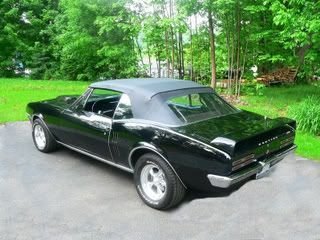
why is the 69 ram air 3 engine have a lower h.p. rating in the firebird than the one in the g.t.o? i heard a rumor that the secondary air door on the quadrajet was kept more closed on the firebird to kill some h.p.
the carbs on gtos are made without a stop. the birds have a stop built in. this keep the carb from opening fully. this keeps the engine from getting the air/fuel mixture to achieve the hp that the gto gets. what a rip hugh?
It was the power to weight ratio. GTO's weighed more than Firebirds. A plastic tab was installed on the linkage of Firebirds to restrict full opening of the secondaries, limiting HP and was easily defeated.
Insurance purposes and GM edict. 1 HP per 10 pounds vehicle weight.
Pontiac engines were quite under rated though.
Si Vis Pacem Parabellum
1967 Starlight black PMD Engineering 400 Auto 1968 Alpine Blue 400 4 speed 1968 Verdoro Green 400 HO 4 speed 2013 1LE 2SS/RS Inferno Orange Camaro.
As stated above, 1hp/10lb was the GM mandate. When the top brass first saw the 3400 lb 67 Firebird 400, they knew it had the GTO engine, and the engineers tried to underrate the Firebird 400....on paper.
The engineers attempted to convince the top brass that the Firebird engine was detuned, but the top brass knew DeLorean (and Pontiac) all too well. To appease GM, the engineers came up with a cheap way to limit the throttle opening on the Q-jet, and that made GM happy.
In every original road test where a Firebird and GTO squared off, the Firebird was always 2/10's quicker. Of course, the road testers already fixed the Firebird carb to allow full throttle.
By the way, not only were the engines the same between the GTO and Firebird, and the Firebird weighed less, but the RAIII/RAIV Firebird exhaust manifolds outflowed the GTO RAIII/RAIV versions by about 5 hp.
And the Firebird 400's may be the only Musclecar ever made where the manufacturer purposely slowed their car down, via a device to limit full throttle, in order to make their manufacturer happy.
The other reason for the limiter, and for the Firebird's lower hp rating, was purely a marketing move. It didn't make sense to impact sales of the hot selling 67 GTO by placing a Firebird 400 on the same showroom floor, and have the Firebird listed with the exact same hp rating. It was already obvious the Firebird was sportier, lighter, and was more performance oriented. So giving the Firebird a hp rating of 350, 360, 366, or 370 hp would have further tarnished the image of Pontiac's flagship GTO.
I've heard it referred to as a "tab" that could be easily broken off, and I've heard it referred to as a "bracket" that could be removed, or a "rod" that could be bent.
From what I've researched, the rod that activates the secondaries (all Q-jets have these), coming off the primary shaft on the driver's side, has a "tab" or "tang" that the rod hits in order to open the secondaries. On the Firebird 400's, this tab was not 90 degrees to the shaft. This made the secondary throttle blades (not the air valve secondary blades up top, the actual throttle blades) only open about 75% of the way.
You could grab the rod with a pair of pliers, and make it "longer" by removing or lessening one of the bends, or you could take a pair of pliers and simply bend the secondary tab (where that primary rod hits it) to get full throttle.
This is probably why some magazines stated you just had to "bend the rod" to get full throttle, while others stated "bend a tab".
I even seen them in the back seat. I had three STANDING on my fold down last St. Patricks Day. You could also call those fold downs 'ejection seats'. Almost lost a few restrictors when urged by the crowd to spin the tires.
I've heard it referred to as a "tab" that could be easily broken off, and I've heard it referred to as a "bracket" that could be removed, or a "rod" that could be bent.
From what I've researched, the rod that activates the secondaries (all Q-jets have these), coming off the primary shaft on the driver's side, has a "tab" or "tang" that the rod hits in order to open the secondaries. On the Firebird 400's, this tab was not 90 degrees to the shaft. This made the secondary throttle blades (not the air valve secondary blades up top, the actual throttle blades) only open about 75% of the way.
You could grab the rod with a pair of pliers, and make it "longer" by removing or lessening one of the bends, or you could take a pair of pliers and simply bend the secondary tab (where that primary rod hits it) to get full throttle.
This is probably why some magazines stated you just had to "bend the rod" to get full throttle, while others stated "bend a tab".
Exactly what I have heard about and seen on some quadrajets. Not just Firebird quadrajets either. I'm wondering where the 'plastic tab' rumour is coming from. Is it a myth?
There have been several articles & publications over the years that have refered to such a variation on the Firebird Carb.
Hot Rod Magazine- 3/68 "...in order to produce the advertised horsepower, there is a small tab on the throttle shaft which actuates the secondaries, but only to two-thirds open at full-throttle. Somehow you don't feel guilty at bending it rearward."
Special Interest Autos- 10/86 "..The 400 was detuned to 335bhp by adding a small metal tab in the throttle linkage which slightly limited travel of the secondaries. Needless to say, very few of these tabs remain today where GM put them."
Motor Trend- 12/91 "...GM only agreed to install the 400 engine if it could restrict it's performance, which meant it placed a stop on the throttle linkage that prevented wide-open throttle. Of course, that could be removed by the owner in about 30 seconds." (Jim Wangers)
The Fabulous Firebird- M.Lamm- 1979 "...Yet to stay within GMs horsepower ruling (1hp for every 10lbs), Pontiac not only derated the Firebird 400 V-8 to 325 bhp but also modified it so, in showroom form, it truly wouldn't produce more than 325 bhp.... by simply changing the link between the primary and secondary barrels of the Rochester Q-Jet carb. This link was arranged with a steel tab that didn't let the secondaries open more than 90% at full throttle."
Firebird Decoding Guide- T. DeMauro- 1997 "A throttle linkage restrictor installed on all Firebird 400s stopped the rear two barrels of the Quadrajet from opening allthe way, thus limiting horsepower and keeping the car within the 10-lbs to 1 hp Gm corporate edict."
So, as you can see, there was obviously something different between a GTO carb and a Firebird. Surely all of these articles were not simply created from simple rumors or suspicions but from experience. Many references were based on modifications by Royal Pontiac during prep for an article (to squeeze out more performance). No mention was ever made about the difference in the exhaust system. If anything, the HO and Ram Air Firebirds had a better exhaust system due to to Long Branch Exhaust Manifolds.
As for defining the actual component on the carb. and how it was different, there needs to be a photo comparision to better explain this. The above excerpts seem to refer to the same thing; a tab on or a part of the throttle linkage.
Si Vis Pacem Parabellum
1967 Starlight black PMD Engineering 400 Auto 1968 Alpine Blue 400 4 speed 1968 Verdoro Green 400 HO 4 speed 2013 1LE 2SS/RS Inferno Orange Camaro.
Looking at those quotes, the rod/tab I was referring to (primary to secondary rod, with the metal tab) fits in to what they were saying.
Remember though, in original road tests from 1967-1969, the magazine writers were being relayed info from Royal Pontiac. I doubt any of those original road test writers ever saw the "tab", they just wrote down what was described to them by Milt Schornack.
You could either bend the rod to straighten it out a bit, or you could bend the tab.
I don't have a good photo with me, but here's a basic 1969 Q-jet (side view, drivers side), showing the rod and tab I'm referring to.
I agree. Haven't seen any plastic tabs. From what I have seen they all have the tab. It's just that some are bent and some are not. Back in the day we used to see quite a few with the tab bent in a way that didn't let the secondaries open all the way. It was the very first carb trick I learned from my older cousins. They always looked for the tab and bent it like the one in the auction. I'm sure we bent dozens of these. There were quite a few applications that the carb tab needed bending to get the most out of the carb.... Now, on the other hand, I've heard tell of people bending this tab in a way to STOP the secondaries from opening all the way. When people used these cars for daily drivers it made the 4 barrel into a stingier carb than the two barrels were. So, there's bound to be some confusion and many many altered tabs out there.
And what many didn't realize was that when they check for full throttle, they would hold the throttle wide open at the carb, then push down on the secondary air valve flaps, and yep, it's opening all the way. They never realized that they have to hang over the fender and look down the throat of the carb to see if those baseplate blades are opening all the way.
By the way, in reference to "Musclecar vs. Ponycar" from Bjorn, it was the Ponycars that ended up being the quickest, fastest, and best handling cars of the Musclecar Era.
By the way, in reference to "Musclecar vs. Ponycar" from Bjorn, it was the Ponycars that ended up being the quickest, fastest, and best handling cars of the Musclecar Era.
true, the "pony cars" had mo muscle than the muscle cars, or , rather...less weight...lol
When I first got my car in 85 the carb was original. After reading about changing linkage in a magazine I looked at mine and it would not open fully. The problem is I can't remember exactly what I did to fix it, but I think I remember doing something to the chock side of the carb. Maybe on the secondary throttle shaft. But I could be Wrong.




 They never realized that they have to hang over the fender and look down the throat of the carb to see if those baseplate blades are opening all the way.