|
|
Joined: Jun 2013
Posts: 48
Member
|
|
Member
Joined: Jun 2013
Posts: 48 |
Hi there,
I was driving my '68 Firebird 400 to work yesterday & thinking myself how well it was running while on the highway. As I got off the highway & onto the surface streets, I suddenly had a big misfire issue which required me to keep the RPMs up while at a stoplight to keep from stalling.
I limped the car the last mile into work & took a look under the hood after work.
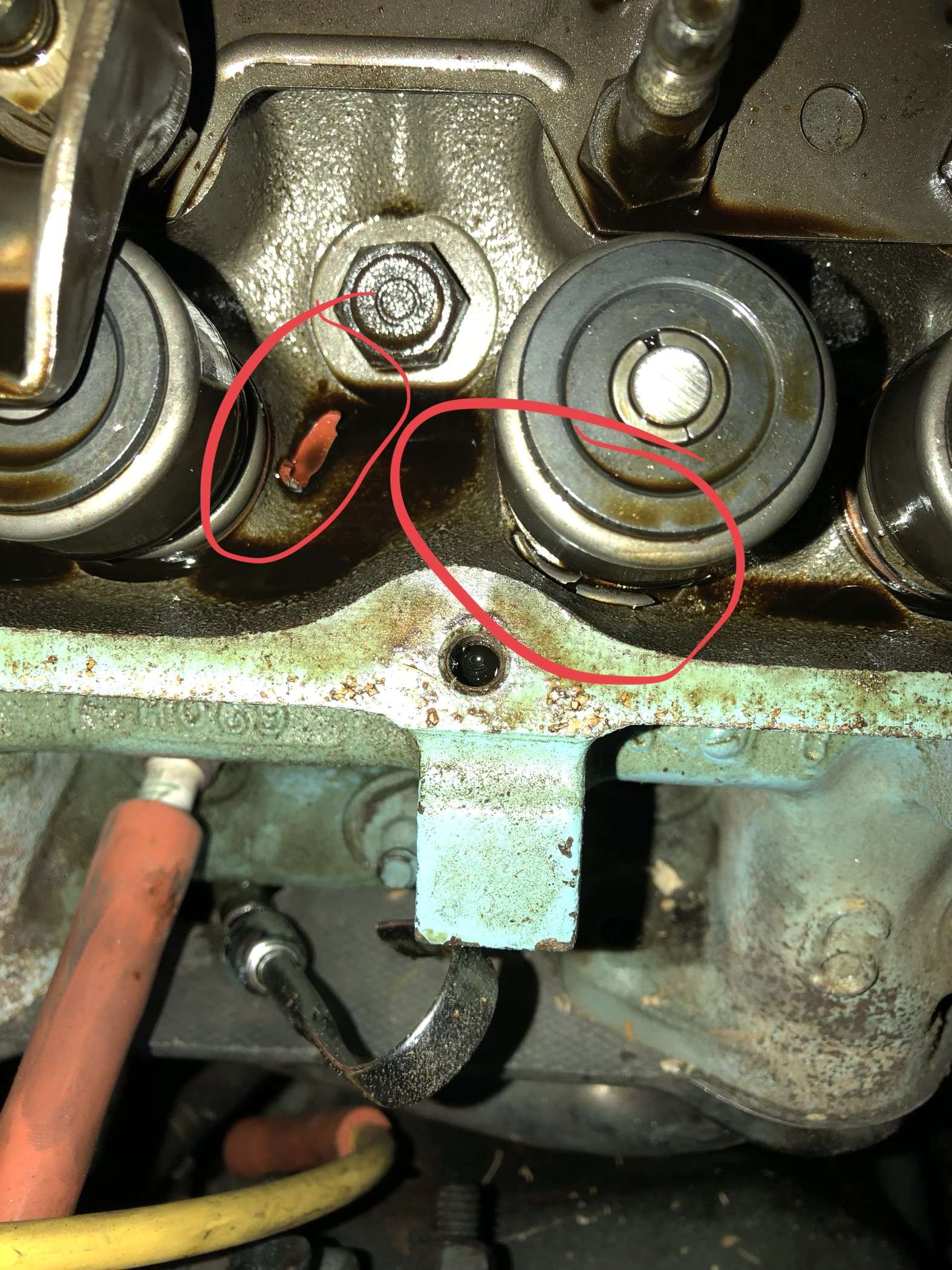
Car suddenly has 0 PSI (no compression) in cylinder #2, with an obviously very rough idle, and a clunking noise. All other cylinders have good compression. I had the car towed home & took a peak under the valve cover for cylinder #2.
In the attached photo, there's a piece of orange rubber (one of two pieces I found), and also some metal fragments at the base of the valve spring for cylinder #2. I removed the rocker arm to make this easier to see.
Any ideas what the issue could be here? What's the best course of action? Remove the heads right away, or try to fix the issue with the heads still on the car?
Thanks,
Alex
Last edited by ahs; 07/24/18 01:49 PM.
|
|
|
|
|
Joined: Jan 2009
Posts: 3,049 Likes: 10
Senior Member
|
|
Senior Member
Joined: Jan 2009
Posts: 3,049 Likes: 10 |
Pull the spark plug and get a boro-scope (one that works with your smartphone) and stick it in the hole and take a peek around.
Hard to say what happen, but I fear you may be pulling the cylinder head. Hopefully no damage to the piston.
Maybe that valve got hung OPEN for some reason and contacted the piston?
-Jeff
|
|
|
|
|
Joined: Jul 2018
Posts: 244 Likes: 1
Member
|
|
Member
Joined: Jul 2018
Posts: 244 Likes: 1 |
Was the engine put together with any orange permatex gasket maker/sealer around an intake? maybe a chunk came off, got sucked in, kept a valve open, BAM, ??? Good luck
|
|
|
|
|
Joined: Jun 2013
Posts: 48
Member
|
|
Member
Joined: Jun 2013
Posts: 48 |
Was the engine put together with any orange permatex gasket maker/sealer around an intake? maybe a chunk came off, got sucked in, kept a valve open, BAM, ??? Good luck I have not seen any orange gasket makers used in the intake or valve area. My initial guess was that maybe the orange rubber is pieces of a valve stem seal, but I'm not sure if that's even orange in the first place.
|
|
|
|
|
Joined: Dec 2005
Posts: 5,108
Power Member
|
|
Power Member
Joined: Dec 2005
Posts: 5,108 |
Looks like valve spring pieces or ???
Get a magnate and pic them out to get a better look.
Last edited by Region Warrior; 07/24/18 05:33 PM.
|
|
|
|
|
Joined: Jan 2010
Posts: 2,405 Likes: 1
Member
|
|
Member
Joined: Jan 2010
Posts: 2,405 Likes: 1 |
Orange looks like orange hi heat sealer from the rocker cover gasket? Or the valve guide seal.
The metal parts on the bottom look like broken pieces of spring or spring seat.
I'd pull the head, may be damage in there you cannot see otherwise. You may be able to get away with the rope in the spark plug hole trick and a valve spring compressor that pivots on the rocker stud.
Al
|
|
|
|
|
Joined: Jan 2010
Posts: 2,405 Likes: 1
Member
|
|
Member
Joined: Jan 2010
Posts: 2,405 Likes: 1 |
Forget the rope trick and pull the head. That valve has to come out for inspection. If it was just a matter of a piece of silicone caught between the valve and seat you could put air in the cylinder and tap on top of the valve to try and dislodge it, but you have broken metal there. Pull the head.
Al
|
|
|
|
|
Joined: May 2001
Posts: 3,615
Premium Member
|
|
Premium Member
Joined: May 2001
Posts: 3,615 |
I agree with Bluebird. Pull the head. Not that big of a project.
...actually, it is quite a project.
Last edited by Bronze Bird; 07/25/18 01:03 PM.
I'm a hobbyist. Not a professional. Don't be hatin'!
|
|
|
|
|
Joined: Jun 2013
Posts: 48
Member
|
|
Member
Joined: Jun 2013
Posts: 48 |
The metal parts on the bottom look like broken pieces of spring or spring seat.
I think the broken metal is most likely from the valve spring, based on the fact that it matches the valve spring's texture perfectly. My plan is to use a borescope to inspect the piston. If I see damage inside the cylinder, I'll pull the entire engine. If I don't see any damage in the piston, I'll pull the head & re-inspect the piston again when the head is off. Thanks guys
|
|
|
|
|
Joined: May 2001
Posts: 3,615
Premium Member
|
|
Premium Member
Joined: May 2001
Posts: 3,615 |
My plan is to use a borescope to inspect the piston. If I see damage inside the cylinder, I'll pull the entire engine. If I don't see any damage in the piston, I'll pull the head & re-inspect the piston again when the head is off. Since you will be pulling the head in either case, why not just pull it first?
I'm a hobbyist. Not a professional. Don't be hatin'!
|
|
|
|
|
Joined: Jun 2013
Posts: 48
Member
|
|
Member
Joined: Jun 2013
Posts: 48 |
My plan is to use a borescope to inspect the piston. If I see damage inside the cylinder, I'll pull the entire engine. If I don't see any damage in the piston, I'll pull the head & re-inspect the piston again when the head is off. Since you will be pulling the head in either case, why not just pull it first? I would like to keep the engine assembled while pulling it, just makes it easier to wrench on and stay organized if the engine is out of the engine bay, before disassembling.
|
|
|
|
|
Joined: May 2001
Posts: 3,615
Premium Member
|
|
Premium Member
Joined: May 2001
Posts: 3,615 |
I'm a hobbyist. Not a professional. Don't be hatin'!
|
|
|
|
|
Joined: Jan 2002
Posts: 7,719
Power Member
|
|
Power Member
Joined: Jan 2002
Posts: 7,719 |
Dropping a cast iron cylinder head on a fender will definitely ruin your day. Picking up freshly machined cast iron heads in your Mom's car (cause yours is not running), then stacking them in the trunk such that hanging a left turn puts one of them into a 1/4 panel - will put you in a big world of hurt (I was 18 at the time). 
2012 Mustang Boss 302 #1918, Competition Orange. FGF replacement
2006 Mustang V6 Pony, Vista Blue. Factory ordered.
2019 BMW X3 (Titled to the wife, but I'm always driving it for her. So I'm claiming it)
Old projects, gone but not forgotten:
1967 FB 400, original CA car. After 22 years of work, trashed by the guy who was supposed to paint it. I had to sell it.
1980 Turbo Trans Am
1970 Mustang fastback, 351C 4Bbl, auto
1988 Mustang GT, 5 speed
1983 F-150 4x4, built 302
1994 Chevy K2500 HD 4x4, 454 TBI
|
|
|
|
|
Joined: Jun 2013
Posts: 48
Member
|
|
Member
Joined: Jun 2013
Posts: 48 |
Update: So I finally got an endoscope & poked around in cylinder #2, which had the sudden loss of compression. There seems to be a large gouge in the cylinder wall of #2, but I'd like to confirm with you guys that it's not something else (optical illusion, whatever) While I was at it, I also took a peak at cylinder #1, and noticed a couple bright spots on the piston head-- one towards the center, and another right on the edge. The bright spot on the edge of piston #1 is reflecting onto the wall-- the walls are actually fine. What do you guys think based on these photos? Do I have definite damage on cylinder #2 that will require pulling the bottom end of the engine? Here's a link to the attached image, in case you're not logged in
|
|
|
|
|
Joined: Apr 2010
Posts: 6,758
FGF Premium Member
|
|
FGF Premium Member
Joined: Apr 2010
Posts: 6,758 |
I will admit that I would be guessing about what your pictures show here, but the main thing is, there is a leak. Question is where is it leaking. Thru a valve (intake or exhaust) or past the rings correct?
You did the compression test to confirms the leak, now do I leak down test to determine where it's leaking. There is a tool you cab buy to do the leak down test. It uses compressed air to locate the leak and what % is leaking. So if the leak is in the valves, pull the head, if it's the piston rings, pull the engine. If it were me I'd pull engine now. Much easier to work with it out of the car. Pulling the engine with one head out will be very unstable.
Good luck!
Engine Test Stand Playlist: https://www.youtube.com/playlist?list=PLwoxyUwptUcdqEb-o2ArqyiUaHW0G_C88restoring my 1968 Firebird 400 HO convertible (Firedawg) 1965 Pontiac Catalina Safari Wagon 389 TriPower (Catwagon) 1999 JD AWS LX Lawn tractor 17hp (my daily driver) 2006 Sequoia 2017 Murano (wife's car) 202? Electric car 203? 68 Firebird /w electric engine 2007 Bayliner 175 runabout /w 3.0L Mercuiser__________________________________________________________
|
|
|
|
|
Joined: Jun 2013
Posts: 48
Member
|
|
Member
Joined: Jun 2013
Posts: 48 |
I will admit that I would be guessing about what your pictures show here, but the main thing is, there is a leak. Question is where is it leaking. Thru a valve (intake or exhaust) or past the rings correct?
You did the compression test to confirms the leak, now do I leak down test to determine where it's leaking. There is a tool you cab buy to do the leak down test. It uses compressed air to locate the leak and what % is leaking. So if the leak is in the valves, pull the head, if it's the piston rings, pull the engine. If it were me I'd pull engine now. Much easier to work with it out of the car. Pulling the engine with one head out will be very unstable.
Good luck! Thanks for your reply! I agree that pulling the engine with the heads still attached will make things easier on me. I did do a leakdown test on the cylinder & found that it is leaking through the exhaust valve while at TDC. Now, I'm not sure if the imperfection on the cylinder wall would have an effect on the cylinder while it's at TDC, since it may be below the piston rings at that point. Could I potentially line up the piston with the imperfection, and do a leakdown test at whatever position that is? I suppose I would be looking for air coming out *both* one of the valves & through the PCV. Or will that be too hard to trace down-- air coming through two places, a correctly open valve, and a potential ring leak?
|
|
|
|
|
Joined: Jan 2012
Posts: 521
Member
|
|
Member
Joined: Jan 2012
Posts: 521 |
If it is leaking out the exhaust then either valve lash is too tight, Valve is burnt, valve is bent, or something is holding it open. Take a quick look at your carb to make sure nothing is missing (squirter, venturi screw etc) then take a straight edge and hold it against your valve retainers ( preferably against the tops of the valve stems and see if #2 is lower than the rest. on a properly machined head these are even when the valves are closed). If they are all even then the valve must be burnt (unusual for it to happen all of a sudden) if they are uneven and #2 is sitting down a bit then either the valve is bent or something is holding it open. Exhaust valves are the ones to get bent because the piston chases them up the cylinder on exhaust stroke, weak spring can do this. I have had a piece of intake gasket hold a valve open before and it lost all compression. Your endoscope up the exhaust port might show this and your endoscope will feel right at home...
68 ohc convertible
68 400 coupe
69 350 coupe(455 4 speed)
|
|
|
|
|
Joined: Apr 2010
Posts: 6,758
FGF Premium Member
|
|
FGF Premium Member
Joined: Apr 2010
Posts: 6,758 |
I will admit that I would be guessing about what your pictures show here, but the main thing is, there is a leak. Question is where is it leaking. Thru a valve (intake or exhaust) or past the rings correct?
You did the compression test to confirms the leak, now do I leak down test to determine where it's leaking. There is a tool you cab buy to do the leak down test. It uses compressed air to locate the leak and what % is leaking. So if the leak is in the valves, pull the head, if it's the piston rings, pull the engine. If it were me I'd pull engine now. Much easier to work with it out of the car. Pulling the engine with one head out will be very unstable.
Good luck! Thanks for your reply! I agree that pulling the engine with the heads still attached will make things easier on me. I did do a leakdown test on the cylinder & found that it is leaking through the exhaust valve while at TDC. Now, I'm not sure if the imperfection on the cylinder wall would have an effect on the cylinder while it's at TDC, since it may be below the piston rings at that point. Could I potentially line up the piston with the imperfection, and do a leakdown test at whatever position that is? I suppose I would be looking for air coming out *both* one of the valves & through the PCV. Or will that be too hard to trace down-- air coming through two places, a correctly open valve, and a potential ring leak? I think your imperfection is a reflection off the top of you piston. It's the piston relief your seeing. Besides, the wall is very thin and I can't see how you could gouge the cylinder without packing in the drive train.
|
|
|
|
|
Joined: Jun 2013
Posts: 48
Member
|
|
Member
Joined: Jun 2013
Posts: 48 |
My plan is to use a borescope to inspect the piston. If I see damage inside the cylinder, I'll pull the entire engine. If I don't see any damage in the piston, I'll pull the head & re-inspect the piston again when the head is off. Since you will be pulling the head in either case, why not just pull it first? Good call about the piston reflecting onto the cylinder wall! That's exactly what it is, and it's obviously now, when looking at the pictures. I pulled the head and verified that the cylinder wall is undamaged. I had a single broken valve spring, which I'm now trying to diagnose... I do have an aftermarket cam in the Pontiac 400, but I'm not sure what the actual profile of it is. The aftermarket cam was installed by a previous owner. The only legible markings on the cam are "CWC" and "540 233". I've searched the internet for those numbers, others have the same cam, but are unable to determine what it is. I didn't have time to remove the cam from the block, but I did measure the lift of the cam by measuring the movement of the lifters as I rotated the engine by hand. It appears that the difference between high & low for the lifters is approximately 0.295'', which, assuming a 1.5 rocker arm, translates to about 0.4425 of valve lift. What is the maximum amount of lift that the stock valve springs can handle? Would ~0.4425'' of valve lift potentially be enough to destroy a valve spring? Or am I looking at a freak event?The valve spring failed after about 3000 miles of driving since the last rebuild. I do not know for sure if the valve springs were replaced last rebuild, but they do at least look to be in new condition.
Last edited by ahs; 10/08/18 04:34 AM.
|
|
|
|
|
Joined: Jan 2010
Posts: 2,405 Likes: 1
Member
|
|
Member
Joined: Jan 2010
Posts: 2,405 Likes: 1 |
CWC 540 233 is the camshaft core number. You will have to pull the camshaft to get the number(s) or letter(s) off the end of the camshaft to identify what the grind is. CWC is Campbell, Wyant and Cannon. The foundery has produced millions of camshaft cores. Camshaft grinders buy the cores then machine them to whatever specs.
Aftermarket camshaft companies and automobile manufacturing companies, including Pontiac, use CWC cores. It is now called CWC Textron.
You will have to compress the valve springs the amount of lift and check if the spring is binding. Maybe take off the other rocker cover and pull the engine through to check what the clearances are.
How much if any play does the valve stem have in the valve guide?
Is the seat damaged at all?
Is there signs that the valves were floating?
Is the pushrod bent?
Is there wear in the rocker cup or on the ends of the pushrod?
I'd say at the least you'd have to remove all the valves and springs then inspect the head, valves, springs, seats, keepers etc. for damage.
Al
|
|
|
|
|
Joined: Jun 2013
Posts: 48
Member
|
|
Member
Joined: Jun 2013
Posts: 48 |
CWC 540 233 is the camshaft core number. You will have to pull the camshaft to get the number(s) or letter(s) off the end of the camshaft to identify what the grind is. CWC is Campbell, Wyant and Cannon. The foundery has produced millions of camshaft cores. Camshaft grinders buy the cores then machine them to whatever specs.
Aftermarket camshaft companies and automobile manufacturing companies, including Pontiac, use CWC cores. It is now called CWC Textron.
You will have to compress the valve springs the amount of lift and check if the spring is binding. Maybe take off the other rocker cover and pull the engine through to check what the clearances are.
How much if any play does the valve stem have in the valve guide?
Is the seat damaged at all?
Is there signs that the valves were floating?
Is the pushrod bent?
Is there wear in the rocker cup or on the ends of the pushrod?
I'd say at the least you'd have to remove all the valves and springs then inspect the head, valves, springs, seats, keepers etc. for damage. Thanks for your reply! I've already dropped off the heads off with the machine shop to be rebuilt, they are going to take a look & see if anything is out of ordinary with regard to signs of floating valves, play in the valve guides, wear on the rocker cups, etc. Everything on the pushrods seemed fine. I ended up pulling the camshaft out halfway (without removing the radiator) and using my endoscope to get the numbers off the end of it. Here's the markings:
X03R
3081B0
ISKENDERIAN
I4 112
270 HYD
MEGACAM
901
I emailed Isky Racing Cams customer support & they immediately told me it is their 270 Megacam, part 901271, with 0.465 lift, 270 degrees advance, 221 degrees of 0.050 duration, with a custom ground 112 degree lobe center. Is there a rule of thumb for using performance vs stock valve springs? In this case I broke a valve spring with 0.465 lift. Could that be because I needed to have performance valve springs with that amount of lift? I don't know the origins of the broken valve spring, so I'm just assuming that it is stock. Could anyone suggest valve springs for my Isky Mega 270 Hyd Megacam with 0.465 lift? Thanks again!
|
|
|
|
Forums57
Topics35,546
Posts298,900
Members8,865
| |
Most Online19,810
Feb 1st, 2026
|
|
|
2 members (Rus, Jimc2002),
175
guests, and
27
robots. |
|
Key:
Admin,
Global Mod,
Mod
|
|
|
There are no members with birthdays on this day. |
|
|
|


