|
|
Joined: Jul 2006
Posts: 132 Likes: 5
Member
|
|
Member
Joined: Jul 2006
Posts: 132 Likes: 5 |
I recently finished an almost two decade restoration process on my 67 with a 400 engine which involved replacing or rebuilding everything. The car was missing a lot when I got it. I replaced the 326 with a 400 and rebuilt that. It already had a TH400 so I rebuilt that. Bought a stock type intake and carb on ebay. Carb is a quadrajet off a 1969 428 Bonneville which I've rebuilt and think it's working pretty well. It idles well with like 19" vacuum and drives great. Stock type mechanical fuel pump. Engine runs well and I can spin the tires pretty easy which is fun.
The engine cranks fast and easy hot or cold so no issues there. I put in a high torque starter, 750 CCA battery, and 2awg cables which all together completely fixed up the slow/no-cranking-when-hot problem I had before.
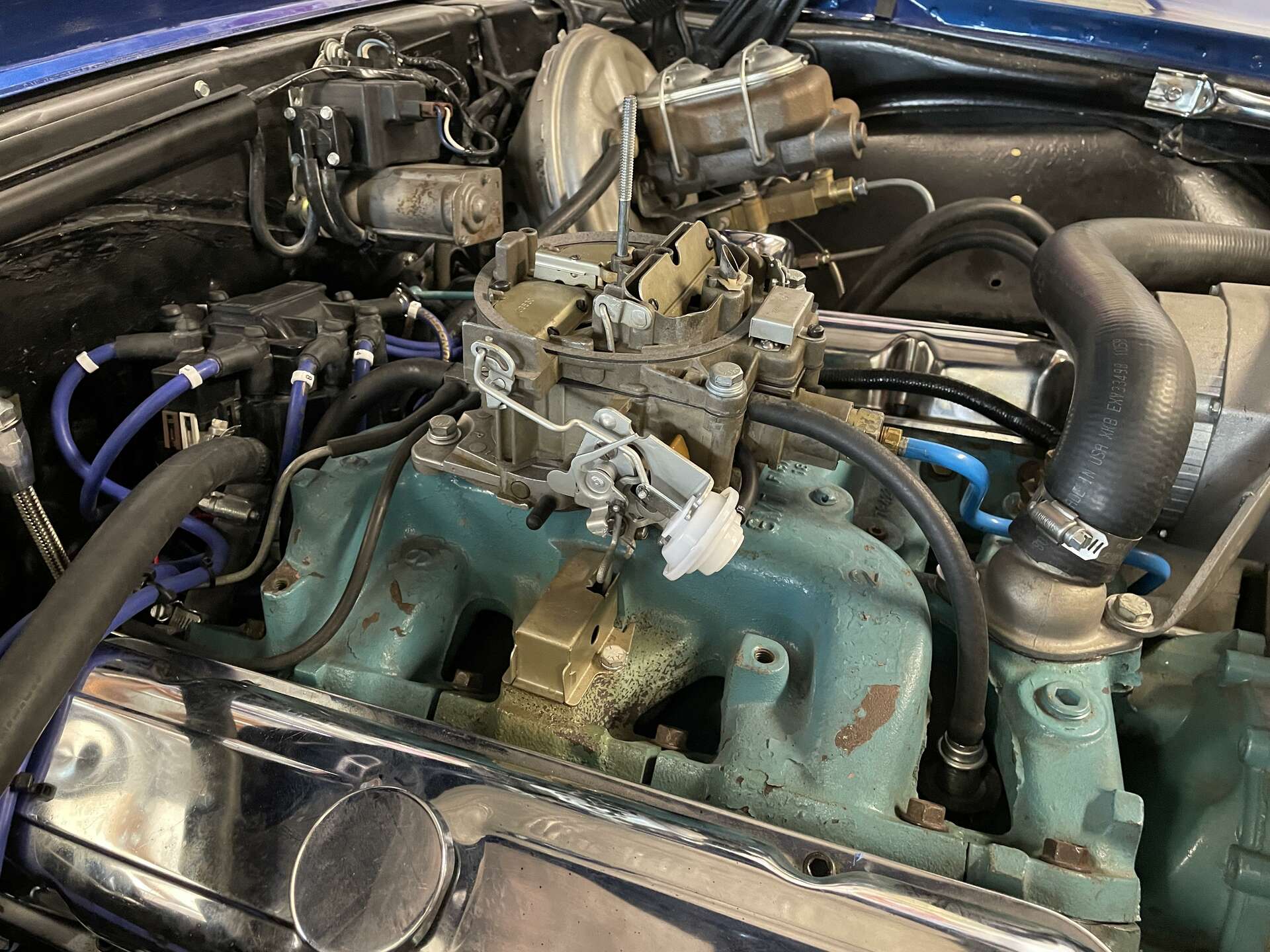
My carb is one with a divorced choke coil in the intake manifold exhaust crossover which you can see in the attached pic. Accelerator pump works. Choke works. Generally the carb is all good I believe. It idles at like 900 in Park fully warmed up which drops to maybe 750rpm in gear while holding the brakes.
This is the only carbureted car I've ever owned so I have very little experience. To start I'll give the accelerator pedal a press or two to the floor then release and crank the engine with foot off the accelerator pedal. When cold it fires right up immediately to like 1500 rpm high idle. Sounds robust, engine speed flare up when it fires off is great.
My issue is actually when the engine is hot. I do the same procedure pump the accel pedal once or twice then crank with my foot off the pedal. As I said the starter spins the engine over very well so no problem there with cranking speed. It will light off right away but engine speed only rises for a second to like a few hundred rpm then it falls back down to cranking and will start after a few seconds of cranking. When it does start it's like a very weak start that does not flare up at all. The engine sort of sputters up to idle speed but it is not a robust start. You know on a new car whenever you start it the engine will flare up over like 1000rpm then fall back down to the idle speed, that flare up is really what I'm missing here but I don't know what is normal operationally or behaviorally for an old car like this.
My question is what do you all do with the accelerator pedal when starting cold and hot? Should I expect a robust engine start when hot with the engine speed flaring up to say 1000rpm before falling down? Am I supposed to be holding down the pedal halfway when hot or something to make up for the high idle speed cam not engaging when it's hot?
thanks
Dan
|
|
|
|
|
Joined: Jan 2009
Posts: 3,049 Likes: 10
Senior Member
|
|
Senior Member
Joined: Jan 2009
Posts: 3,049 Likes: 10 |
Sounds like the choke is working well based on how you start the car from dead cold.
The choke set-up is stepped, so you should get the full high idle and then if you tap the pedal after about 10-15 seconds it should settle down to around 1200-1300 RPM.
There are adjustments available for the choke and the stepped idle (choke cam, yellowed plastic piece).
As far as flare up when it's hot, that never will happen, just the nature of the carbureted engine.
I'd say, if the car sits for less than an hour after it's been driven, don't step on the pedal at all.
Anymore than that and a quick squirt should be all it needs. You may be flooding it slightly causing your issue.
The hotter the day, the more fuel will evaporate from the carb bowl, especially with the crap formulated gases available now. This can also cause your issues.
-Jeff
|
|
|
|
|
Joined: Jan 2011
Posts: 170 Likes: 4
Member
|
|
Member
Joined: Jan 2011
Posts: 170 Likes: 4 |
In my opinion, when you start a hot carbureted engine, push the accelerator half way down and hold it there (don't pump it!). Then engage the starter. When the engine fires and begins to rev up, release the accelerator. If the engine was flooded, you might have to wait a few seconds before it starts to rev up, and then release the accelerator slowly. The procedure is also desciebed in the owners manual (sorry for the ads on this page, but you should be able to read the important bits): https://oldcarmanualproject.com/manuals/Pontiac/1969/Owners/pages/69PontOwnrManP05_jpg.htm
1969 Pontiac Firebird 400
1966 Chevrolet Corvair Monza
|
|
|
|
|
Joined: Jul 2006
Posts: 132 Likes: 5
Member
|
|
Member
Joined: Jul 2006
Posts: 132 Likes: 5 |
Dan
|
|
|
|
|
Joined: Dec 2022
Posts: 489 Likes: 11
Member
|
|
Member
Joined: Dec 2022
Posts: 489 Likes: 11 |
Sounds like a great car you have there. Welcome to carburetor land. This used to be common knowledge, but now it is a history lesson.
Never pump the pedal on a hot engine as that floods it. That divorced choke is sitting right on the exhaust crossover on the intake manifold. It will stay HOT for a long time. Thus, the choke will stay wide open. The beauty of that type choke is that the bi-metal coil inside the housing adjusts itself to the temperature of the manifold. So a cold manifold will close the choke, a hot manifold will hold it open.
First start-up on a cold engine, you pump the gas pedal once. A freezing cold day may require several pumps. That squirts some gas into the carb, closes the choke, and sets the fast idle speed. The engine should start and run at around 1500rpm to warm up fast. Once the engine heats up, the choke will open, the idle speed will slow down after you tap the gas pedal to release the fast idle cam. Finally the engine will be at operating temps, at curb idle speed, and the choke will be totally open.
After driving around, if you stop and then re-start quickly, it should start right up without touching the gas pedal. If you wait a while, and the engine cools, it may or may not start right up. This is a judgement call on your part and experience will come into play. Try to start it, and if it doesn't, tap the gas pedal once for some extra fuel. Do NOT sit there pumping the gas as you will flood it for sure.
This is why the factory changed from the manifold mounted choke stove, to the hot air choke, and finally to the electric choke. Emissions and starting ease improved as a result. It is too bad an 1980's type electric choke can't be easily back-fitted to that 1960's old style carb. I tried but failed. I think the electric choke is the best kind.
|
|
|
|
Forums57
Topics35,546
Posts298,895
Members8,865
| |
Most Online19,810
Feb 1st, 2026
|
|
|
There are no members with birthdays on this day. |
|
|
|


