|
|
Joined: Dec 2007
Posts: 29
Member
|
|
Member
Joined: Dec 2007
Posts: 29 |
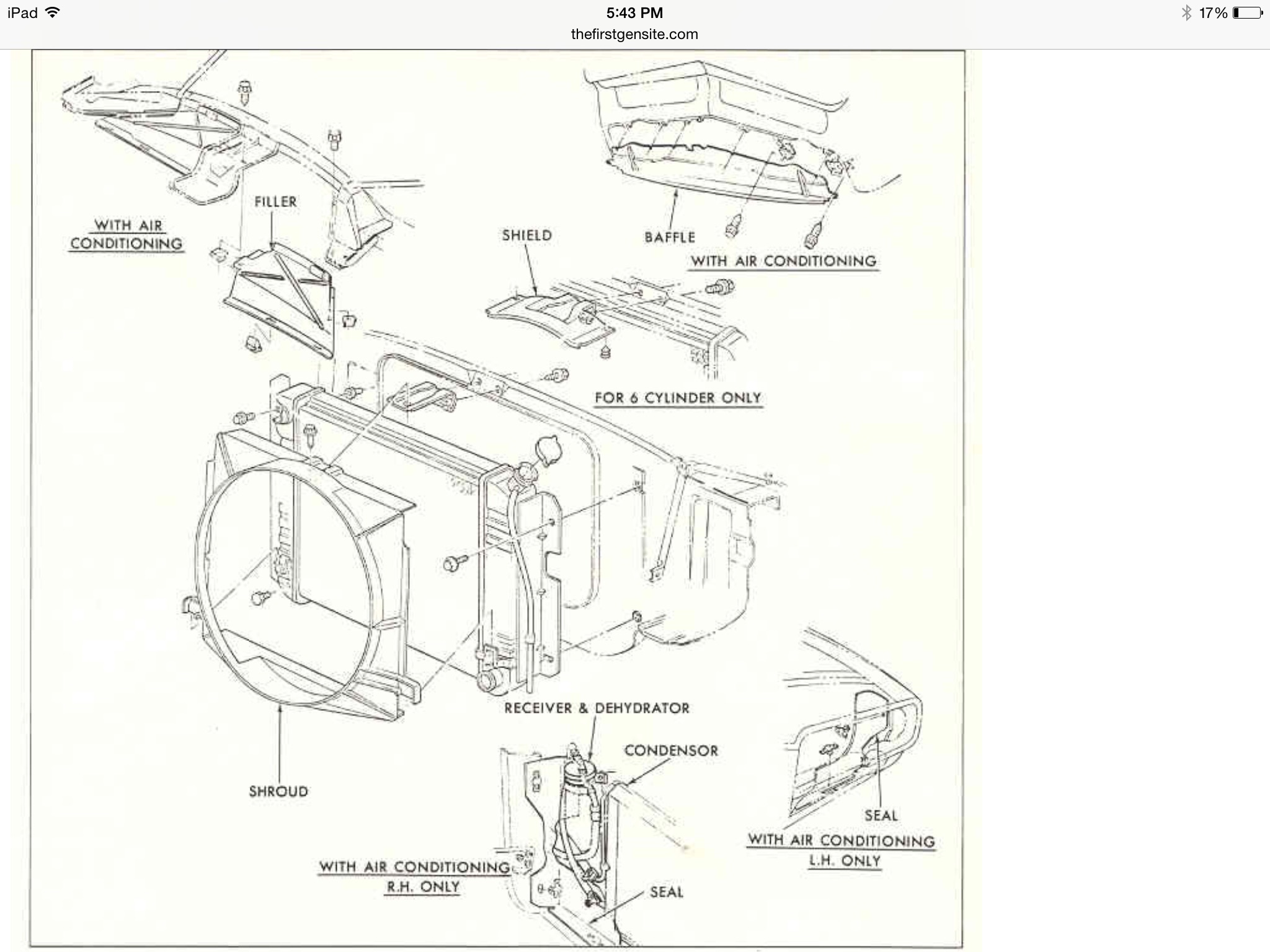
I have a new (to me) 68 non-AC car with Vintage Air. Running hot. Radiator good. Just changed out to larger fan, 180 thermostat and higher output AC rated water pump. Plus has electric fan in front of AC condenser (which was running backward, but now corrected and connected to ignition so always on). Now better, 180-190 while driving, but quickly gets to 205-210 when idling in hot weather. Does not have any of the baffles and I suspect adding them is my next best bet to help. I understand the upper filler panels and lower valence, but not the masticated filler panels. Despite the great pics in this post ( https://firstgenfirebird.org/forums/ubbthreads.php?ubb=showflat&Number=230387), I am disoriented without obvious external landmarks. Do the filler panels go on the sides of the radiator? What gap are they filling and what exactly do they attach to? The repro upper panel comes with fasteners. What about the lower valence and masticated panels? What bolts or clips do I use? One post mentions Chrysler headliner clips??? Can't I just use short bolts with flat folded sheetmetal nuts? I have a double pulley for water pump and fan, 8" diameter. Should that be smaller and worth changing compared to everything else? Unrelated question if someone has input. The car runs fine EXCEPT the engine occasionally stutters/coughs and dies, usually when hot and drive after has been idling a while or after has been off for a short period and start to drive again. Thanks David
Last edited by NC69CONV; 05/31/15 12:00 PM.
|
|
|
|
|
Joined: May 2008
Posts: 2,113 Likes: 1
Premium Member
|
|
Premium Member
Joined: May 2008
Posts: 2,113 Likes: 1 |
Ibut not the masticated filler panels. Despite the great pics in this post ( https://firstgenfirebird.org/forums/ubbthreads.php?ubb=showflat&Number=230387), I am disoriented without obvious external landmarks. Do the filler panels go on the sides of the radiator? What gap are they filling and what exactly do they attach to? The repro upper panel comes with fasteners. What about the lower valence and masticated panels? What bolts or clips do I use? One post mentions Chrysler headliner clips??? Can't I just use short bolts with flat folded sheetmetal nuts? The lower valence will need bolts to hold it on, I don't remember size. By masticated filler panels, are we really talking about these: http://www.classicindustries.com/product/firebird/parts/k282.html
1968 400 Coupe, verdoro green, black vinyl top, auto
1969 GTO Judge coupe, Carousel Red, manual
1971 Trans Am, cameo white, auto
1970 Buick Skylark Custom Convertible 350-4(driver), Fire Red, white top, auto
1972 Buick GS Stage 1, Royal Blue, black vinyl top, auto
|
|
|
|
|
Joined: Dec 2007
Posts: 29
Member
|
|
Member
Joined: Dec 2007
Posts: 29 |
I think I am just talking about these, but not exactly sure: (not the splash/mud guards on inner fender wells, but just the air baffles for radiator) https://www.npdlink.com/store/products/C_8155_202A-118386-1819.htmlDo they go on each side of the compartment in front of radiator (with the other baffles/valence on top and bottom)? Is my $300 better spent on all these air baffles or instead upgrading to a bigger aluminum radiator (I have stock repro now)? Thanks
|
|
|
|
|
Joined: Nov 2003
Posts: 6,161 Likes: 51
Administrator
|
|
Administrator
Joined: Nov 2003
Posts: 6,161 Likes: 51 |
Last edited by Jimc2002; 05/31/15 03:34 PM.
Jim
'68 400HO Conv.
|
|
|
|
|
Joined: Dec 2007
Posts: 29
Member
|
|
Member
Joined: Dec 2007
Posts: 29 |
when I try to duplicate view and photo of the masticated filler panels in the above referenced post, I see this:
(not sure if my picture posted)
I seem to have metal filling the gap between rad and sidewall, where other pic shows the filler panel
???
THE BIG QUESTION AT THIS POINT: BETTER TO SPEND $300 ON THE UPPER BAFFLES AND LOWER VALENCE OR PUT TOWARDS ALUMINUM RADIATOR UPGRADE?
Last edited by NC69CONV; 05/31/15 03:57 PM.
|
|
|
|
|
Joined: Feb 2013
Posts: 3,220
Senior Member
|
|
Senior Member
Joined: Feb 2013
Posts: 3,220 |
|
|
|
|
|
Joined: Nov 2003
Posts: 6,161 Likes: 51
Administrator
|
|
Administrator
Joined: Nov 2003
Posts: 6,161 Likes: 51 |
Maybe the '69 is different than the '68.
Jim
'68 400HO Conv.
|
|
|
|
|
Joined: Dec 2007
Posts: 29
Member
|
|
Member
Joined: Dec 2007
Posts: 29 |
Thanks Harold. You don't seem to have the lower black valence in place in your photos???
Seems you are using the flexible filler panels both at bottom and sides of the cavity in front of rad.
See the pics in the post prior to your reply.
Very confusing.
Last edited by NC69CONV; 05/31/15 04:11 PM.
|
|
|
|
|
Joined: Dec 2007
Posts: 29
Member
|
|
Member
Joined: Dec 2007
Posts: 29 |
mine is a 68 (despite forum ID from when I had a 69)
I don't seem to need the flexible filler panels, just the upper baffles and lower valence
still trying to decide if better to do than aluminum radiator upgrade instead
|
|
|
|
|
Joined: Dec 2007
Posts: 29
Member
|
|
Member
Joined: Dec 2007
Posts: 29 |
my water pump/fan double pulley is 8" diameter
should I have smaller?
important?
still deciding priority order of next investment:
upper baffles/lower valence
or
aluminum radiator
or
smaller pulley or other fixes
any thoughts appreciated
|
|
|
|
|
Joined: Feb 2013
Posts: 3,220
Senior Member
|
|
Senior Member
Joined: Feb 2013
Posts: 3,220 |
Thanks Harold. You don't seem to have the lower black valence in place in your photos???
Seems you are using the flexible filler panels both at bottom and sides of the cavity in front of rad.
See the pics in the post prior to your reply.
Very confusing. Some of the pics I have the lower baffle and a couple I don't. I Only have flexible fillers on sides not at bottom. In this picture in the service manual, lower right shows the seals Jim and I have in place. The metal you see in your picture in the bumper support bracket. These seals attaches to it and the radiator core so there is no open gap in in the corner you see. So all all goes through the radiator instead of forced through the open gaps.
Last edited by HaroldB; 05/31/15 08:47 PM.
|
|
|
|
|
Joined: Dec 2007
Posts: 29
Member
|
|
Member
Joined: Dec 2007
Posts: 29 |
perfect, that diagram really helps, thanks
|
|
|
|
|
Joined: Jun 2000
Posts: 20,054
Administrator
|
|
Administrator
Joined: Jun 2000
Posts: 20,054 |
other things could make it run 'hot' too, like if its running too lean....and is timing set right?
|
|
|
|
|
Joined: Dec 2007
Posts: 29
Member
|
|
Member
Joined: Dec 2007
Posts: 29 |
timing checked, I don't think running lean
have ordered baffles and am looking to switch from 8" to 6.5" pulley
hopefully that will do, since problem at idle
|
|
|
|
|
Joined: Apr 2012
Posts: 105
Member
|
|
Member
Joined: Apr 2012
Posts: 105 |
Have you checked the water pump divider plate? It's behind the water pump on the timing cover. Aftermarket water pumps seem to have smaller impellors than the factory originals, and the space between the water pump impellors and backing plate gets too large and there isn't good suction at idle to move the coolant around. You can take the water pump off and hammer the divider plate so it sits pretty close to the water pump and it will make you car run a lot cooler. This is if you haven't already done so.
My car always ran hot and I couldn't figure it out. Then I finally saw something on here or in one of Jim Hands books and I finally changed the clearance. Runs super steady now. No more over heating and/or vapor lock.
Also depending on the carb, some pull vacuum advance from the ported vacuum port vs. the manifold vacuum port. If you run it off the ported vacuum port you won't have any advance at idle and it will essentially make your car run with less timing and therefore more heat.
|
|
|
|
|
Joined: Apr 2012
Posts: 105
Member
|
|
Member
Joined: Apr 2012
Posts: 105 |
|
|
|
|
|
Joined: Dec 2007
Posts: 29
Member
|
|
Member
Joined: Dec 2007
Posts: 29 |
OK, added AC baffles, new smaller fan/water pump pulley, new fan, high output water pump and thermostat.
AT, vintage AC, 350/350 car still running hot in NC.
Time for an aluminum radiator upgrade.
Which one best?
Is something like this from Classic Industries a significant enough upgrade? I assume 4 row is their best.
A8600112 - 1967-69 GM F-BODY - ALUMINUM RADIATOR (4 ROW) - 17" X 23" X 2-34" CORE
Or is a specialty radiator best, like Desert Cooler, etc.
I have read in other forums (esp. for hot rods) that 1.25" tubing is the best.
Any recommendations for a radiator to never run hot again???
Thanks!
Last edited by NC68CONV; 07/23/15 02:58 PM.
|
|
|
|
|
Joined: Feb 2013
Posts: 3,220
Senior Member
|
|
Senior Member
Joined: Feb 2013
Posts: 3,220 |
Is reaching 210 degrees really that hot at idle with cast iron heads and block? Pontiac did not have the dummy light come on till around 245 I think.
A lot can depend on the engine build and timing.
|
|
|
|
|
Joined: Dec 2007
Posts: 29
Member
|
|
Member
Joined: Dec 2007
Posts: 29 |
OK, so maybe half my problem is that I have a temp gauge
gets up to around 210 on hot day, maybe 215
when turn off engine gauge quickly moves to over 230 which I assume is normal as will just as quickly edge down when turn on engine
if those more knowledgable than me think 210-215 is OK for engine than maybe I will live with it for now
would still be interested in any alumuminum radiator recommendations (more in the $300-$400 range than the $800+ range)
|
|
|
|
|
Joined: Feb 2013
Posts: 3,220
Senior Member
|
|
Senior Member
Joined: Feb 2013
Posts: 3,220 |
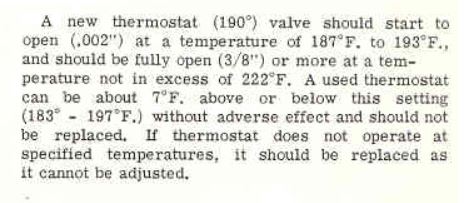
So I went back and checked the service manual. Pontiac used a 190 degree thermostat. It states that it should fully open not to excess 222 F. The boiling point is 258 F with a 15 PSI cap. Most things I've read is operating temperature swing 190-220F. I rechecked the dummy light setting and read it is around 245F.
|
|
|
|
|
Joined: Dec 2007
Posts: 29
Member
|
|
Member
Joined: Dec 2007
Posts: 29 |
Thanks Harold.
Sounds like these old iron 350s can safely run at 220 degrees or less, which makes me feel a whole lot better about driving it and turning on the AC,
|
|
|
|
Forums57
Topics35,546
Posts298,896
Members8,865
| |
Most Online19,810
Feb 1st, 2026
|
|
|
0 members (),
114
guests, and
25
robots. |
|
Key:
Admin,
Global Mod,
Mod
|
|
|
There are no members with birthdays on this day. |
|
|
|


.JPG "photo (1).JPG
Views: 1267
Size: 115.03 KB")